Questions · Page 1 of 2

[3 Mark Question Answer]

🎯

Test yourself on this topic

50 questions · timed · auto-graded

Question 13 Marks

A bulb marked 12 V, 24 W operates on a 12 V battery for 20 minutes. Calculate:

(i) The current flowing through it, and

(ii) The energy consumed.

Answer
(a) Given,
Power, $P=24 W$
Voltage, $V=12 V$
Current, $I=$ ?
As power, $P = VI$
(i) $I =\frac{24}{12}=2 A$
(ii) Energy, $E = P \times t$
$E=24 \times 20 \times 60 sec$
$E=28800 J$
View full question & answer
Question 23 Marks
An electrical appliance having a resistance of 200 Ω is operated at 220 V. calculate the energy consumed by the appliance in 5 minutes.
in joules.
Answer
Given, Resistance , $R=200 \Omega$
Voltage, $V=200 V$
time, $t=5 min =5 \times 60 sec =300 sec$
As, Energy , $E=\frac{ V ^2 t }{ R }$
In joules
$E=\frac{(200)^2 \times 300}{200}$
$E=60000 J$
View full question & answer
Question 33 Marks
An electric bulb is rated at 220 V, 100 W.
(a) What is its resistance?
(b) What safe current can be passed through it?
Answer
(a) Given,
Power P $=100 W$
Voltage V $=220 V$
As power, $P=\frac{V^2}{R}$
$
R=\frac{(220)^2}{100}=484 \Omega
$
(b) The safe limit of current that can pass through it
$\begin{aligned} & I=\frac{P}{V} \\ & I=\frac{100}{220}=0.45 A \end{aligned}$
View full question & answer
Question 43 Marks
An electric bulb is rated '100 W, 250 V'. How much current will the bulb draw if connected to a 250 V supply ?
Answer
Given,
Power P $=100 W$
Voltage V $=250 V$
As Power , $P = VI$
$
I =\frac{100}{250}=0.4 A
$
View full question & answer
Question 53 Marks
Calculate the current through a 60 W lamp rated 250 V. If the line voltage falls to 200 V, how is power consumed by the bulb affected?
Answer
Given,
Power $P =60 W$
Voltage, $V=250 V$
As Power, $P = VI$
$
I =\frac{60}{250}=0.24 A
$
Resistance of bulb $R =\frac{ V ^2}{ P }=\frac{250^2}{60}=1041.6 \Omega$
Now if voltage falls to $200 V$, power consumed will be
$P=\frac{V^2}{R}=\frac{200^2}{1041.6}=38.4 W$
View full question & answer
Question 63 Marks
A current of 2 A is passed through a coil of resistance $75 \Omega$ for $2$ minutes.
(a) How much heat energy is produced?
(b) How much charge is passed through the resistance?
Answer
Given, current $( I )=2$ AResistance $R =75 \Omega$
Time, $t =2 min=120 s$
(a) Heat produced, $H =1^2 Rt$
or, $H =(2)^2(75)(120) J =36000 J$
(b) Charge passed, $Q = It$
or, $Q=(2)(120) C=240 C$
View full question & answer
Question 73 Marks
An electric kettle is rated 2.5 kW, 250 V. Find the cost of running the kettle for two hours at Rs. 5.40 per unit.
Answer
Given ,

Power of kettle , P = 2.5 kW

Voltage , V = 250 V

Time, t = 2 h

As , Energy , E = P × t

= 2.5 × 2 = 5 kWh

Cost per unit of energy = Rs 5.40

Cost for 5 kWh of energy = 5.40 × 5 = Rs 27

View full question & answer
Question 83 Marks
An electric bulb of resistance 500 Ω draws current 0.4 A from the source. Calculate:
(a) the power of bulb and
(b) the potential difference at its end.
Answer

Resistance of electric bulb (R) = 500Ω

Current drawn from the source (I) = 0.4 A

Power of the bulb (P) = VI

V = I x R

V = 0.4 x 500 = 200 V

The potential difference at its end is 200 V.

Hence,

Power (P) = VI

P = 200 x 0.4 = 80 W

The power of the bulb is 80 Watt.

View full question & answer
Question 93 Marks
An electric toaster draws 8 A current in a 220 V circuit. It is used for 2 hr. Find the cost of operating the toaster if the cost of electrical energy is Rs. 4.50 per kWh.
Answer
Given:
Voltage (V) = 220 V
Current (I) = 8 A
Time (t) = 2 h

Energy (E) = Vlt = 220 × 8 × 2 = 3.52 kWh

>The cost per kWh is Rs. 4.50 >Hence, the cost of running the kettle for two hours is: >3.52 × 4.50 = Rs. 15.84
View full question & answer
Question 103 Marks
Water in an electric kettle connected to a 220 V supply took 5 minutes to reach its boiling point. How long would it have taken if the supply had been of 200 V?
Answer
$
P=\frac{V^2}{R}
$
Heat gained $=\frac{ V ^2}{ R } \times t$
$
\left(\frac{ V _1^2}{ R }\right) \times t _1=\left(\frac{ V _2^2}{ R }\right) \times t _2
$
$
t _2=\left(\frac{ V _1}{ V _2}\right)^2 \times t _1
$
$
=\left(\frac{220}{200}\right)^2 \times 300=363 s =6.05 min
$
View full question & answer
Question 113 Marks
A bulb is connected to a battery of p.d. $4 V$ and internal resistance $2.5 \Omega$. A steady current of $0.5 A$ flows through the circuit. Calculate:The energy dissipated in the bulb in $10$ minutes.
Answer
Given ,Voltage , $V = 4 V$
Resistance of the battery , $RB = 2.5 \Omega$
Current ,$ I = 0.5 A$
Energy dissipated in the bulb in 10 min , $E = I^2Rt$
$E = (0.5)^2 \times 5.5 \times 600 = 825 J$
View full question & answer
Question 123 Marks
A bulb is connected to a battery of p.d. $4 V$ and internal resistance $2.5 \Omega$. A steady current of $0.5 A$ flows through the circuit. Calculate:The resistance of the bulb
Answer
Given, Voltage, $V =4 V$
Resistance of the battery, $RB =2.5 \Omega$
Current, $I =0.5 A$
Total resistance, $R =8 \Omega$
Resistance of the battery, $R _{ B }=2.5 \Omega$
Resistance of the blub, $R _{ b }=8-2.5 \Omega=5.5 \Omega$
View full question & answer
Question 133 Marks
A bulb is connected to a battery of p.d. 4 V and internal resistance 2.5 Ω . A steady current of 0.5 A flows through the circuit. Calculate:

The total energy supplied by the battery in 10 minutes

Answer

Given,
Voltage, $V =4 V$
Resistance of the battery, $R_B=2.5 \Omega$
Current, $I =0.5 A$
Energy supplied by the battery,$E=\frac{V^2}{R}$
$\begin{aligned} & t =10 \times 60=600 sec \\ & R =\frac{ V }{ I }=\frac{4}{0.5}=8 \Omega \\ & E =\frac{(4)^2 \times 600}{8}=1200 J \end{aligned}$

View full question & answer
Question 143 Marks
Three heaters each rated 250 W, 100 V are connected in parallel to a 100 V supply of the energy supplied in kWh to the three heaters in 5 hours.
Answer
Given ,

Power , P = 250 W

Voltage , V = 100 V

Time for which energy is supplied , t = 5 h

As , Energy E = P × t

E = 250 × 5 = 1250 Wh

or E = 1.25 kWh

Energy for three heaters = 3 × 1.25 = 3.75 kWh

View full question & answer
Question 153 Marks
Three heaters each rated 250 W, 100 V are connected in parallel to a 100 V supply. The resistance of each heater
Answer
Given,
Power , P $=250 W$
Voltage, $V=100 V$
Resistance for each heaters $R =\frac{ V }{ I }$
$
=\frac{100}{2.5}=40 \Omega
$
View full question & answer
Question 163 Marks
Three heaters each rated 250 W, 100 V are connected in parallel to a 100 V supply. Calculate :

The total current taken from the supply

Answer
Given,
Power, $P =250 W$
Voltage, $V=100 V$
Current through each heater, $I=$ ?
As $P = VI$
$
\begin{aligned}
& \Rightarrow I =\frac{ P }{ V } \\
& =\frac{250}{100}=2.5 A
\end{aligned}
$
$\therefore$ Current taken for the three heaters $=3 \times 2.5=7.5 A$
View full question & answer
Question 173 Marks
A current of 0.2 A flows through a wire whose ends are at a potential difference of 15 V. Calculate:

(i) The resistance of the wire, and

(ii) The heat energy produced in 1 minute.

Answer
Given,
|Current, $I =0.2 A$
Potential difference, V $=15 V$
Time,$t=60 sec$
As $V = IR$
(a) $R =\frac{15}{0.2}=75 \Omega$
(b) Heat energy, $H = I ^2 Rt$
$
H=(0.2)^2 \times 75 \times 60
$
or $H =180 J$
View full question & answer
Question 183 Marks
Electrical power P is given by the expression $P = (Q \times V) ÷$ time
(a) What do the symbols $Q$ and $V$ represent?
(b) Express the power $P$ in terms of current and resistance explaining the meanings of symbols used there in.
Answer
(a) Q represents Charge and $V$ represents Voltage.
(b) Electrical Power , $P = I^2R$
where I : Current
and R : Resistance
View full question & answer
Question 193 Marks
Four resistors each of resistance 2Ω are connected in parallel. What is the effective resistance?
Answer
$
\begin{aligned}
& R 1=2 ohm \\
& R 2=2 ohm \\
& R 3=2 ohm
\end{aligned}
$
R4 $=2 ohm$
$
\frac{1}{R}=\frac{1}{R_1}+\frac{1}{R_2}+\frac{1}{R_3}+\frac{1}{R_4}
$
$
=\frac{1}{2}+\frac{1}{2}+\frac{1}{2}+\frac{1}{2}=2
$
$
R =0.5 ohm
$
View full question & answer
Question 203 Marks
Two resistors having resistance 4𝛀 and 6𝛀 are connected in parallel. Find their equivalent resistance.
Answer
Let ' $R$ be their equivalent resistance of the $4 \Omega$ and $6 \Omega$ resistors connected in parallel
Then, $\frac{1}{R}=\frac{1}{4}+\frac{1}{6}=\frac{3+2}{12}=\frac{5}{12} \Omega$
Or, $R=\frac{12}{5}=2.4 \Omega$
Z
View full question & answer
Question 213 Marks
A battery of e.m.f. 15 V and internal resistance 3 ohm is connected to two resistors of resistances 3 ohm and 6 ohm is series Find:
(a) the current through the battery
(b) the p.d. between the terminals of the battery.
Answer
(a) ε = 15 V
R = 6 + 3 = 9 ohm
r = 3 ohm
I = ?
I = ε / (R + r)
I = 15 / (9 + 3) = 15/12 = 1.25 A
(b) Current (calculated in (a) part) I = 1.25 A
External Resistance R = 6 + 3 = 9 ohm
V = IR = 1.25 × 9 = 11.25 V
View full question & answer
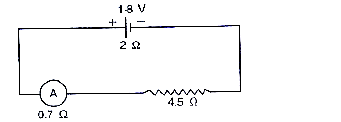
Question 223 Marks
A cell of e.m.f. 1.8V and internal resistance 2Ω is connected in series with an ammeter of resistance 0.7Ω and a resistor of 4.5Ω as shown in Fig. 8.41


(a) what would be the reading of the ammeter?
(b) what is the potential difference across the terminals of the cell?
Answer
(a) ε = 1.8 V
Total Resistance = 2 + 4.5 + 0.7 = 7.2 W
I = ?
I = ε / R (total resistance)
I = 1.8 / 7.2 = 0.25 A
(b) Current (calculated in (a) part) I = 0.25 A
Now, total resistance excluding internal resistance = 4.5 + 0.7 = 5.2 ohm
V = IR = 0.25 x 5.2 = 1.3 V
View full question & answer
Question 233 Marks

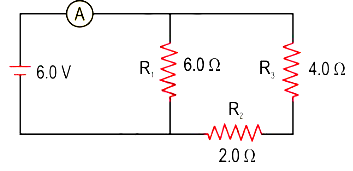
Three resistors of $6.0 ohm , 2.0 ohm$ and $4.0 ohm$ are joined to ammeter $A$ and a cell of emf $6.0 V$ as shown in following figure. Calculate:
(a) the efective resistance of the circuit.
(b) the reading of ammeter

Answer
(a)
$
R _1=6 W
$
$
R^{\prime}=R_2+R_3=2+4=6 W
$
$R_1$ and $R^{\prime}$ in parallel :
$
\frac{1}{ R }=\frac{1}{ R _1}+\frac{1}{ R ^{\prime}}=\frac{1}{6}+\frac{1}{6}=\frac{2}{6}
$
$R =3 ohm$
(b)
$
R =3 ohm
$
$\begin{aligned} & V=6 V \\ & I =?\end{aligned}$
$I=\frac{V}{R}=\frac{6}{3}=2 A$
View full question & answer
Question 243 Marks
A particular resistance wire has a resistance of 3 ohm per meter. Find :

The total resistance of three lengths of this wire each 1.5 m long, in parallel.

Answer
$R =3$ ohm for $1 m$
For $5 m : R =3 \times 5=15 ohm$
But Area $A$ is double i.e. $2 A$ and Resistance is inversely proportional to area so Resistance will be half.
$R =\frac{15}{2}=7.5 ohm$
View full question & answer
Question 253 Marks
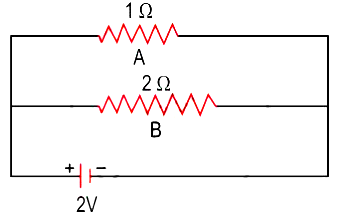
Calculate current flowing through each of the resistors A and B in the circuit shown in following figure?

Answer
For resistor $A$ :
$
R =1 ohm
$
$
V=2 V
$
$
=\frac{ V }{ R }=\frac{2}{1}=2 A
$
For resistor B :
$
R =2 ohm
$
$
V =2 V
$
$
I=\frac{V}{R}=\frac{2}{2}=1 A
$
View full question & answer
Question 263 Marks
Two resistors of resistance 4 Ω and 6 Ω are connected in parallel to a cell to draw 0.5 A current from the cell.

Calculate current in each resistor.

Answer
Equivalent resistance of the circuit:
$
\begin{aligned}
& \frac{1}{ R }=\frac{1}{4}+\frac{1}{6}=\frac{3+2}{12}=\frac{5}{12} \\
& \therefore R =\frac{12}{5}=2.4 \Omega
\end{aligned}
$
Hence, the emf of the cell is
$
V=I R
$
$
\therefore V =0.5 \times 2.4
$
$
\therefore V =1.2 V
$
Therefore, current through each resistor is
$
\begin{aligned}
& I _4=\frac{ V }{ R _4}=\frac{1.2}{4}=0.3 A \\
& I _6=\frac{ V }{ R _6}=\frac{1.2}{6}=0.2 A
\end{aligned}
$
View full question & answer
Question 273 Marks
A resistor of 6Ω is connected in series with another resistor of 4 Ω. A potential difference of 20 V is applied across the combination. Calculate (a) the current in the circuit and (b) the potential difference across the 6Ω resistor.
Answer

$\begin{aligned} & \text { (a) } R_1=6 ohm \\ & R_2=4 ohm \\ & R = R \_1+ R \_2=6+4=10 ohm \\ & V =20 V \\ & I= V / R =20 / 10=2 A \\ & \text { (b) } R =6 W \\ & I=2 A \\ & V=? \\ & V=I R=6 \times 2=12 V \end{aligned}$

View full question & answer
Question 283 Marks
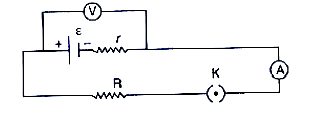
The diagram below in Fig. 8.40 shows a cell of e.m.f. ε = 2 volt and internal resistance r = 1 ohm to an external resistance R = 4 ohm. The ammeter A measures the current in the circuit and the
voltmeter V measures the terminal voltage across the cell. What will be the readings of the ammeter and voltmeter when (i) the key K is open, (ii) the key K is closed.

Answer
(i) Ammeter reading = 0 because of no current
Voltage V = ϵ − Ir
V = 2 − 0 × 1 = 2 volt

(ii) Ammeter reading :
I =ε /(R + r)
I=2 / (4+1) = 2 / 5 = 0.4 amp
Voltage reading :
Voltage V = ϵ - Ir
V=2 - 0.4 x 1 = 2 - 0.4 = 1.6 V

View full question & answer
Question 293 Marks

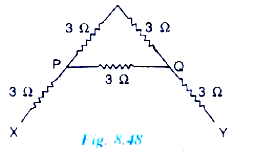
Five resistors, each 3 Ω, are connected as shown in Fig 8.48. Calculate the resistance (a) between the points P and Q. (b) between the points X and Y.

Answer
(a) $R_1=3+3=6 W$
$
R_2=3 W
$
$R \_1$ and $R \_2$ are connected in parallel
$
\frac{1}{R}=\frac{1}{R_1}+\frac{1}{R_2}=\frac{1}{6}+\frac{1}{3}=\frac{1}{2}
$
(b) As calculated above $R =2 ohm$
$
R 3=3 ohm
$
$
R 4=3 ohm
$
$
R^{\prime}=R+R 3+R 4=2+3+3=8 ohm
$
View full question & answer
Question 303 Marks
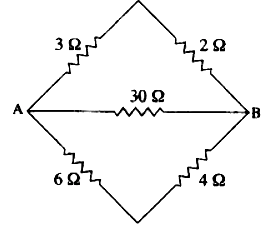
Calculate the equivalent resistance between A and B in the adjacent diagram.

Answer
$
\begin{aligned}
& R _1=3+2=5 ohm \\
& R _2=30 W \\
& R _3=6+4=10 ohm
\end{aligned}
$
$R _1, R _2$ and $R _3$ are connected in parallel
$
\begin{aligned}
& \frac{1}{ R }=\frac{1}{ R _1}+\frac{1}{ R _2}+\frac{1}{ R _3} \\
& =\frac{1}{5}+\frac{1}{30}+\frac{1}{10}=\frac{10}{30}
\end{aligned}
$
$
R =3 ohm
$
View full question & answer
Question 313 Marks
A wire of uniform thickness with a resistance of 27Ω is cut into three equal pieces and they are joined in parallel. Find the equivalent resistance of the parallel combination.
Answer
Wire cut into three pieces means new resistance $=\frac{27}{3}=9 ohm$
Now three resistance connected in parallel :
$
\begin{aligned}
& \frac{1}{ R _{ P }}=\frac{1}{ R _1}+\frac{1}{ R _2}+\frac{1}{ R _3}=\frac{1}{9}+\frac{1}{9}+\frac{1}{9} \\
& Rp _{ p }=\frac{9}{3}=3 ohm
\end{aligned}
$
View full question & answer
Question 323 Marks
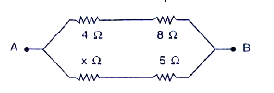
In the circuit shown below in Fid 8.43, calculate the value of x if the equivalent resistance between A and B is 4Ω

Answer
$\begin{aligned} & r_1=4 \text { ohm } \\ & r_2=8 \text { ohm } \\ & r_3=\text { xohm } \\ & r_4=5 \text { ohm } \\ & r =4 \text { ohm } \\ & r_{=}=r_{-} 1+r_{-} 2=4+8=12 \text { ohm } \\ & r_{-}=r_{-} 3+r_{-} 4=(x+5) \text { ohm } \\ & \frac{1}{r}=\frac{1}{r}+\frac{1}{r} \\ & \frac{1}{4}=\frac{1}{12}+\frac{1}{5+x} \\ & \frac{1}{6}=\frac{1}{5+x} \\ & x =1 \text { ohm }\end{aligned}$
View full question & answer
Question 333 Marks
A combination consists of three resistors in series. Four similar sets are connected in parallel. If the resistance of each resistor is 2 ohm, find the resistance of the combination.
Answer
Resistance of each set:
$
\begin{aligned}
& 1 r =2+2+2=6 ohm \\
& 2 r =2+2+2=6 ohm \\
& 3 r =2+2+2=6 ohm \\
& 4 r =2+2+2=6 ohm
\end{aligned}
$
Now these resistances are arranged in parallel :
$\begin{aligned} & \frac{1}{r}=\frac{1}{r_1}+\frac{1}{r_2}+\frac{1}{r_3}+\frac{1}{r_4} \\ & \frac{1}{r}=\frac{1}{6}+\frac{1}{6}+\frac{1}{6}+\frac{1}{6}\end{aligned}$
$r=\frac{6}{4}=1.5 ohm$

View full question & answer
Question 343 Marks
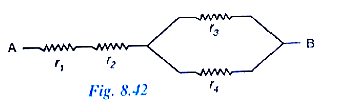
Calculate the equivalent resistance of the following combination of resistors $r 1, r 2$, $r 3$ and $r 4$ if $r_1=r_2=r_3=r_4=2.0 \Omega$ between the points $A$ and $B$ in Fig. 8.42

Answer
$\begin{aligned} & r_1=r_2=r_3=r_4=2.0 ohm \\ & r=r_1+r_2=2+2=4 ohm \\ & \frac{1}{r}=\frac{1}{r_3}+\frac{1}{r_4}=\frac{1}{2}+\frac{1}{2}=1 \\ & r =1 ohm \end{aligned}$
$r=r+r=4+1=5 ohm$
View full question & answer
Question 353 Marks
In parallel combination of resistances:

  • P.D. is same across each resistance

  • Total resistance is increased

  • Current is same in each resistance

  • All of the above are true

Answer
In parallel combination of resistances, P.D. is same across each resistance.

Hint: In parallel combination, the ends of each resistor are connected to the ends of the same source of potential. Thus, the potential difference across each resistance is same and is equal to the potential difference across the terminals of the source (or battery).

View full question & answer
Question 363 Marks
Explain why the p.d across the terminals of a cell is more in an open circuit and reduced in a closed circuit.
Answer
When the electric cell is in a closed circuit the current flows through the circuit. There is a fall of potential across the internal resistance of the cell. So, the p.d. across the terminals in a closed circuit is less than the p.d. across the terminals in an open circuit by an amount equal to the potential drop across the internal resistance of the cell.
View full question & answer
Question 373 Marks
A cell of e.m.f ε and internal resistance r is used to send current to an external resistance R. write expresssions for (a) the total resistance of circuit, (b) the current drawn from the cell. (c) the p.d
across the cell. And (d) voltage drop inside the cell.
Answer
(a) Total resistance $=R+r$
(b) Current drawn from the circuit:
As we know that,
$
\begin{aligned}
& \varepsilon=V+V \\
& =I R+I r \\
& =I(R+r) \\
& I=e /(R+r)
\end{aligned}
$
(c) p.d. across the cell : $\frac{\varepsilon}{(R+r)} \times R$
(d) voltage drop inside the cell: $\frac{\in}{R+r} \times r$
View full question & answer
Question 383 Marks
Name two factors on which the internal resistance of a cell depends and state how does it depend on the factors stated by you.
Answer
Internal resistance of a cell depends upon the following factors:

(i) The surface area of the electrodes: Larger the surface area of the electrodes, less is the internal
resistance.
(ii) The distance between the electrodes: As the distance between the electrodes increases, the internal resistance of cell also increases. It is also affected by the nature, concentration and temperature of the solution (electrolyte).

View full question & answer
Question 393 Marks
Explain the meaning of the terms e.m.f.., terminal voltage, and internal resistance of a cell.
Answer
e.m.f.: When no current is drawn from a cell, the potential difference between the terminals of the cell is called its electro-motive force (or e.m.f.).
Terminal voltage: When current is drawn from a cell, the potential difference between the electrodes of the cell is called its terminal voltage.
Internal Resistance: The resistance offered by the electrolyte inside the cell to the flow of electric current through it is called the internal resistance of the cell
View full question & answer
Question 403 Marks
Calculate the current flowing through a wire of resistance 5 Ω connected to a battery of potential difference 3 V.
Answer
Potential Difference/Voltage (V) = 3 V
Resistance (R) = 5 ohm
Current (I) = ?
According to Ohm's Law :
V=IR
Then I = V/R
I = 3/5 = 0.6 A
View full question & answer
Question 413 Marks
A car bulb connected to a 12 volt battery draws 2 A current when glowing. What is the resistance of the filament of the bulb? Will the resistance be more same or less when the bulb is not glowing?
Answer
Potential Difference/Voltage (V) = 12 V
Current (I) = 2 A
Resistance (R) = ?
According to Ohm's Law :
V=IR
Then R = V/I
R = 12 / 2
R = 6 Ohm
Resistance will be less when the bulb is not glowing.

View full question & answer
Question 423 Marks
Find the potential difference required to pass a current of 0.2 A in a wire of resistance 20Ω
Answer
Current (I) = 0.2 A

Resistance (R) = 20 ohm
Potential Difference (V) = ?
According to Ohm's Law :
V = IR
V = 0.2 × 20 = 4 V

View full question & answer
Question 433 Marks
What length of copper wire of resistivity 1.7 × 10⁻⁸ 𝛀 m and radius 1 mm is required so that its resistance is 1𝛀?
Answer
Resistance $(R)=1 ohm$
Resistivity $(\rho)=1.7 \times 10-8$ ohm metre
Radius $(r)=1 mm =10-3 m$
Length $(l)=$ ?
$\begin{aligned} & R=\rho \frac{1}{A} \\ & I=\frac{R A}{\rho} \\ & =\frac{R \pi r^2}{\rho} \\ & =\frac{1 \times \pi \times 10^{-6}}{1.7 \times 10^{-8}} \\ & =184.7 m \end{aligned}$
View full question & answer
Question 443 Marks
A wire of 9 ohm resistance having 30 cm length is tripled on itself. What is its new resistance?
Answer
Resistance $(R)=9 ohm$
Length I $=30 cm$
New Length $(l)=30 cm =3 / l =10 cm$
$R=\rho \frac{1}{A}$
New Resistance:
With change in length, there will be change in area of cross-section also in the same order.
$\begin{aligned} & R=\rho \frac{\frac{I}{3}}{3 A} \\ & R=\frac{1}{9} \rho \frac{I}{A} \\ & R=\frac{1}{9} R \\ & R =1 ohm \end{aligned}$
View full question & answer
Question 453 Marks
A wire 3 ohm resistance and 10 cm length is stretched to 30 cm length. Assuming that it has a
uniform cross section, what will be its new resistance?
Answer
Resistance $(R)=3$ ohm
Length $I =10 cm$
New Length $\left( l ^{\prime}\right)=30 cm =3 \times l$
$R =p \frac{1}{A}$
New Resistance:
With stretching length will increase and area of cross-section will decrease in the same order
$R ^{\prime}=p \frac{3}{A / 3}$
Therefore,
$
R ^{\prime}=9 p \frac{1}{A}=9 R
$
$
R^{\prime}=9 \times 3=27 \Omega
$
View full question & answer
Question 463 Marks
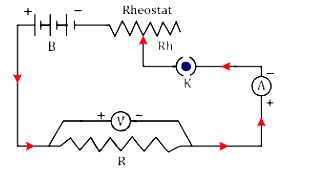
State Ohm’s law and draw a neat labelled circuit diagram containing a battery, a key, a voltmeter, an ammeter, a rheostat and an unknown resistance to verify it.
Answer
It states that electric current flowing through a metallic wire is directly proportional to the potential difference $V$ across its ends provided its temperature remains the same. This is called Ohm's law.
$V=I R$

View full question & answer
Question 473 Marks

Explain the flow of current in a metallic wire on the basis of movement of the particles named by you above in part.

Answer
In metals, free electrons are the moving charges that result in the conduction of electricity. If 'n' electrons pass through the metallic conductor in time 't', then the total charge that has flown is given by Q (charge) = n x e (charge on an electron).
View full question & answer
Question 483 Marks
State whether the potential is a scalar or vector? What does the positive and negative sign of potential convey?
Answer
Potential is also a scalar quantity. The positive sign of potential conveys that work has to be done on the positive test charge against the repulsive force due to the positive charge in bringing it from infinity. The negative sign of potential conveys that work is done on the negative test charge by the attractive force.
View full question & answer
Question 493 Marks
Write an expression connecting the resistance and resistivity. State the meaning of symbols used.
Answer
Expression :
$
R=p \frac{I}{A}
$
$p$ - resistivity
$R$ - resistance
I - length of conductor
A - area of cross-csection
View full question & answer
Question 503 Marks
How does the resistance of a wire depend on its length? Give a reason for your answer with reason.
Answer
Resistance of a wire is directly proportional to the length of the wire.
R ∝ I
The resistance of a conductor depends on the number of collisions which the electrons suffer with the fixed positive ions while moving from one end to the other end of the conductor. Obviously the number of collisions will be more in a longer conductor as compared to a shorter conductor. Therefore, a longer conductor offers more resistance.
View full question & answer
[3 Mark Question Answer] - Physics STD 10 Questions - Vidyadip