Question
How is a cathode ray beam affected while passing through a magnetic field?

Answer

A cathode ray beam while passing through a magnetic field is deflected in a direction normal to both the direction of magnetic field and the direction of its travel, as given by Fleming’s left hand rule.

Need a full question paper?

Generate a complete, print-ready paper with questions like this in minutes — across 16+ boards, with answer keys.
Start Generating Free

Similar questions

Three heaters each rated 250 W, 100 V are connected in parallel to a 100 V supply of the energy supplied in kWh to the three heaters in 5 hours.
Define magnifying power of a simple microscope. How can it be increased?
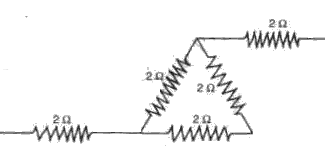
Find the effective resistance in the following circuit diagrams (Fig.):Image
What are ohmic conductors? Give one exmaple. Draw a graph showing the current-voltage relationship for an ohmic conductor.
Where are the cartridge type fuse used?
A wire 3 ohm resistance and 10 cm length is stretched to 30 cm length. Assuming that it has a
uniform cross section, what will be its new resistance?
Three $250 \ W$ heaters are connected in parallel to a $100 \ V$ supply, Calculate total current taken from the supply.

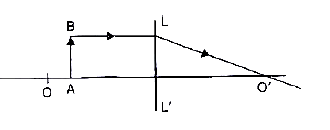
Study the following diagram :


Complete the diagram to form the image of the object AB.
A truck weighing 1000 kgf changes its speed from $36 km h ^{-1}$ to $72 km h -1$ in 2 minutes. Calculate:
(i) the work done by the engine and
(ii) its power/ $\left( g =10 m s ^{-2}\right)$
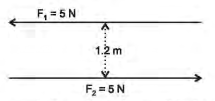
$(i)\  (a)$ Study the diagram alongside and calculate the moment of couple.
Image
$(b)$ Two forces $F_1= F_2$ are applied on a wheel of radius $1.5\  m,$ such that moment of couple is $30\  Nm$. Calculate the magnitude of each of the force.
$(ii)\  A$ force of $50\  N$ produces a moment of force of $10\  Nm$ in a rigid body. Calculate the perpendicular distance between the point of application of force and the turning point.
$(iii)\  (a)$ State the laws of moments.
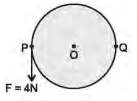
$(b)$ The diagram shows a wheel of diameter $4\  m,$ and pivoted at $O$. Calculate the moment of force about point $(1)\  O, (2)\  Q,$ when a force$ F = 4N$ acts at point $P$ or $Q$.
Image