Questions

[3 Mark Question Answer]

🎯

Test yourself on this topic

29 questions · timed · auto-graded

Question 13 Marks
An element X has the symbol $_{84}X^{202}.$ It emits an alpha-particle and then a beta-particle. The final nucleus is $_bY^a.$ Find a and b.
Answer
( $\beta$-emission)
$
{ }_{84} X ^{202} \longrightarrow{ }_{82} X _1{ }^{198}+{ }_2 He ^4
$
( $\alpha$ - particles)
$
{ }_{82} X _1{ }^{198} \longrightarrow{ }_{83} Y ^{198}+{ }_{-1} e ^0
$
( $\beta$-emission)
$
{ }_b Y ^a={ }_{83} Y ^{198}
$
$\therefore a=198$ and $b=83$
View full question & answer
Question 23 Marks
State three safety precautions that you would take while handling the radioactive substances.
Answer
(i) The people working with radioactive materials should use mechanical devices such as tongs, clamps, tweezers, etc., to help minimize exposure.
(ii) The people working with radioactive materials should wear special lead lined lab coasts, gloves and safety glasses and remove them when leaving the work area or laboratory.
(iii) All radioactive materials should be stored in specially designed thick lead containers with a very narrow opening so as to stop radiations coming out from other directions.
View full question & answer
Question 33 Marks
What are the types of emission?
Answer
There are four types of emissions:
(i) Thermionic emission. (ii) Photoelectric emission.
(iii) Field emission. (iv) Secondary emission.
View full question & answer
Question 43 Marks
State the medical use of radioactivity.
Answer
Many diseases such as leukemia, cancer, etc., are cured by radiation therapy. Radiations from cobalt -60 are used to treat cancer by killing the cells in the malignant tumor of the patient.
The salt of weak radioactive isotopes such as radio-sodium chloride, radio-iron and radio-iodine are used for diagnosis. Such radio isotopes are called the tracers.
View full question & answer
Question 53 Marks
What changes occur in the nucleus of radioactive element when it emits gamma radiation? Give an example.
Answer
When the nucleus of a radioactive element emits gamma radiation, there is no change inside the nucleus except that its excess energy is released in the form of $y$-radiation.
Example:
$
{ }_{ Z }^{ A } Z \longrightarrow{ }_{ Z }^{ A } Z +\gamma
$
The star indicates the excited state of nucleus.
View full question & answer
Question 63 Marks
Arrange α, β, and γ rays in ascending order with respect to their1) Penetrating power.
2) Ionising power
3) Biological effect
Answer
  Minimum More Maximum
(i) Penetrating power α β γ
(ii) Ionising power γ β α
(iii) Biological effect α β γ
View full question & answer
Question 73 Marks
The nucleus B emit a β-particle and is transformed into nucleus C. What is the composition of C?
Answer
With the emission of a β-particle from nucleus B, number of protons will increase by one, i.e., number of protons = 82 + 1 = 83 and number of neutrons will be 126 – 1 = 125, i.e., the nucleus C will have 83 protons and 125 neutrons.
Mass number of nucleus A = Number of protons + number of neutrons
= 84 + 128 = 212.
View full question & answer
Question 83 Marks
QUESIION A nucleus of an element has the symbol ${ }_{84} P ^{202}$, and emits an $\alpha$-particle and then a $\beta$-particle. The final nucleus is bQ ${ }^a$ Find a and b .
Answer
(i) On the emission of an alpha $\left(H e_2^4\right)$ particle:
$
{ }_{84}^{202} P \xrightarrow{\alpha}{ }_{82}^{19} X \text { (new nucleus) }
$
(ii) On the emission of a beta particle:
$
{ }_{82}^{198} X \xrightarrow{\text { 队-particle }}{ }_{83}^{198} Q \text { (new nucleus) }
$
${ }_{83}^{198} Q$ is the same as ${ }_b^a Q$. Hence $a =198, b =83$.
View full question & answer
Question 93 Marks
State three common properties of beta rays and cathode rays.
Answer
(i) Beta rays and cathode rays both are composed of electrons.
(ii) Beta rays and cathode rays both are deflected by the electric and magnetic fields in the same direction.
(iii) Beta rays and cathode rays both ionise the gas through which they pass.
View full question & answer
Question 103 Marks
What are α-and β-radiations?
Answer
 $\alpha$ radiations are positively charged particles with charge +2 e and mass $4 m_p$ where $e$ is electronic charge (i.e., charge on a proton) and $m_p$ is the mass of a proton.
$\beta$ radiations are negatively charged particles (i.e., electrons) with charge - e and mass $1 / 1836$ times the mass of a proton. Y -radiation are electromagnetic waves of wavelength in the range $0.001 \AA$.
View full question & answer
Question 113 Marks
What is the effect on the atomic mass and the atomic number of a radioactive element, after the emission of an α-particle?
Answer
During the emission of an $\alpha$-particle from the nucleus of a radioactive element, its atomic mass decreases by 4 and the atomic number also decreases by 2 . If ${ }_Z X^A$ represents a radioactive element having atomic mass $A$ and atomic number $Z$, then:
$
Z ^{ A } \xrightarrow[{ }_2 He ^4]{\text { a-particles }}{ }_{ Z -2} Y ^{ A -4}
$
View full question & answer
Question 123 Marks
State three properties of α-rays.
Answer
(i) Alpha rays are composed of helium nuclei.
(ii) Alpha rays ionise the gas through which they pass.
(iii) Alpha rays are deflected by the electric and magnetic fields.
View full question & answer
Question 133 Marks
What are isotopes? Give one example.
Answer
The atoms of the same element which have the same atomic number $Z$ but differ in their mass number $A$ are called isotopes.
Example: Hydrogen has three isotopes Protium ${ }_1^1 H$, Deuterium ${ }_1^2 H$, and Tritium ${ }_1^3 H$.
View full question & answer
Question 143 Marks
A nucleus ${ }_{11} N a^{24}$ emits a beta particle to change into Magnesium (Mg).
(i) Write the symbolic equation for the process.
(ii) What are numbers 24 and 11 called?
(iii) What is the general name ${ }_{12}^{24} Mg$ with respect to ${ }_{11}^{24} N a$ ?
Answer
(i) $ { }_{11} Na ^{24} \longrightarrow{ }_1 Mg ^2+{ }_{-1} e ^0+\text { energy } $ (ii) 24 - mass no. (no. of protons and neutrons) 11 - atomic number (no. of protons) (iii) ${ }_{11} N a^{24}$ is called parent nuclei. ${ }_{12} M g^{24}$ is called daughter product.
View full question & answer
Question 153 Marks
State two factors upon which the rate of emission of thermions depends.
Answer
Factors on which the rate of emission of thermions depends:

1) Nature of the metal surface: Lower the work function of the metal, greater is the rate of emission of electrons.

2) The temperature of the surface: Higher the temperature of the surface, greater is the rate of emission of electrons.

View full question & answer
Question 163 Marks
Name the Different Radiations Which Are Emitted by the Radioactive Substances.
Are all the radiations mentioned by you, emitted in a single radioactive decay?
Answer
Following three radiations are emitted by the radioactive substances:
(i) Alpha (α), (ii) Beta (β), and (iii) Gamma (γ).
All the above radiations are not emitted in a single radioactive decay. There will be either an α emission or a β emission, which may be accompained by γ-emission.
View full question & answer
Question 173 Marks
What are ‘Becquerel rays’?
Answer
Becquerel rays are ‘radioactive radiations’, emitted from radioactive substances like uranium, thorium etc. Since these radiations were discovered by Henry Becquerel, so they are named as ‘Becquerel rays’.
View full question & answer
Question 183 Marks
Name the three main parts of a Cathode Ray Tube.
Answer
The three main parts of a cathode ray tube are
(i) Electron gun,
(ii) Deflecting system,
(iii) Flourescent screen.
View full question & answer
Question 193 Marks
What are cathode rays? Why are they called ‘cathode rays’? Name a material which exhibits fluorescence when cathode rays fall on it.
Answer
Cathode rays are the stream of negatively charged particles called electrons. They are called cathode rays because they are given out from cathode in a discharge tube operating at about 10,000 V when the pressure inside the tube is about 0.01 mm of Hg. Zinc Sulphide exhibits fluorescence when cathode rays fall on it.
View full question & answer
Question 203 Marks
How is a cathode ray beam affected while passing through a magnetic field?
Answer
A cathode ray beam while passing through a magnetic field is deflected in a direction normal to both the direction of magnetic field and the direction of its travel, as given by Fleming’s left hand rule.
View full question & answer
Question 213 Marks
State three factors on which the rate of emission of electrons from a metal surface depends
Answer
A rate of emission of electrons from a metal surface depends on
(1) Nature of the metal surface: Lower the work function of the metal, greater is the rate of emission of electrons from its surface.
(2) The temperature of the surface: Higher the temperature of the surface, greater is the rate of emission of electrons from the surface.
(3) Surface area of the metal: Larger the surface area of the metal emitting electrons, greater is the rate of emission of electrons.
View full question & answer
Question 223 Marks
An isotope of uranium is ${ }_{92} Y ^{238}$, i.e., it has mass number $235$ and atomic number $92$. Mention the relationship between ${ }_{92} U ^{235}$ and ${ }_{92} U ^{238}$.
Answer
${ }_{92} U ^{238}$ and ${ }_{92} U ^{235}$ the difference is in their atomic masses but their atomic number is the same i.e., both have the same atomic number 92 . The elements, that differ in their atomic masses but have the same atomic number are called isotopes, hence ${ }_{92} U ^{238}$ and ${ }_{92} U ^{235}$ are isotopes of the element uranium.
View full question & answer
Question 233 Marks
What safety measures and needed in a nuclear power plant?
Answer
(i) The nuclear power plant must be shielded with lead and steel walls so as to stop radiations from escaping out to the environment during its normal operations.
(ii) The nuclear power plant must be housed in an airtight building of strong concrete structure which can withstand earthquakes, fires and explosions.
(iii) There must be a back up of cooling system for the reactor core, so that in case of failure of one system, the other system could take it place.
View full question & answer
Question 243 Marks
State three safety precautions that you would take while handling the radioactive substances.
Answer
(i) The people working with radioactive materials should use mechanical devices such as tongs, clamps, tweezers, etc., to help minimize exposure.
(ii) The people working with radioactive materials should wear special lead lined lab coasts, gloves and safety glasses and remove them when leaving the work area or laboratory.
(iii) All radioactive materials should be stored in specially designed thick lead containers with a very narrow opening so as to stop radiations coming out from other directions.
View full question & answer
Question 253 Marks
Mention one important function of ear main parts:
State the principle on which the functioning of a nuclear reactor is based.
Answer
(i) Electron gun gives out fine beam of electrons.
(ii) The deflecting system deflect electron beam in horizontal and vertical direction.
(iii) The fluorescent screen gives bright spot on stirking of electron.
View full question & answer
Question 263 Marks
Name the three main parts of a Cathode Ray Tube.
Answer
The three main parts of a cathode ray tube are
(i) Electron gun,
(ii) Deflecting system,
(iii) Flourescent screen.
View full question & answer
Question 273 Marks
Name the particles that constitute the cathode rays. State some properties of cathode rays.
Answer
Cathode rays are made up of electrons—the fundamental negatively charged particles. These rays have the following properties, among others.
(i) They can affect photographic plates and produce fluorescence in materials like zinc sulphide.
(ii) They carry momentum and energy.
(iii) They are deflected by electric and magnetic field in the sense in which negatively charged particles are deflected.
View full question & answer
Question 283 Marks
State three ways of obtaining an electron-beam.
Answer
The three ways are:
(i) In a cathode ray tube, when pressure of 0.01 mm of Hg and a high p.d. of about 10000 V is applied across its electrodes.
(ii) In a diode-valve, it is produced from the heated cathode from where they are attracted by the anode plate kept at a high positive potential.
(iii) Electrons are also produced in the process known as ‘photo electric emission’ by focussing light on a metal surface coated with cesium oxide.
View full question & answer
Question 293 Marks
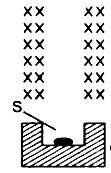
The figure shows a radioactive source S placed in a thick-walled lead container. The radiations given off pass through a magnetic field acting in direction perpendicular to the plane of paper inwards as shown by X. Copy the diagram and show the path of radiations. Explain why the source is kept in a thick-walled lead container.
View full question & answer
[3 Mark Question Answer] - Physics STD 10 Questions - Vidyadip