Question
How is a prokaryotic cell different from a eukaryotic cell?
| Prokaryotic cell | Eukaryotic cell |
| Most prokaryotes are unicellular. | Most eukaryotes are multicellular. |
| Size of the cell is generally small (0.5- 5µm). | Size of the cell is generally large (50- 100µm). |
| Nuclear region is poorly defined due to the absence of a nuclear membrane or the cell lacks true nucleus. | Nuclear region is well-defined and is surrounded by a nuclear membrane, or true nucleus bound by a nuclear membrane is present in the cell. |
| It contains a single chromosome. | It contains more than one chromosome. |
| Nucleolus is absent. | Nucleolus is present. |
| Membrane-bound cell organelles such as plastids, mitochondria, endoplasmic reticulum, Golgi apparatus, etc. are absent. | Cell organelles such as mitochondria, plastids, endoplasmic reticulum, Golgi apparatus, lysosomes, etc. are present. |
| Cell division occurs through binary fission | Cell division occurs by mitosis. |
| Prokaryotic cells are found in bacteria and blue-green algae. | Eukaryotic cells are found in fungi, plants, and animal cells. |
Generate a complete, print-ready paper with questions like this in minutes — across 16+ boards, with answer keys.
Discuss briefly the principle of immunization.
Given alongside is the velocity-tine graph for a moving body:
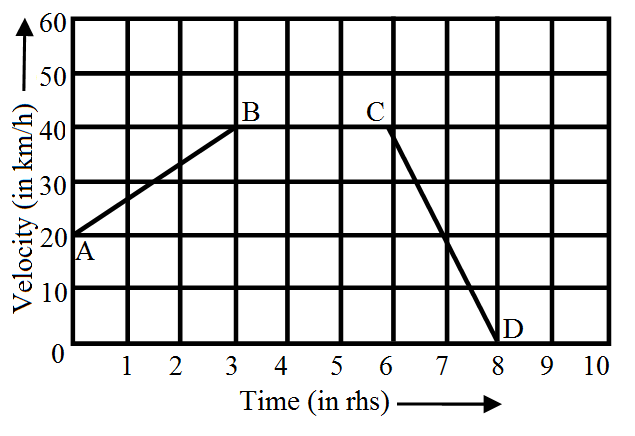
Find:
Explain various methods of weed control.
How is nitrogen replenished in atmosphere?
How these acids affect our heritage monuments such as Taj Mahal?
Write down four main characters of Pteriodophyta. Give two examples.