Question
How is a sample of an n-type semiconductor electrically neutral though it has an excess of negative charge carriers?
Answer

The sample contains atoms of either original material or the impurity which are all neutral.

Need a full question paper?

Generate a complete, print-ready paper with questions like this in minutes — across 16+ boards, with answer keys.

Start Generating Free

Similar questions

State the condition under which the terminal pd across a battery and its emf are equal.
At $\vec{r}_1$ and $\vec{r}_2$ duc to two point charges $Q_1$ and $Q _2$ respectively at any point whose position vector is $\vec{r}$. Write the expression for electric potential $(\vec{r})$
Two wires one of copper and other of manganin have same resistance and equal length. Which wire is thicker and why?
Differentiate between conduction current and displacement current.
Which part of electromagnetic spectrum is used in satellite communication?
A barometer tube reads 76cm of mercury. If the tube is gradually inclined keeping the open end immersed in the mercury reservoir, will the length of mercury column be 76cm, more than 76cm or less than 76cm?
A wheel with 10 metallic spokes each $0.5 m$ long is rotated with a speed of $120 rev / min$ in a plane normal to the horizontal component of earth's magnetic field $H_E$ at a place. If $H_E=0.4 G$ at the place, what is the induced emf between the axle and the rim of the wheel? Note that $1 G =10^{-4} T$.
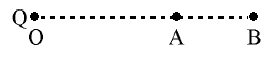
A point charge Q is placed at point O as shown in the figure. The potential difference VA – VB positive. Is the charge Q negative or positive?

When a forward bias is applied to a p-n junction, it
  1. Raises the potential barrier.
  2. Reduces the majority carrier current to zero.
  3. Lowers the potential barrier.
  4. None of the above.
A proton and an electron travelling along parallel paths enter a region of uniform magnetic field, acting perpendicular to their paths. Which of them will move in a circular path with higher frequency?