Question
How is electrolytic dissociation different from thermal dissociation?

Answer

Electrolytic Dissociation is the dissociation of an electrovalent compound into ions in the fused state or in aqueous solution state.
Reversible breakdown of a chemical compound into simpler substances by heating it. The splitting of ammonium chloride into ammonia and hydrogen chloride is an example. On cooling, they recombine to form the salt.

Need a full question paper?

Generate a complete, print-ready paper with questions like this in minutes — across 16+ boards, with answer keys.
Start Generating Free

Similar questions

The following question is pertaining to the laboratory pertaining hydrogen chloride gas.
Name the drying agent used and justify your choice
4.5 moles of calcium carbonate are reacted with dilute hydrochloric acid. What mass of calcium chloride is formed? (Relative molecular mass of calcium chloride is 111)
In order to obtain 1 tonne of aluminium the following inputs are required. 4 tonnes of bauxite, $150 kg$ of sodium hydroxide and $600 kg$ of graphite. The aluminium compound in bauxite is aluminium oxide and the main impurity is iron (III) oxide, Aluminium is obtained by the electrolysis of aluminium oxide dissolved in cryolite
1. Write the formula of cryolite.
2. Write down the word which correctly completes the following sentence. By dissolving aluminium oxide in cryolite a (conducting/non-conducting) solution is produced.
3. Why is so much graphite required for the electrolytic process?
4. Write the equation for the reaction which takes place at the cathode.
5. What is cathode made up of?
What do you understand by amphoteric oxide? Give the balanced equations for the reaction with three different amphoteric oxides with a caustic alkali. Write your observation if any.
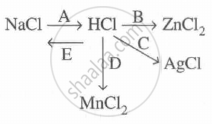
Study the flow chart and give balanced equations with conditions for the conversions A, B, C, D and E.

Mention three important uses of nitric acid. Give the property of nitric acid involved in the use.
The volumes of gases $\text{A, B, C}$ and $\text{D}$ are in the ratio$, 1:2:2:4$ under the same conditions of temperature and pressure.
If the volume of $\text{A}$ is actually $5.6 \ dm^3$ at $\text{STP},$ calculate the number of molecules in the actual volume of $\text{D}$ at $\text{STP}$.
Give reason for the following:
Commercial concentrated nitric acid is yellow in colour, but when it is dilute with water, it turns colourless.
Give one chemical test for nitric acid.
A sample of ammonium nitrate when heated yields 8.96 litres of steam (measure at $S.T.P$.)
$NH_4NO_3 \rightarrow N_2O + 2H_2O$
(i) What volume of dinitrogen oxide is produced at the same time as 8.96 litres of steam?
(ii) What mass of ammonium nitrate should be heated to produce 8.96 litres of steam? (Relative molecular mass of ammonium nitrate is $80$)
(iii) Determine the percentage of oxygen in ammonium nitrate $(O = 16).$
Give reason for the following:
Aqua regia dissolves gold and platinum.