Questions

[3 Mark Question Answer]

🎯

Test yourself on this topic

15 questions · timed · auto-graded

Question 13 Marks
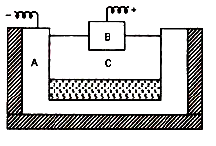
Copper sulphate solution is electrolyzed using copper electrodes. Study the diagram given alongside and answer the questions that follows.
(i) Which electrode to your left or right is known as the oxidizing electrode and why?
(ii) Write the equation representing the reaction that occurs
(iii) State two appropriate observations for the above electrolysis reactions.
Answer
(i) The right electrode is the anode and oxidising electrode $Cu \rightarrow Cu ^{2+}+2 e ^{-}$losing electrode.
(ii) Reaction at the anode: $Cu \rightarrow Cu ^{2+}+2 e ^{-}$
Reaction at the cathode: $Cu ^{2+}+2 e ^{-} \rightarrow Cu$
(iii) The anode dissolves and anode mud containing precious metal is recovered.
View full question & answer
Question 23 Marks
Differentiate between electrical conductivity of copper sulphate solution and copper metal.
Answer
Copper Sulphate Solution Copper metal
Conduction of electricity is
due to the flow of ions.
Conduction of electricity is
due to the flow of electrons.
It is an aqueous solution of
an ionic compound.
It is a metal in the solid state.
It undergoes a chemical
change.
It remains unchanged
chemically.
View full question & answer
Question 33 Marks
Three different electrolytic cells, A,B, and C are conncted in separate circuits. Electrolytic cell A contains sodium chloride solution. When the circuit is completed a bulb in the circuit glows brightly. Electrolytic cell B contains acetic acid solution and in this case the bulb in the circuit glows dimly. The electrolytic cell C contains sugar solution and the bulb does not glow. Give a reason for each of these observations.
Answer
  • Cell A contains sodium chloride solution which is a strong electrolyte and contains only ions. So, it conducts electricity and the bulb glows brightly.
  • Cell B contains both ions and molecules. So, there are few ions to conduct electricity and the bulb glows dimly.
  • Cell C contains sugar solution which is a non-electrolyte and does not contain ions. So, it is a bad conductor of electricity and the bulb does not glow.
View full question & answer
Question 43 Marks
During the electrolysis of copper (II) sulphate solution using platinum as cathode and carbon an anode:
(i) What do you observe at the cathode and at the anode?
(ii) What change is noticed in the electrolyte?
(iii) Write the reactions at the cathode and at the anode.
Answer
(i) Red shiny metal is deposited at the cathode.
(ii) The colour of the electrolytes changes gradually from blue to colourless.
(iii) At the cathode:
$Cu^{2+}+ 2e^-→ Cu$
Reaction at the anode:
$OH^-→ OH + e^-$
$4OH → 2H_2O + O_2​​​​​​​$​​​​​​​
View full question & answer
Question 53 Marks
The following is a sketch of an electrolytic cell used in the extraction of aluminium :

(a) What is the substance of which the electrode A and B are made?
(b) At which electrode (A or B) is aluminium formed?
(c) What are the two aluminium compounds in the electrolyte C?
(d) Why is it necessary for electrode B to be co ntinuously replaced?
Answer
(a) Electrode A is made of gas carbon and electrode B is made of Carbon rods.
(b) At electrode A.
(c) Two compounds in the electrolyte are $Al_2O_3$ and $Na_3AlF_6​​​​​​​$
(d) As at electrode B the oxygen is liberated during the process. The oxygen liberated oxidizes the carbon anode producing CO and $CO_2$.Thus electrode B is to be replaced continuously.
View full question & answer
Question 63 Marks
Write the equations of the reactions which take place at the cathode and anode when acidified water is electrolyzed.
Answer
Reaction at Cathode :
$H^+ + e^- → H$
$H + H → H_2$
$^{or}4H^+ + 4e^- → 2H_2$​​​​​​​
Reaction at anode :
$20H^- - 2e^- → H_2O + O$
$or 4OH^- - 4e^- → 4OH$
 
View full question & answer
Question 73 Marks
Write the equations of the reactions which take place at the cathode and anode when acidified water is electrolyzed.
Answer
Reaction at Cathode :
$H^+ + e^- → H$
$H + H → H_2$
$^{or}4H^+ + 4e^- → 2H_2$​​​​​​​
Reaction at anode :
$20H^- - 2e^- → H_2O + O$
$or 4OH^- - 4e^- → 4OH$
$4OH → 2H_2O + O_2​​​​​​​$​​​​​​​
View full question & answer
Question 83 Marks
Explain how electrolysis is an example of Redox reaction.
Answer
Redox reaction is one in which oxidation and reduction occurs simultaneously. Similarly in case of electrolysis:
At cathode : The cations gain electron and become neutral. As the electrons are gained the ion is said to be reduced.
At anode : The anions lose electron to form neutral atoms. As the electrons are lost the ion is said to be oxidized.
Hence in electrolysis also the oxidation and reduction occurs hence it is an example of Redox reaction.
View full question & answer
Question 93 Marks
The following Question refer to the electrolysis of copper sulphate solution with copper electrodes:
(a) Compare the change in mass of the anode
(b) What is seen to happen to the colour of the copper sulphate solution if platinum electrodes are used? Explain the observation.
(c) What is the practical application of the electrolysis of copper sulphate solution? Briefly, describe one such application.
Answer
(a) As for every copper ion discharged at the cathode, an ion of copper is formed at the anode which goes into the solution .Since atoms of copper are deposited at the cathode, the cathode becomesthicker and as the atoms of copper from the anode change into ions of copper, the anode becomes thinner.
(b) When platinum rods are used as electrodes, then x the blue colour of copper sulphate solution fades and sulphuric acid is formed. This is because oxygen is liberated at anode and copper metal is deposited at cathode
(c) Practical application of electrolysis of copper sulphate solution: This is the basis for purification of copper.
Other metals like Zinc, Nickel, Silver .Lead can also be purified.
View full question & answer
Question 103 Marks
How is electrolytic dissociation different from thermal dissociation?
Answer
Electrolytic Dissociation is the dissociation of an electrovalent compound into ions in the fused state or in aqueous solution state.
Reversible breakdown of a chemical compound into simpler substances by heating it. The splitting of ammonium chloride into ammonia and hydrogen chloride is an example. On cooling, they recombine to form the salt.
View full question & answer
Question 113 Marks
How is impure copper purified by electrolysis ? Explain.
Answer
Electrolytic refining is used for the purification of copper. In this case
Cathode : Pure copper strip
Anode : Impure copper
Electrolyte : A solution of copper sulphate and dilute sulphuric acid.
When the current is passed through the electrolyte , the copper ions of the copper sulphate solution are attracted to the cathode where they gain electrons and are deposited on pure copper strips. The impure copper loses electrons and passes into solution as soluble copper ions.
At Cathode : $Cu^{+2} + 2e^- → Cu$
At anode : $Cu + 2e^- → Cu^{+2}​​​​​​​$​​​​​​​
View full question & answer
Question 123 Marks
A solution of caustic soda (NaOH) in water or when fused, conducts an electric current. what is the similarity in these two cases ?
Answer
A solution of NaOH dissociates by electrolytic dissociation.
And fused NaOH dissociates by thermal dissociation.
The similarity between both of these is that they both liberate same ions.
$NaOH ⇌ Na^+ + OH^-$
(aq. or fused)
View full question & answer
Question 133 Marks
Explain, why electrolysis is an example of redox reaction?
Answer
Redox reaction is one in which oxidation and reduction occurs simultaneously.
Similarly in case of electrolysis :
At cathode : The cations gain electron and become neutral. As the electrons are gained the ion is said to be reduced.
At anode : The anions lose electron to form neutral. As the electrons are lost the ion is said to be oxidized.
Hence in electrolysis also the oxidation and reduction occurs hence it is an example of redox reaction.
View full question & answer
Question 143 Marks
Write the difference between with examples:
Electrolytic dissociation and ionization
Answer
Electrolytic dissociation and ionization :
Sr.No.IonizationElectrolytic dissociation
1.Formation of positively or negatively charged ions from molecules which are not intially in the ionic state.Separation of ions which are already present in an ionic cmpound.
2.Polar covalent compounds show ionization.Electrovalent compounds show dissociation.
3. For example : HClFor example : KCl
View full question & answer
Question 153 Marks
From the given list :
NaCl, NaOH, $H_2O$ (pure), $NH_4OH$, urea, dil.$H_2SO_4$, glucose, acetic acid, $H_2CO_{3.}$
Select :
a) Substances which will behave as strong electrolytes.
b) Substances which will behave as weak electrolytes.
c) Substances which are non-elctrolytes.
Answer
a) Substances which will behave as strong electrolytes : $NaCl, NaOH, H_2O$ (pure), dil.$H_2SO_4$
b) Substances which will behave as weak electrolytes :
$NH_4OH$, acetic acid, $H_2CO_3$​​​​​​​
c) Substances which are non-elctrolytes : urea, glucose
View full question & answer
[3 Mark Question Answer] - Chemistry STD 10 Questions - Vidyadip