Question
How is $p-n$ junction diode is used as an half wave rectifier? Explain its action with proper circuit diagram. Show the input and output waveform also.

Answer

$p-n$ junction diode as a Half Wave Rectifier : "A device that converts an alternating current or voltage into direct i.e., unidirectional current or voltage is called rectifier." The rectifier which converts only half cycle of alternating current into direct current is called half wave rectifier.
A $p-n$ junction diode has asymmetric conducting property i.e., it is highly conducting when forward biased and non-conducting when reverse biased. In this way a $p-n$ junction diode allows the electric current to pass through it only in one direction, hence it on be used as a rectifier.
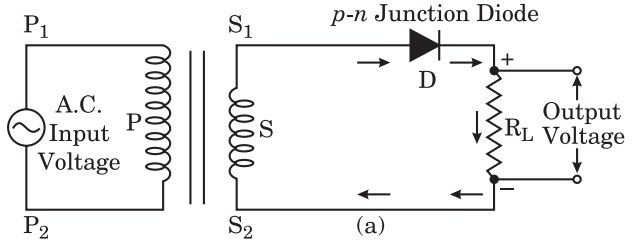
The circuit for a $p-n$ junction diode used as a half wave rectifier is shown in the figure (a).
Image
Working : A.C. from the main supply is fed to the primary P of suitable step-down transformer. The desired low voltage A.C. is obtained across the terminals S1 and S2 of secondary S. The load resistance R1. through which direct current (d.c.) is required is connected to terminals S1 and S2 through $p-n$ junction diode D.
Image
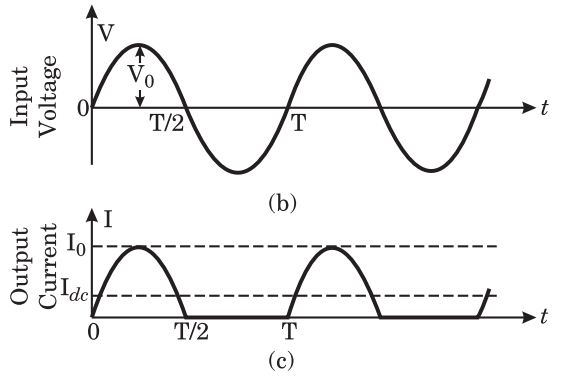
The potential of terminal S1 with respect to S2 varies as sine function of the time as shown in figure (b). It is input waveform. It is obvious that the polarity of S1 and S2 alternately becomes positive and negative with time.
During the first half-cycle of the a.c. input, when the terminal S1 of the secondary is supposed to be positive and S2 is negative, the junction diode is forward biased. Hence it conducts and current flows through the load RL in the direction shown by arrows. The current produces across the load an output voltage of the same type as the half-cycle of the input voltage. During the second half-cycle of the a.c. input, the terminal S1 is negative and S2 is positive. The diode is now reverse-biased. Hence there is almost zero current and zero output voltage across RL. The process is repeated during the next cycles.
In this way the output current is a continuous series of unidirection pulses [Fig. (c)]. It is output waveform. Thus the output current is D.C. current (i.e., flowing in one direction) which is not steady but fluctuating between 0 and maximum value Im.
Since the output current corresponds to one half of the input voltage wave, the other half being missing, the process is called half-wave rectification and the $p-n$ junction diode is called half-wave rectifier.

Need a full question paper?

Generate a complete, print-ready paper with questions like this in minutes — across 16+ boards, with answer keys.
Start Generating Free

Similar questions

  1. Derive an expression for drift velocity of electrons in a conductor. Hence, deduce Ohm's law.
  2. A wire whose cross-sectional area is increasing linearly from its one end to the other, is connected across a battery of V volts.
Which of the following quantities remain constant in the wire?
  1. Drift speed.
  2. Current density.
  3. Electric current.
  4. Electric field.
Figure shows a smooth track which consists of a straight inclined part of length $1$ joining smoothly with the circular part. $A$ particle of mass m is projected up the incline from its bottom.
  1. Find the minimum projection $-$ speed $v_0,$ for which the particle reaches the top of the track.
  2. Assuming that the projection $-$ speed is $2v_0$ and that the block does not lose contact with the track before reaching its top, find the force acting on it when it reaches the top.
  3. Assuming that the projection $-$ speed is only slightly greater than $v_0,$ where will the block lose contact with the track?
Are the nucleons fundamental particles, or do they consist of still smaller parts? One way to find out is to probe a nucleon just as Rutherford probed an atom. What should be the kinetic energy of an electron for it to be able to probe a nucleon? Assume the diameter of a nucleon to be approximately $10^{-15}m.$
Can $\text{L}_\alpha$ X-ray of one material have shorter wavelength than $\text{K}_\alpha$ X-ray of another?
A point object is placed at a distance of $15\ cm$ from a convex lens. The image is formed on the other side at a distance of $30\ cm$ from the lens. When a concave lens is placed in contact with the convex lens, the image shifts away further by $30\ cm.$ Calculate the focal lengths of the two lenses.
A gas is initially at a pressure of $100\ kPa$ and its volume is $2.0m^3.$ Its pressure is kept constant and the volume is changed from $2.0m^3$ to $2.5m^3.$ Its volume is now kept constant and the pressure is increased from $100\ kPa$ to $200\ kPa.$ The gas is brought back to its initial state, the pressure varying linearly with its volume.
  1. Whether the heat is supplied to or extracted from the gas in the complete cycle?
  2. How much heat was supplied or extracted?
Radiation coming from transition $n = 2$ to $n = 1$ of hydrogen atoms falls on helium ions in $n = 1$ and $n = 2$ states. What are the possible transitions of helium ions as they absorbs energy from the radiation?
What is wave-front ? Use Huygen's principle of secondary wavelets to verify the laws of reflection.
A circular coil of radius 2.00cm has 50 turns. A uniform magnetic field B - 0.200T exists in the space in a direction parallel to the axis of the loop. The coil is now rotated about a diameter through an angle of 60.0°. The operation takes 0.100s.
  1. Find the average emf induced in the coil.
  2. If the coil is a closed one (with the two ends joined together) and has a resistance of $4.00\Omega.$ calculate the net charge crossing a cross-section of the wire of the coil.
A tightly-wound solenoid of radius a and length l has n turns per unit length. It carries an electric current i. Consider a length dx of the solenoid at a distance x from one end. This contains n(dx) turns and may be approximated as a circular current in (dx).
  1. Write the magnetic field at the centre of the solenoid due to this circular current. Integrate this expression under proper limits to find the magnetic field at the centre of the solenoid.
  2. Verify that if a >> l, the field tends to $\text{B}=\frac{\mu_0\text{nil}}{2\text{a}}.$ Interpret these results.