Questions

5 Marks Questions

Take a timed test

9 questions · self-marked practice — reveal the answer and mark yourself.

Question 15 Marks
Explain with the help of a diagram the formation of depletion region and barrier potential in a $p-n$ junction diode.
Answer
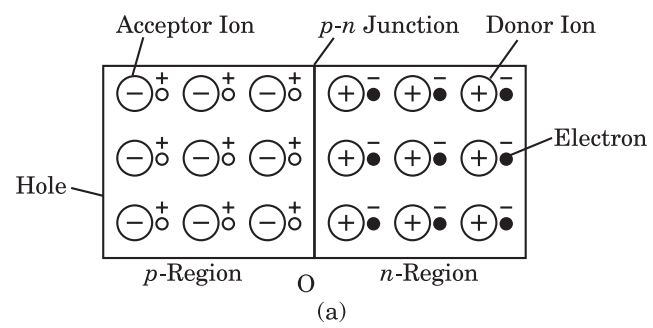
Formation of depletion region and barrier potential : A $p-n$ junction is shown in fig. (a). In its p-region positive holes are majority charge carriers along with equal number of fixed negatively charged acceptor ions. In its $n$-region negatively charged electrons are majority charged carriers along with equal number of positively charged ions. Hence both regions seem to be electrically neutral. But as soon as the $p-n$ junction is formed, the majority charge carriers of both the regions due to thermal agitation begin to diffuse at once across the junction from the region of higher concentration to the region of lower concentration.
Image
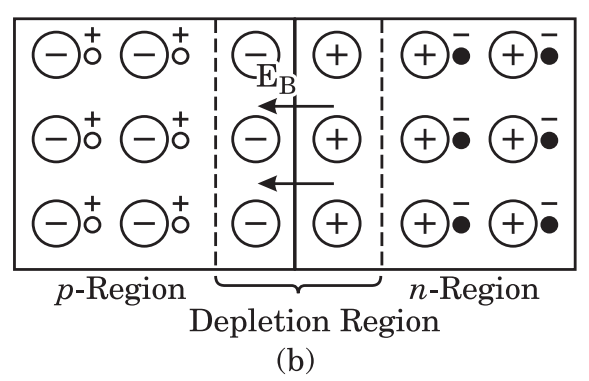
Therefore the electrons from $n$-region diffuse into $p$-region, where they combine with holes near the junction and get neutralised. Similarly, holes from $p$-region diffuse into $n$-region where they combine with the electrons near the junction and get neutralised. Thus near the junction $p$-region is left with immobile negative ions and $n$-region is left with immobile positive ions [Fig. (b)]. This small region near the $p-n$ junction in which there are no free charge carriers and has only immobile ions is called depletion region. The width of the depletion region is of the order of 10-6 m.
Image
Now the accumulation of positive charge in $n$-region and that of negative charge in $p$-region sets up a potential difference $V_B$ across the junction. This potential difference acts as a barrier and is called potential barrier which opposes further diffusion of majority charge carriers (electrons and holes) across the junction. This potential barrier sets up an internal electric field $\overrightarrow{ E }_{ B }$ from n-region (+) to p-region (-). Equilibrium is reached when the field $\overrightarrow{ E }_{ B }$ becomes strong enough to stop further diffusion of the majority charge carriers. Although this field $\overrightarrow{ E }_{ B }$ helps the minority charge carriers i.e., holes in n-region and electrons in p-region to diffuse across the junction.
The potential barrier VB depends upon (i) the nature of the semi-conductor, (ii) temperature and (iii) amount of doping. It's value for Silicon is 0.7 volt and for Germanium it is 0.3 volt.

View full question & answer
Question 25 Marks
Explain oscillating action of a n-p-n transistor with circuit diagram.
Answer
An oscillator is an electronic device which produces electric oscillation of constant frequency and amplitude requiring any external input signal.
It converts dc energy obtained from a battery into a.c. energy in same oscillatory circuit. Obviously an oscillator may be regarded as the self sustained transistor amplifier with positive feedback.
Construction
(i) Tank Circuit : A tank circuit is just a parallel combination of an inductance L and a capacitance C. The electric energy once given to it alternately changes between electrostatic energy in the capacitor and the magnetic energy in the inductor. The frequency of electric oscillations in the tank circuit is :
$f=\frac{1}{2 \pi \sqrt{ LC }}$
However, the oscillations get damped due to resistive losses in the inductance and dielectric losses in the capacitor.
(ii) Transistor Amplifier : The oscillations of the tank circuit are fed to the transistor amplifier. The oscillations get amplified due to the amplifying action of the transistor.
(iii) Feedback Circuit : To compensate for the energy losses occurring in the tank circuit, the feedback circuit returns (feedback) a part of the output power of the transistor amplifier to the tank circuit in phase with the input signal. This process is called positive feedback and produces undamped oscillations. The feedback may be done through inductive coupling (mutual inductance).
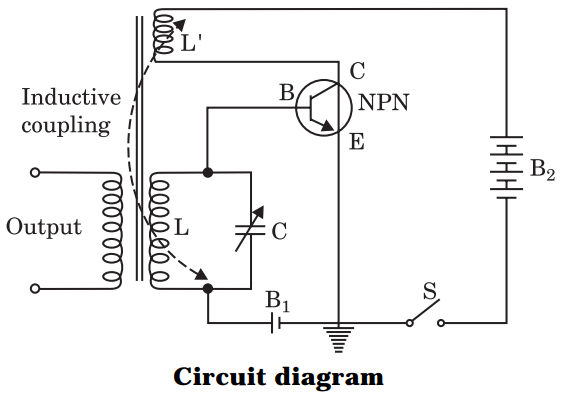
Figure shows the basic circuit using a common-emitter $n-p-n$ transistor as an oscillator. A tank circuit con-sisting of an inductance L and a variable capacitor C is connected in the input or the emitter-base circuit which is forward biased. A small coil L' called feedback or tickler coil is connected in the output or the emitter-collector circuit which is reverse biased. The coil L' is induc-tively coupled with the coil L of the tank circuit.
Image
Working of Oscillator with Feedback Action : When the switch S is closed, a small collector current starts growing through coil L'. This increases the magnetic flux linked with coil L' and hence with coil L. This induces e.m.f. in coil L in the direction of forward bias and a positive charge begins to build on the upper plate of capacitor C. The emitter current increases and also the collector current increases. This increases the magnetic flux linked with L' and hence with L. Consequently, the forward bias increases which further increases the emitter and collector currents. Charging of capacitor continues. This process continues till the collector current becomes maximum.
When the current through L' stops changing, the induced emflinked with L vanishes. This decreases the emitter current and hence the collector current. The decreasing current through L' induces emf in L in the opposite direction of the forward bias. This results in decrease in the emitter current and hence the collector current. At the same time positive charge on the lower plate of capacitor C begins to build up. The process continues till the collector current becomes zero. (In fact, inertia of the collapsing magnetic field carries the collector current below the zero value). The induced emf linked with L again becomes zero, i.e., the forward bias is now not being opposed by induced emf. The emitter current and hence the collector current will start increasing. This cycle repeats again and again to give electric oscillations of constant amplitude and of constant frequency.
$f=\frac{1}{2 \pi \sqrt{ LC }}$
The oscillations of a desired frequency can be obtained by changing the value of capacitance C of the variable capacitor. In this oscillator, we have connected tank circuit on the base side. Hence, it is known as tuned base oscillator. If the tank circuit is on the collector side, it will be known as tuned-collector oscillator.
In common-emitter transistor circuit, a signal applied to the base-emitter circuit appears with a phase change of 180° in the collector-emitter circuit. The coupling of L and L' produces a further phase change of 180° due to mutual induction. Hence the energy feedback to the tank circuit is in phase with the input signal. Due to this positive feedback, the oscillations of the tank circuit are correctly maintained.

View full question & answer
Question 35 Marks
What happens when a forward bias is applied to a $p-n$ junction?
Answer
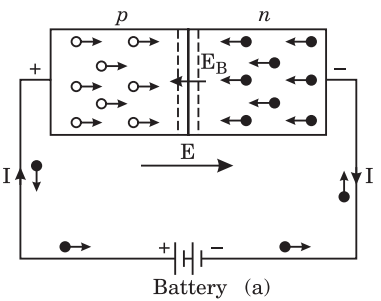
Forward Biasing: When the positive terminal of an external battery is connected to the $p$-region and negative terminal of the battery to the $n$-region of a $p-n$ junction then the junction is said to be forward-biased and this process is known as forward biasing of the junction. Hence in this biasing an external field E is set up on the junction which is directed from $p$-region to $n$-region of the junction. It is obvious that this field is in the direction opposite to the direction barrier field $\vec{E}_{B}$.
Image
The electric field E is much stronger than the opposing field $E_{B}$. Therefore, the force on the positive hole will act in the direction of field E and the force on the negatively charged electron will act in the direction opposite to that of $\vec{E}$. Therefore, positive holes of $p$-region and electrons of $n$-region both move towards the $p-n$ junction. These holes and electrons combine with each other near the junction and their existence is gone. Now for each electron-hole combination a covalent band breaks up in $p$-region near the positive terminal of the battery. Now out of the newly produced hole and electron, the hole moves towards the junction while the electron enters the positive terminal of the battery through the connecting wire used. At the same instant an electron is detached from the negative terminal of the battery and enters the $n$-region to compensate the electron loss in the combination with hole at the junction. In this way the flow of majority charge carriers i.e., holes in $p$-region and electron in n-region constitutes an electric current across the $p-n$ junction. The electric current flowing through the junction in forward biasing is called forward current. The electric current in the external circuit is due to the flow of electrons as shown is Fig. (a).
In addition to the large forward current, a small current due to the motion of minority carriers i.e., electrons in $p$-region and holes in n-region flows in the direction opposite to the forward current. This current is called reversed current, but it is almost negligible.
In forward biasing of a $p-n$ junction applied external electric field E dominates the small barrier field $E_{B}$, hence majority charge carriers i.e., holes in $p$-region and electron in n-region are pulled towards the junction. Therefore, in this biasing, the width of the depletion layer decreases due to which $p-n$ junction offers a low resistance for the forward biased current.
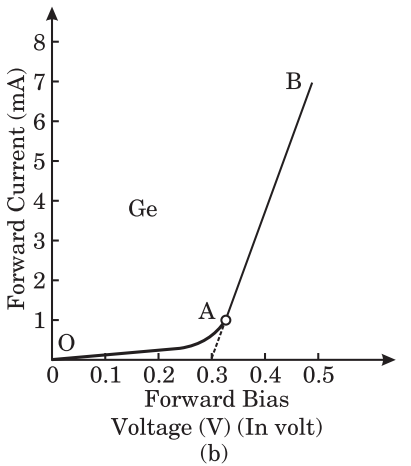
Voltage-Current Characteristic Curve : For forward biasing of a $p-n$ junction the graph drawn between applied voltage known as forward bias voltage V and the corresponding forward biased current is shown in Fig. (b). This is voltage-current characteristic curve of $p-n$ junction in forward biasing. It has been drawn for Germanium $p-n$ junction.
Image
It is obvious from the curve that in the beginning when the applied voltage is low (of the order of barrier voltage ≈ 0.3 V) the current through the junction is almost zero because both these voltages oppose each other. As the applied voltages is increased the current increases very slowly and nonlinearly until the applied voltage becomes greater than barrier voltage or say potential barrier. This behaviour of the junction is shown by the graph portion OA. With further increase in applied voltage forward biased current increases very rapidly and linearly. In this position the junction behaves as a conductor. This behaviour of junction is shown by straight line part AB of characteristic curve. When this straight line is drawn back, it intersects the voltage-axis at barrier voltage.

View full question & answer
Question 45 Marks
What is Zener diode? Give its symbolic diagram. Draw its (I-V) characteristic curve. Explain its use as a voltage regulator ?
Answer
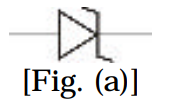
Zener diode: A properly dopped (heavy doped) $p-n$ junction diode which works in the breakdown region without damaging itself is called a Zener diode. Its symbolic diagram is represented by
Image
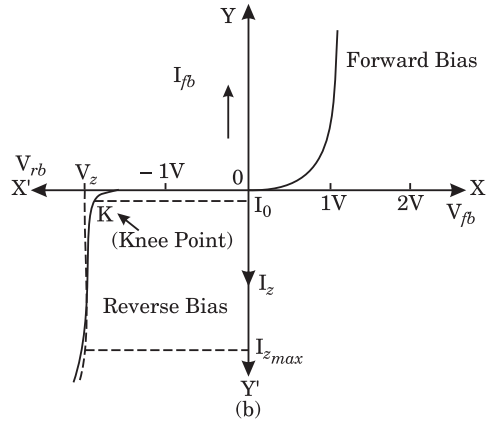
V-I Characteristic of Zener Diode : The circuit diagram for obtaining voltage-current characteristic of a Zener diode is the same as for ordinary $p-n$ junction diode. It's V-I characteristics is shown in Fig. (b). Under increasing forward bias the zener diode acts like an ordinary $p-n$ junction diode. But under increasing reverse bias a small saturated current $\left( I _{ z }\right)$ flows across the junction and remains constant upto a critical value of reverse voltage V2 upto the point K known as knee point, beyond which reverse current increases abruptly and now it is known as Zener current Iz.
Image
Here $I _0$ is the minimum value of reverse current which must be maintained to keep the diode in the breakdown region. $I_{z \max }$ is the maximum value of the zener current above which the diode may be damaged.
The value of this current is given by maximum power rating (provided by the manufacturer), and can be controlled by suitable external load. As long as this limit is not crossed, the diode is not damaged and comes out of the breakdown region on reducing the voltage below $V _z$.
Zener Diode as a Voltage Regulator :
Working Principle : When a Zener diode is operated under reverse biased position in the breakdown region the voltage across it remains practically constant, equal to the breakdown voltage Vz for a large change in the reverse current. This is the fact on which, Zener diode's working principle as a voltage regulator is based. The voltage regulator is also known as voltage stabilizer.
Image
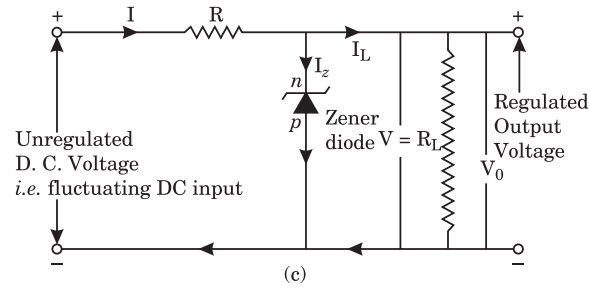
Circuit diagram and its action : The circuit diagram for using Zener diode as a voltage regulator is shown in Fig. (c). In this circuit diagram a zener diode is connected in reversed bias position to a source of unregulated D.C. voltage e.g., fluctuating voltage output of a rectifier through a series resistance R. A load resistance RL through which regulated voltage is to be received is connected in parallel to zener diode. Here the zener diode is selected with a zener voltage VZ equal to the stabilized voltage desired across RL.
If during the fluctuations in the input voltage at some instant there is a rise in it, the current through resistance R and zener diode also increases. Due to this there is a rise in voltage drop across R but no change in the voltage across the zener diode because in the breakdown region zener voltage VZ remains constant even though the current through it changes. In the same way if the input voltage decreases, the voltage across the resistance R decreases without any change in the voltage across the zener diode. Thus any change (rise or fall) in input voltage results in the corresponding similar change in voltage drop across R without any change in voltage across zener diode. Hence the output voltage across load resistance RL equal to VZ remains constant. Thus, the zener diode acts as a voltage regulator or say voltage stabilizer. It should be noted that since the resistance R removes the fluctuations to give a regulated i.e., constant output voltage VZ, the circuit cannot work if the input voltage falls below VZ.
Image
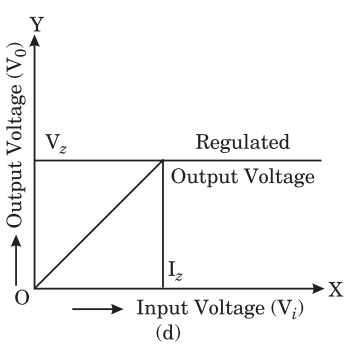
If a graph between output voltage (Vo) and input voltage (Vi) for a zener diode is drawn, it is obtained as shown in Fig. (d). It is obvious from this graph that the output voltage remains constant beyond the reverse breakdown voltage VZ.

View full question & answer
Question 55 Marks
Describe $p-n-p$ transistor as an amplifier in common emitter configuration with proper circuit diagram.
Answer
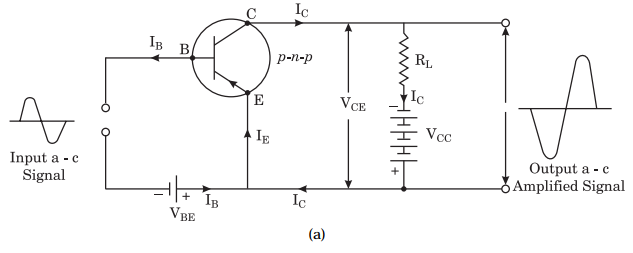
Common Emitter $p-n-p$ Transistor Amplifier : Circuit Diagram : For this amplifier the circuit diagram is shown in Fig. (a) in which emitter is made common to input and output circuits.
Action : Here the input circuit is forward biased by a low voltage battery $V _{ BE }$ and the output circuit is reversed biased by a high voltage battery Vcc. Thus, the resistance of the input (≈ 1 ΚΩ) is low and that of output is high (= 50 ΚΩ).
Image
A load resistance RL is connected in collector-emitter circuit i.e., output circuit. The weak input a.c signal is applied in the base-emitter circuit and the amplified output a.c. signal is obtained across RL in the collector emitter circuit i.e., output circuit.
When there is no a.c. input voltage signal in the circuit then according to Kirchhoff's current law, the relation between emitter current IE base current IB and collector current IC will be :
$I_E=I_B+I_C$ ...(1)
where IC is sightly less than IE due to a bit small value of IB.
Now due to collector current IC the potential drop across the load resistance RL will be, IC RL Therefore, the potential difference between collector and emitter i.e., collector-emitter voltage VCE would be given by
$V_{C E}=V_{C C}-I_C \cdot R_L$ ...(2)
But when the a.c. input voltage signal (which is to be amplified) is applied in the input circuit, it changes the base-emitter voltage VBE due to which emitter current IE and correspondingly the collector current IC will be changed. The change in the base current IB being very small.
Thus, due to change in IC according to equation (2), the voltage VCE varies. This variation in VCE due to input a.c. signal appears as an amplified output across the load resistance RL.
Phase Relationship between Input and Output Voltage Signals : In first positive half-cycle of a.c. input it opposes the forward biasing of input circuit resulting in reduction in forward biasing of this base-emitter circuit. Due to this the emitter current $I _{ E }$ decreases and correspondingly there is a decrease in collector current $I _{ C }$ also. Hence according to the equation $V_{C E}=V_{C C}-I_C R_L$, the decrease in $I _{ C }$ results in an increase in voltage VCE . Since collector is connected to the negative terminal of the biasing battery VCC hence an increase in voltage $V _{ CE }$ means that it becomes more negative.
This in first positive half-cycle amplified amplitude of the output signal in negative direction is obtained.
In the next negative half-cycle of the input signal it supports the forward biasing of the base-emitter circuit. Therefore, the emitter current IE and correspondingly the collector current IC both increases. As a result on the bases of equation $V_{C E}=V_{C C}-I_C \cdot R_L$, the voltage VCE decreases, hence the collector becomes less negative. In this way in the next negative half-cycle amplified amplitude of the output signal in the positive direction is obtained.
Hence it may be conclude that in common-emitter transistor amplifier the output voltage signal is in opposite phase to that of input signal i.e., output voltage signal is 180° out of phase with the input voltage signal.
Constants of Common Emitter Transistor Amplifier:
The various constants i.e., gains of a common emitter transistor amplifier are defined as follows which are similar for both types i.e., $p-n-p$ and $n-p-n$ transistor amplifiers.
(i) A.C. Current Gain i.e., Current Amplification Factor : "It is defined as the ratio of the change in the collector current to the change in the base current when collector-emitter voltage is kept constant." It is denoted by $\beta_{a c}$
$\therefore \quad \beta_{a c}=\left(\frac{\Delta I _{ C }}{\Delta I _{ B }}\right)_{ V _{ C E } \text { constant }}$ ...(1)
The value of $\beta$ is from 15 to 50 .
(ii) A.C. Voltage Gain i.e., Voltage Amplification Factor : "It is defined as the ratio of the change in the output voltage to the change in the input voltage." It is denoted by AV.
$\therefore \quad A _{ V }=\left(\frac{ V _o}{V_i}\right)$ ...(2)
But $V _o=\Delta I _{ C } \times R _o$ and $V _i=\Delta I _{ B } \times R _i$
Where $R _o=$ Output resistance
And $R _i=$ Input resistance
$\Delta I _{ C }=$ Change in collector current
and $\Delta I _{ B }=$ Change in base current
$\therefore \quad A _{ V }=\frac{\Delta I _{ C } \times R _o}{\Delta I _{ B } \times R _i}=\left(\frac{\Delta I _{ C }}{\Delta I _{ B }}\right)\left(\frac{ R _o}{ R _i}\right)$
But $\frac{\Delta I _{ C }}{\Delta I _{ B }}=$ Current gain $\beta_{\text {a.c. }}$ and $\frac{ R _o}{ R _i}=$ Resistance gain
$\therefore \quad A_V=\beta_{a c} \times \text { resistance gain }$ ... (3)
Since $\beta_{ ac } \gg \alpha_{ ac }$ hence $A _{ V }$ for C.E amplifier is larger than that for CB amplifier.
(iii) A.C. Power Gain or Power Amplification Factor : "It is defined as the ratio of the change in output power to the change in input power. "It is denoted by Pac.
∵ Power, $P = I \times V$
$P _{ ac }=$ a.c. current gain × a.c. voltage gain
$P_{a c}=\beta_{a c} \times A_V$
$=\beta_{ ac } \times\left(\beta_{ ac } \times\right.$ resistance gain $)$
$\Rightarrow \quad P _{ ac }=\beta_{ ac }^2 \times$ resistance gain ...(4)

View full question & answer
Question 65 Marks
How is $p-n$ junction diode is used as an half wave rectifier? Explain its action with proper circuit diagram. Show the input and output waveform also.
Answer
$p-n$ junction diode as a Half Wave Rectifier : "A device that converts an alternating current or voltage into direct i.e., unidirectional current or voltage is called rectifier." The rectifier which converts only half cycle of alternating current into direct current is called half wave rectifier.
A $p-n$ junction diode has asymmetric conducting property i.e., it is highly conducting when forward biased and non-conducting when reverse biased. In this way a $p-n$ junction diode allows the electric current to pass through it only in one direction, hence it on be used as a rectifier.
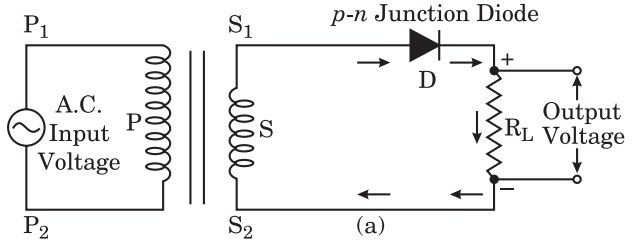
The circuit for a $p-n$ junction diode used as a half wave rectifier is shown in the figure (a).
Image
Working : A.C. from the main supply is fed to the primary P of suitable step-down transformer. The desired low voltage A.C. is obtained across the terminals S1 and S2 of secondary S. The load resistance R1. through which direct current (d.c.) is required is connected to terminals S1 and S2 through $p-n$ junction diode D.
Image
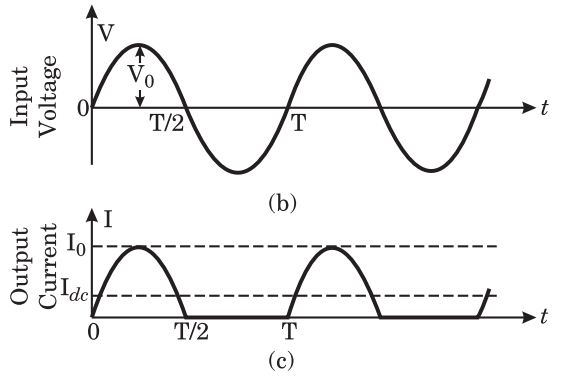
The potential of terminal S1 with respect to S2 varies as sine function of the time as shown in figure (b). It is input waveform. It is obvious that the polarity of S1 and S2 alternately becomes positive and negative with time.
During the first half-cycle of the a.c. input, when the terminal S1 of the secondary is supposed to be positive and S2 is negative, the junction diode is forward biased. Hence it conducts and current flows through the load RL in the direction shown by arrows. The current produces across the load an output voltage of the same type as the half-cycle of the input voltage. During the second half-cycle of the a.c. input, the terminal S1 is negative and S2 is positive. The diode is now reverse-biased. Hence there is almost zero current and zero output voltage across RL. The process is repeated during the next cycles.
In this way the output current is a continuous series of unidirection pulses [Fig. (c)]. It is output waveform. Thus the output current is D.C. current (i.e., flowing in one direction) which is not steady but fluctuating between 0 and maximum value Im.
Since the output current corresponds to one half of the input voltage wave, the other half being missing, the process is called half-wave rectification and the $p-n$ junction diode is called half-wave rectifier.

View full question & answer
Question 75 Marks
Explain the Function of a $n-p-n$ transistor as a switch with necessary circuit diagram.
Answer
Any device which can turn ON and OFF current in an electrical circuits in known as a switch. Generally, mechanical switches are used to resume and break connection in electrical circuits. Digital devices like computers perform a very large number of switching operations every day. In computer circuits an electronic device like junction diode and junction transistor can be used to turn rapidly on or off the current.
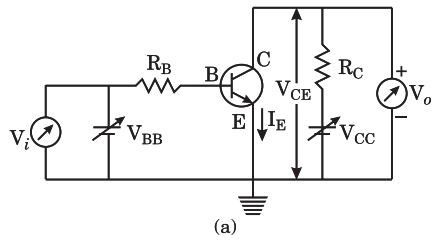
Junction Transistor as a Switch : In order to understood the switching action of a junction transistor we should be familiar with three states of working of a transistor. In Fig. (a), circuit diagram of an $n-p-n$ transistor in common-emitter configuration is shown. In this circuit a battery of variable voltage VBB IS connected to input circuit i.e., base-emitter circuit and another battery of variable voltage Vcc is connected to the output circuit i.e., emitter-collector circuit, RB and Re are the resistances in the input and output circuits, respectively.
Image
Now applying Kirchhoff's voltage rule in the closed loop of input side and output side, we get respectively as :
$V_{BB}=I_{B} R_{B}+V_{BE} \text { and } V_{CE}=V_{CC}-I_{C} R_{C}$ ... (1)
But the voltage $V_{B B}$ can be regarded as d.c. input voltage Vi and VCE as the d.c. output voltage VO Hence the above equation can be written as :
$V _i= I _{ B } R _{ B }+ V _{ BE }$ and $V _o= V _{ CC }- I _{ C } R _{ C }$ ...(2)
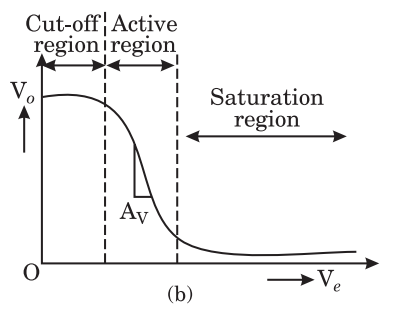
With the help of series (2) of the equation, a graph between $V _o$ and $V _i$ is drawn, which is called transfer characteristic of the junction transistor Fig. (b). This typical characteristic curve has three well defined regions as follows :
(i) Cut-off region : In Si transistor, as long as input Vi is less than 0.6 V the transistor remains in cut off state and current Ic remains zero.
$\therefore \quad V _o= V _{ CC }$
This region is called cut-off region.
(ii) Active region : When Vi becomes greater then 0.6 V tansistor is in active region with some current Ic in the output path and the output Vo decreases as the current $I _{ C }$ increases ( $V _o= V _{ CC }- I _{ C } R _{ C }$ ). With increase in $V _i, I _{ C }$ increases almost linearly and so $V _o$ decreases linearly till its value becomes less than about 1.0 V .
Image
(iii) Saturation Region : When Vi is further increased to a high value, the large collector current flows which produces such a large potential drop across the load Rc that the emitter-collector junction gets also forward biased. The output voltage Vo decreases to almost zero. Since it cannot pass any more collector currect IC, hence this situation is called saturation state and the transistor is said to be in saturation region.
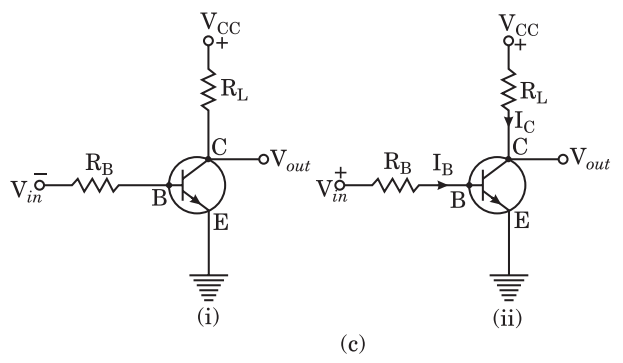
A transistor can be used as a switch only if it is operated in its cut-off and saturation states. The electric circuit required to explain the switching action of a junction transistor is shown in Fig. (c) (i) in which common emitter $n-p-n$ transistor is used.
Image
When the base input voltage Vin is negative or zero as shown in Fig. (c) (ii), the transistor is cut-off (i.e., base current IB is zero) and no collector current flows in the load resistance RL connected to the collector circuit. As such, there is no voltage drop across RL. Hence the output voltage is equal to the collector supply voltage,
i.e. $V _{\text {out }}= V _{ CC }$
Strictly speaking, the collector current is not zero since a small collector-to-emitter leakage current always flows when the base input voltage is negative or zero.
When the base input voltage is positive [Fig. (c) (ii)], a base current IB flows and an amplified collector-current Ic flows through the load RL. Clearly, the output voltage is now given as follows :
$V _{\text {out }}= V _{ CC }- I _{ C } R _{ L }$
Thus, the transistor turns the current ON or OFF in the load RL depending upon whether the input base voltage is positive or negative (or zero). In other words, it acts like a switch.
An compared to other types of switches, the transistor switch is compact, noiseless, trouble-free and has a very fast speed of operation.

View full question & answer
Question 85 Marks
What are intrinsic semiconductor and extrinsic semiconductor ? Explain.
Answer
Intrinsic Semiconductor: A pure semiconductor which is free from any impurity is called intrinsic semiconductor. Pure germanium and pure silicon in their natural state are the examples of intrinsic semiconductors. The electronic configuration of these elements is as given below :
Germanium (Ge) : $Z=32$; $1s^{2}, 2s^{2}2p^{6}, 3s^{2}3p^{6} 3d^{10}, 4s^{2}4p^{2}$.
Silicon (Si) : $Z=14$; $1s^{2}, 2s^{2}2p^{6}, 3s^{2}3p^{2}$.
Now it is obvious from this configuration that there are four electrons in outermost orbit of each of these atoms i.e., Ge and Si both have four valence electrons i.e., both are tetravalent.
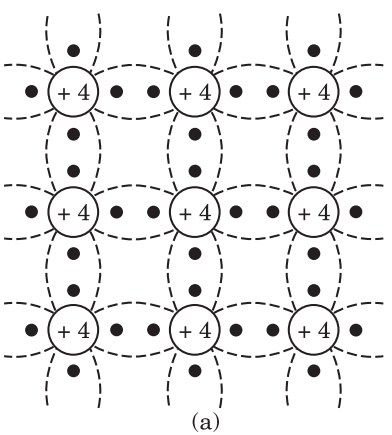
The outermost shell of an atom is of interest in electronics because it contains the loosely bound valence electrons which are easily dislodged to become electric charge carriers. Since germanium has four valence electrons, hence for our purpose the germanium atom may be pictured as containing only these electrons and four protons in the nucleus to keep it electrically neutral. When germanium is in its crystalline form its atoms are arranged in an ordered array in which each atom is situated at a corner of a regular tetrahedron [Fig. (a)].
Image
In this figure, each of the four valence electrons of the atom is shared with the nearest neighbouring electron and forms a covalent bond, shown by shaded curved lines in the figure. In this way in this structure four valency electron pairs are associated with each nucleus.
At temperatures near to absolute zero all valency electrons are bound so strongly with each other and with the nucleus that no free electrons are available to conduct an electric current through the crystal. Thus, at such temperature pure germanium crystal i.e., intrinsic semiconductor seems to be a non-conductor of electricity.
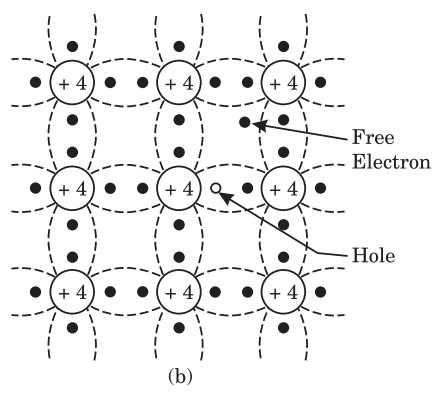
At room temperature due to thermal agitation in the crystal a few covalent bonds are broken liberating some free electrons as charge carriers. An electron disloged from a covalent bond leaves behind a vacancy in the covalent band which is named as hole. Since a hole represents the deficiency of an electron in the band, hence it behaves as a positive charge which is equal in magnitude to be charge of an electron.
Image
Because the liberation of one free electron by thermal agitation creates one hole, hence in intrinsic semiconductors, the number of free electrons is equal to the number of holes.
Now, when a hole is created in some covalent bond an electron from the neighbouring covalent bond may jump into it creating a new hole in that bond. Thus, hole has moved from one place to another. In this way the actual motion of the electron from one covalent bond to another give $\Delta$ rise to the apparent motion of hole from one atom to another. Here it should be noted that thermally generated free electron does not take part in the process of apparent motion of the hole.
Now, when a potential difference is applied across the ends of an intrinsic semiconductor an electric field is established inside it. Hence thermally generated free electrons move in the direction opposite to that of the field and constitute an electric current $I_e$ known as electron current. Along with it under the action of the electric field developed in the semiconductor jumping of bound electrons into the hole takes place from one atom to another in the opposite direction of the field with the corresponding creation of the holes in the direction of the field. Thus, it can be said that holes move in the direction of field and so they act as positive charge carriers giving rise to an electric current Ih known as hole current.
Thus, the total current in the intrinsic semiconductor is equal to the sum of electron current and hole current i.e., $I = I _e+ I _h$.
Extrinsic Semiconductor : The conductivity of an intrinsic semiconductor is very poor unless the temperature is very high. At room temperature, only one atom out of $10^9$ contributes to conduction. The intrinsic semiconductor is thus of no practical use. In order to make the intrinsic semiconductors of practical use, small amount of some suitable impurity atoms is added to them. The resulting semiconductors are called extrinsic semiconductors. The process of adding impurity atoms to the intrinsic semiconductors is known as dopping. The impurity that is added to the intrinsic semiconductors is called dopant. The amount of impurity added is extremely small i.e., generally about 1 part of 108 of intrinsic semiconductor atoms. Extrinsic semiconductor is called doped semiconductor.
The purpose of adding impurity intrinsic semiconductor is to increase its electrical conductivity by increasing either the number of free electrons or holes in the semiconductor. Usually the impurity atoms are taken either from group V having 5 valence electrons or from group III elements having 3 valence electrons. Since the percentage of impurity atoms (dopants) is very small in extrinsic semiconductor hence it does not change either the crystal structure or the chemical properties of the original semiconductor.
On the basis of the type of dopant used extrinsic semiconductors are of two types as given below :
(i) $p$-type extrinsic semiconductor, (ii) $n$-type extrinsic semiconductor.
On dopping pure germanium with trivalent impurity $p$-type extrinsic semiconductor is obtained and on dopping pure germanium semiconductor with pentavalent impurity. $n$-type extrinsic semiconductor is obtained.

View full question & answer
Question 95 Marks
How are fundamental logic gates OR, AND and NOT obtained from NOR gates ?
Answer
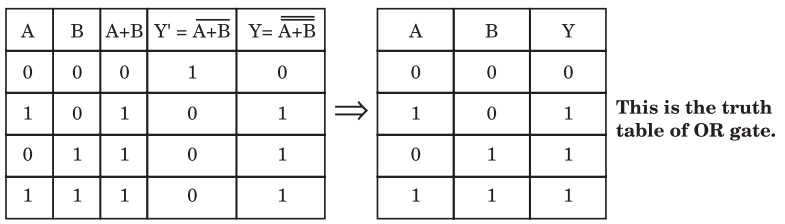
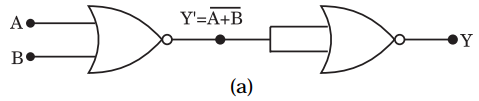
(1) To get OR Gate from NOR Gate : When output of a NOR gate is made input of a NOT gate obtained with the help of another NOR gate then OR gate is obtained. [Fig. (a)]
Image
Boolean Expression :
$Y =\overline{\overline{ A \cdot B }}=\overline{\overline{ A } \cdot \overline{ B }}= A + B$
This can be explained with the help of truth table as follows :
Image
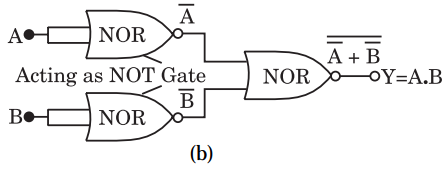
(2) To obtain AND gate from NOR gate : By using three NOR gates interconnected in the following manner as shown in figure (b), an AND gate can be obtained.
Image
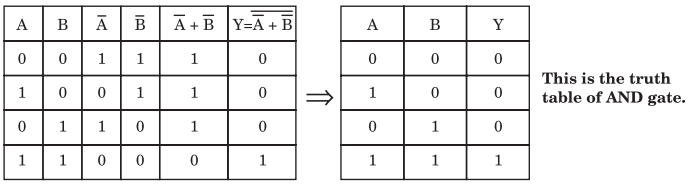
Thus : $Y =\overline{\overline{ A } \cdot \overline{ B }} \Rightarrow Y = A \cdot B$
This can be explained with the help of truth table as follows :
Image
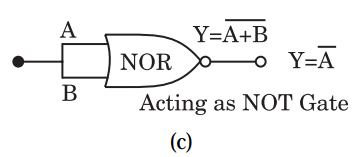
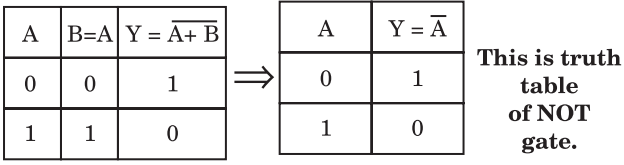
(3) To obtain NOT gate from NOR gate : By joining both the input terminals of a NOR gate, one input NOR gate is obtained which behaves as a NOT gate [Fig. (c)]. In NOR gate output is high when both the inputs are low and output is low when either or both the inputs are high.
Image
Here $Y =\overline{ A + B }$ or $Y =\overline{ A }($ i.e. $A = B )$
This can be explained with the help of truth table as follows :
Image
View full question & answer
5 Marks Questions - Physics STD 12 Science Questions - Vidyadip