Question
How is $p-n$ junction diode is used as an half wave rectifier? Explain its action with proper circuit diagram. Show the input and output waveform also.

Answer

$p-n$ junction diode as a Half Wave Rectifier : "A device that converts an alternating current or voltage into direct i.e., unidirectional current or voltage is called rectifier." The rectifier which converts only half cycle of alternating current into direct current is called half wave rectifier.
A $p-n$ junction diode has asymmetric conducting property i.e., it is highly conducting when forward biased and non-conducting when reverse biased. In this way a $p-n$ junction diode allows the electric current to pass through it only in one direction, hence it on be used as a rectifier.
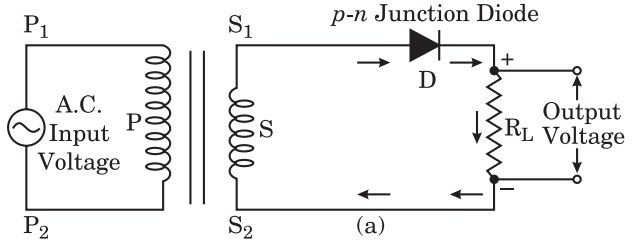
The circuit for a $p-n$ junction diode used as a half wave rectifier is shown in the figure (a).
Image
Working : A.C. from the main supply is fed to the primary P of suitable step-down transformer. The desired low voltage A.C. is obtained across the terminals S1 and S2 of secondary S. The load resistance R1. through which direct current (d.c.) is required is connected to terminals S1 and S2 through $p-n$ junction diode D.
Image
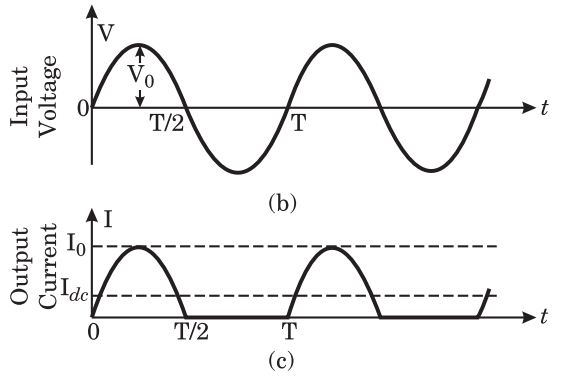
The potential of terminal S1 with respect to S2 varies as sine function of the time as shown in figure (b). It is input waveform. It is obvious that the polarity of S1 and S2 alternately becomes positive and negative with time.
During the first half-cycle of the a.c. input, when the terminal S1 of the secondary is supposed to be positive and S2 is negative, the junction diode is forward biased. Hence it conducts and current flows through the load RL in the direction shown by arrows. The current produces across the load an output voltage of the same type as the half-cycle of the input voltage. During the second half-cycle of the a.c. input, the terminal S1 is negative and S2 is positive. The diode is now reverse-biased. Hence there is almost zero current and zero output voltage across RL. The process is repeated during the next cycles.
In this way the output current is a continuous series of unidirection pulses [Fig. (c)]. It is output waveform. Thus the output current is D.C. current (i.e., flowing in one direction) which is not steady but fluctuating between 0 and maximum value Im.
Since the output current corresponds to one half of the input voltage wave, the other half being missing, the process is called half-wave rectification and the $p-n$ junction diode is called half-wave rectifier.

Need a full question paper?

Generate a complete, print-ready paper with questions like this in minutes — across 16+ boards, with answer keys.
Start Generating Free

Similar questions

The deuteron is bound by nuclear forces just as H-atom is made up of p and e bound by electrostatic forces. If we consider the force between neutron and proton in deuteron as given in the form of a Coulomb potential but with an effective charge e':
$\text{F}=\frac{1}{4\pi\in_0}\frac{\text{e}'^2}{\text{r}}$
estimate the value of (e’/e) given that the binding energy of a deuteron is 2.2MeV.
A conducting loop of area 5.0cm2 is placed in a magnetic field which varies sinusoidally with time as $\text{B}=\text{B}_0\sin\omega\text{t}$ wherer $\text{B}_0=0.20\text{T}$ and $\omega=300\text{s}^{-1}.$ The normal to the coil makes an angle of 60° with the field. Find
  1. The maximum emf induced in the coil.
  2. The emf induced at $\text{t}=\Big(\frac{\pi}{900}\Big)\text{s}$
  3. $\text{t}=\Big(\frac{\pi}{600}\Big)\text{s}.$
  4. The emf induced at $\text{t}=\Big(\frac{\pi}{600}\Big)\text{s}.$
A convex lens has a focal length of 10cm. Find the location and nature of the image if a point object is placed on the principal axis at a distance of:
  1. 9.8cm
  2. 10.2cm from the lens.
The two blocks in an Atwood machine have masses 2.0kg and 3.0kg. Find the work done by gravity during the fourth second after the system is released from rest.
What is meant by electric potential? Calculate the electric potential generated by a point charge. Draw the equipotential surfaces resulting from this.
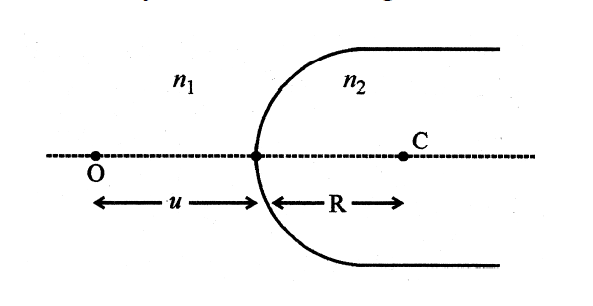
A point object 'O' is kept in a medium of refractive index n1 in front of a convex spherical surface of radius of curvature R which separates the second medium of refractive index n2 from the first one, as shown in the figure. Draw the ray diagram showing the image formation and deduce the relationship between the object distance and the image distance in terms of n1, n2 and R.

  1.  

  1. hen the image formed above acts as a virtual object for concave spherical, surface separating the medium n2 from n1 (n2> n1), draw this ray diagram and write the similar (similar to (a) relation. Hence obtain the expression for the lens maker's formula.
A magnetic field set up using Helmholtz coils (described in Exercise 4.16) is uniform in a small region and has a magnitude of 0.75 T. In the same region, a uniform electrostatic field is maintained in a direction normal to the common axis of the coils. A narrow beam of (single species) charged particles all accelerated through 15 kV enters this region in a direction perpendicular to both the axis of the coils and the electrostatic field. If the beam remains undeflected when the electrostatic field is 9.0 × 10–5 V m–1, make a simple guess as to what the beam contains. Why is the answer not unique?
A wire of resistance $15.0\Omega$ is bent to form a regular hexagon ABCDEFA. Find the equivalent resistance of the loop between the points (a) A and B (b) A and C and (c) A and D.
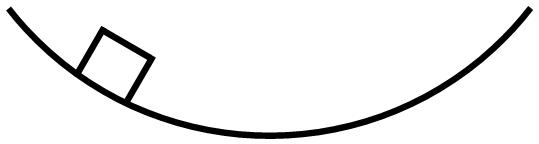
A small block oscillates back and forth on a smooth concave surface of radius R figure. Find the time period of small oscillation.

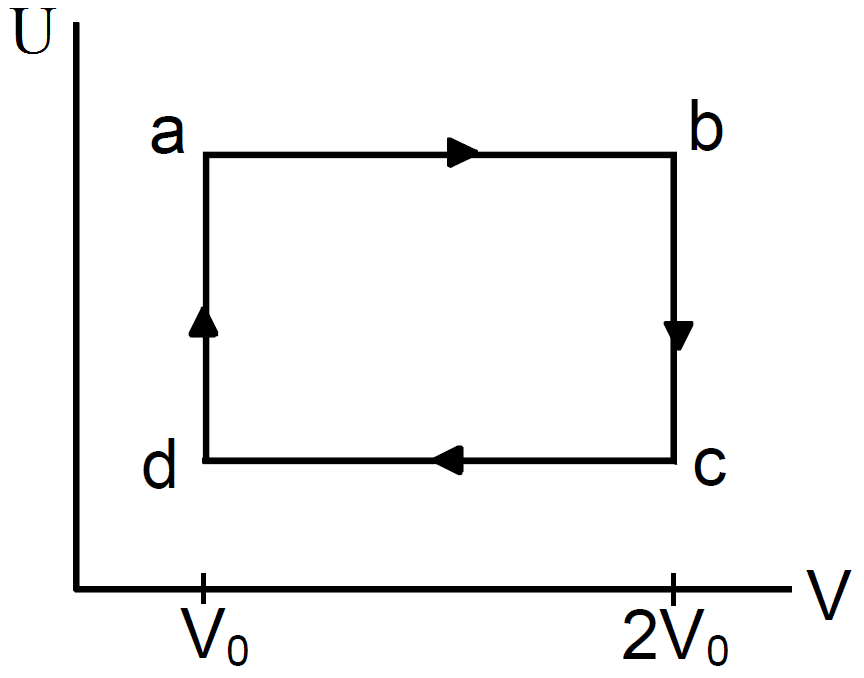
Figure. shows the variation in the internal energy U with the volume V of 2.0mol of an ideal gas in a cyclic process abcda. The temperatures of the gas at b and c are 500K and 300K respectively. Calculate the heat absorbed by the gas during the process.