Question
How is sound perceived by us?

Answer

Sound requires a material medium for its propagation. It is produced when a body vibrates. The vibrations produced at a point are transmitted in the medium (air) from one point to the next and so on in the form of mechanical waves which produce compressions and rarefactions in air. These compressions and rarefactions produce vibrations in the eardrum which are perceived by us as sound.

Need a full question paper?

Generate a complete, print-ready paper with questions like this in minutes — across 16+ boards, with answer keys.

Start Generating Free

Similar questions

What are damped vibrations? How do they differ from free vibrations? Give one example of each.
An electrical appliance having a resistance of 200 Ω is operated at 220 V. calculate the energy consumed by the appliance in 5 minutes in kWh.
What is the equivalent resistance between the points $X$ and $Y$ for the given network?
A prism causes dispersion of white light while a rectangular glass block does not. Explain.
Point out two differences between e.m.f. and potential difference as applied to electric circuits.
What is a total reflecting prism? State three actions that it can produce. Draw a diagram to show one action of the total reflecting prism.
(i) (a) State the laws of refraction of light.
(b) Write a relation between the angle of incidence ( $i$ ), angle of emergence (e), angle of prism ( $A$ ) and angle of deviation (D) for a ray of light passing through an equilateral prism.
(ii) (a) Suggest one way, in each case, by which we can detect the presence of:
1. Infrared radiations
2. Ultraviolet radiations.
(b) Give one use of infrared radiations.
The mechanical advantage of a machine is 5 and its efficiency is $80\%$. It is used to lift a load of 200 kgf to a height of $20 m.$ Calculate:
(i) The effort required, and
(ii) The work done on the machine $(g = 10 ms^{−2}).$
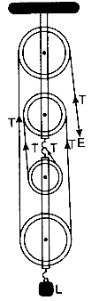
Draw a diagram showing a block and tackle system of 4 pulleys.
Image
(i) State, how many strands of tackle support the load?
(ii) Draw arrows to represent tension in each strand.
(iii) Find the mechanical advantage of the system, stating the assumptions made.
(iv) If the load is pulled up by a distance 1m, how much does the effort end move?