Question
What are damped vibrations? How do they differ from free vibrations? Give one example of each.

Answer

The periodic vibrations of a body of decreasing amplitude in the presence of resistive force are called the damped vibrations.
The amplitude of the free vibrations remains constant and vibrations continue forever. But, the amplitude of damped vibrations decreases with time and ultimately the vibrations ceases.
For eg, When a slim branch of a tree is pulled and then released, it makes damped vibrations.
A tuning fork vibrating in air excute damped vibrations.

Need a full question paper?

Generate a complete, print-ready paper with questions like this in minutes — across 16+ boards, with answer keys.
Start Generating Free

Similar questions

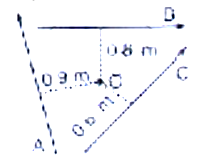
A, B and C are the three forces each of magnitude 4 n acting in the plane of the paper as shown in
Figure. The point O lies in the same plane.

(1) Which force has the least moment about O? Give a reason.
(2) which force has the greatest moment about O? Give a reason.
(3) Name the forces producing (a) Clockwise (b) anticlockwise moments.
(4) what is the resultant torque about the point O?
Give an experiment to verify the principle of moments.
A geyser is rated 1500 W, 250 V. This geyser is connected to 250 V mains. Calculate:

(i) The current drawn,

(ii) The energy consumed in 50 hours, and

(iii) The cost of energy consumed at Rs 4.20 per kWh.
$200 g$ of hot water at $80^\circ C$ is added to $300 g$ of cold water at $10 ^\circ C$. Calculate the final temperature of the mixture of water. Consider the heat taken by the container to be negligible. [specific heat capacity of water is $4200 J kg^{-1} ^\circ C^{-1}]$
How does the action of a convex lens differ from that of a concave lens on a parallel beam of light incident on them? Draw diagram to illustrate your answer.
Draw images in case of a concave lens when the object is at any point on the principal axis between the lens and infinity.
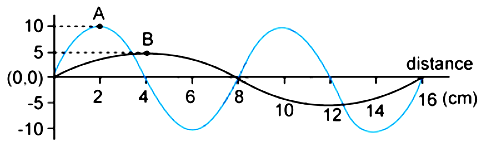
Figure below shows the distance-displacement graph of two waves A and B. Compare (i) the amplitude, (ii) the wavelength of the two waves.

Why do the farmers fill their fields with water on a cold winter night?
A block and tackle system has the velocity ratio 3. Draw a labelled diagram of the system indicating the points of application and the directions of load L and effort E. A man can exert a pull of 200 kgf.
If the effort end moves a distance 60 cm, what distance does the load move?
Shears, used for cutting metals and scissors used for cutting clothes are both examples of levers of the first order. However, whereas the shears always have short blades and long handles, the scissors often have blades much longer than the handles. Explain, why this is so?