Question
How is the equilibrium price determined under perfect competition? Explain with the help of a diagram.

OR

Show the determination of market equilibrium with the help of demand and supply schedules and a diagram.

OR

Explain the process of price determination under perfect competition with the help of a schedule and a diagram.
Answer

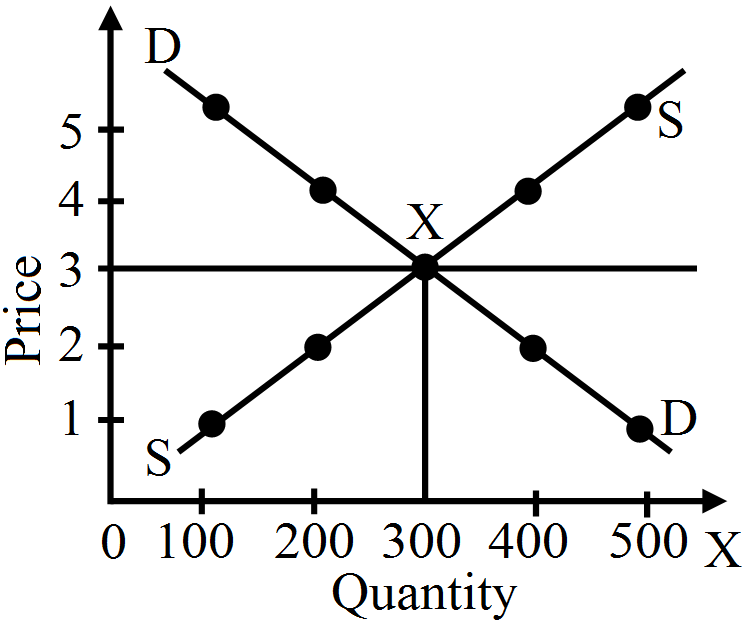
Equilibrium price is determined under perfect competition by the interaction of the forces of demand and supply of a good. It is determined at a point where quantity demanded and quantity supplied of a good are equal. The following schedule and diagram illustrate the determination of equilibrium price:
Price(₹) Demand Supply  
5 100 500  
4 200 400  
3 300 300 Demand = Supply
2 400 200  
1 500 100  

The above table and diagram shows that the given market is in equilibrium at point X in the diagram and the equilibrium price is ₹ 3 and the equilibrium quantity is 300 units.

Need a full question paper?

Generate a complete, print-ready paper with questions like this in minutes — across 16+ boards, with answer keys.

Start Generating Free

Similar questions

Giving reasons, explain how the following are treated in estimating national income:
  1. Wheat grown by a farmer but used entirely for family’s consumption.
  2. Earnings of the shareholders from the sale of shares.
  3. Expenditure by government on providing free education.
Calculate:
  1. Net National Product at market price.
  2. Gross Domestic Product at factor cost.
    (₹ in crores)
(i) Rent and interest 6,000
(ii) Wages and salaries 1,000
(iii) Undistributed profit 400
(iv) Net indirect taxes 100
(v) Subsidies 20
(vi) Corporation tax 120
(vii) Net factor income to abroad 70
(viii) Dividends 80
(ix) Consumption of fixed capital 50
(x) Social securty contribution by employers 200
(xi) Mixed income 1,000
Using marginal cost and marginal revenue approach, find out the level of output at which producer will be in equilibrium. Give reasons for your answer.
Output (Units)123456
Average Revenue (Rs.)202020202020
Total Cost (Rs.)2242607696120
Explain the implications of the following:
  1. Product differentiation in monopolistic competition.
  2. Perfect knowledge in perfect competition.
Given the following data:
S. No.
 
(₹ in crores)
(i)
GDPC.
25,215
(ii)
Net indirect taxes.
1,575
(iii)
Depreciation.
1,000
(iii)
Net factor income from abroad.
40
Calculate:
  1. GDPMP.
  2. GNPMP.
  3. NNMP.
  4. NNPFC.
  5. NDPMP.
  6. NDPFC.
Assuming that 'increase' in investment is Rs. 900 crore and marginal propensity to consume is 0.6, explain the working of multiplier.
Suppose there are three consumers in a particular market: Ashok, Mohan and Jay. Their demand schedules are given in the following table:
Price
Quantity Demanded by Ashok
Quantity Demanded by Mohan
Quantity Demanded by Jay
1
60
55
24
2
50
40
13
3
40
25
5
4
30
10
0
5
20
0
0
  1. Derive the market demand schedule.
  2. Suppose Mohan drops out of the market. Derive the new market demand schedule.
  3. Suppose Mohan stays in the market and another person, Bhim, joins the market, whose quantity demanded at any given price is half of that of Ashok. Derive the new market demand schedule.
Explain the distinction between autonomous and accommodating' transactions in balance of payments. Also explain the concept of balance of payments 'deficit' in this context.
Complete the following table:
Output units
Total cost Rs.
Average variable cost Rs.
Marginal cost Rs.
Average fixed costRs.
0
30


1
---
---
20
---
2
68
---
---
---
3
84
18
---
---
4
---
---
18
---
5
125
19
---
6
State three causes each for a rightward shift and a leftward shift of demand curve.