Question
Explain the meaning of Monopolistic competition with its features.
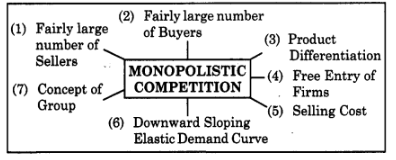
(1) Fairly large number of Sellers : There are large number of sellers selling closely related, but not identical products. There is tough competition among sellers. An individual seller supply is just a small part) of the total supply, so he has limited degree l of control over market supply and price. Each firm (seller) can formulate its own price and output policy independently.
(2) Fairly large number of Buyers: There are large numbers of buyers in a monopolistic competition market. Each buyer enjoys his preference over a particular brand and chooses to buy a specific brand of product. Hence, the buying is by choice and not by chance.
(3) Product Differentiation : The most distinguishing feature of monopolistic competition is that the product produced by different firms are not identical, they are slightly different from each other but they are close substitutes. The product differentiation can be done in different ways like may be in the form of brand names say Raymonds. It can be differentiated in terms of colour, size, design, etc., say soap, mobiles etc., or through sales technique. For e.g. cars, two wheelers, air conditioners, etc.
(4) Free Entry of Firms: A firm is free to enter the market as there are no entry barriers. Similarly there are no restrictions if the firm wants to quit the market. Freedom of entry leads to occurrence of only normal profit in the long run.
(5) Selling Cost : One of the special features of monopolistic competition is the selling cost. Selling costs are those costs, which are incurred by firms to create more and more demand for its products through advertisement, salesmanship, free samples, exhibitions, etc.
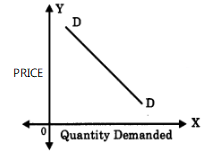
(6) Downward Sloping Elastic Demand Curve : The demand curve faced by each firm is downward sloping and comparatively more elastic. It implies that an individual firm can sell more only by reducing the price.
 (7) Concept of Group : Under monopolistic competition, Prof. E. H. Chamberlin introduced the concept of group in place of Marshallian concept of industry. Industry means a number of firms producing identical products. A group means a number of firms producing differentiated product, which are close substitutes.
Generate a complete, print-ready paper with questions like this in minutes — across 16+ boards, with answer keys.