Question
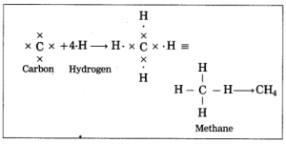
How is the methane molecule formed?
Answer

(1) The electronic configuration of carbon is (2, 4). Carbon has four electrons in the outermost shell, hence it is tetravalent.
(2) The electronic configuration of hydrogen is 1, hence it is monovalent.
(3) Carbon needs four electrons to complete the L shell and attain the configuration of neon (Ne).
(4) Four atoms of hydrogen share 1 electron each with 4 electrons of carbon.
(5) A single covalent bond is formed by sharing of two electrons.
Image

Thus, the methane molecule contains four single bonds between the carbon and hydrogen atoms.

Need a full question paper?

Generate a complete, print-ready paper with questions like this in minutes — across 16+ boards, with answer keys.

Start Generating Free

Similar questions

There are four organisms A, B, C and D. The organism A eats only the flesh of other animals as food. The organism B can eat grains, fruits and vegetables as well as meat and fish. The organism C can make the food itself from simple inorganic substances present in the environment by utilising sunlight energy. On the other hand, organism D eats only plants and their products as food.
  1. Which organism is
  1. Omnivore,
  2. Herbivore,
  3. Carnivore?
  1. Which organism is an autotroph?
  2. Which organism is/ are heterotroph (s)?
  3. Which organism can be a producer?
  4. Which organism is/ are consumer (s)?
Give one example each of organisms which could be like A, B, C and D.
Mendeleev predicted the existence of certain elements not known at that time and named two of them as eka - aluminium, and eka - silicon.
  1. Name the element which has taken the place of $(i)$ eka - aluminium, and $(ii)$ eka - silicon.
  2. Mention the period/ periods of these elements in the modern periodic table.
  3. Write the group/ groups of these elements in the modern periodic table.
  4. Classify these elements as metals, non - metals or metalloids.
  5. How many valence electrons are present in the atoms of each of these elements$?​​​​​​$
Sketch, label and classify the following organisms: Liverfluke.
Explain the application of heating effect of electric current in an electric iron.
A food chain occurring in the sea which provides food for many people can be written as:
phytoplankton → zooplankton → X → Y
  1. Name one phytoplankton.
  2. Name two zooplanktons.
  3. What could be X?
  4. Name the organism which Y could be.
  5. Which organism in the above food chain is a (i) primary consumer, and (ii) tertiary consumer?
Classify the following into herbivores, carnivores and omnivores:
Lion, Man, Dog, Goat, Crow, Elephant, Snake, Hawk, Rabbit, Deer.
The farmers have been cultivating a food plant X for over two thousand years and have produced as many as five entirely different looking vegetables A, B, C, D and E from it.
  1. What could the plant X be?
  2. What are A, B, C, D and E?
  3. What is the process of evolution involved in this example known as?
What are the main uses of coal and petroleum products?
A colourless organic liquid $X$ of molecular formula $C_2H_4O_2$ turns blue litmus to red. Another colourless organic liquid $Y$ of molecular formula $C_3H_6O$ has no action on any litmus but it is used as a nail polish remover. A yet another colourless organic liquid $Z$ of molecular formula $C_2H_6O$ has also no action on litmus but it is used in tincture of iodine.
  1. Name the liquid $X.$ To which homologous series does it belong? Give the name of another member of this homologous series.
  2. Name the liquid $Y.$ To which homologous series does it belong? Write the name of another member of this homologous series.
  3. Can you name an organic compound having the same molecular formula as liquid $Y$ but which belongs to a different homologous series? What is this homologous series?
  4. Name the liquid $Z.$ To which homologous series does it belong? Write the name of another member of this homologous series.
Obtain the mathematical expression for the heat generated in a metallic conductor by electric current (Joule’s law).