Question
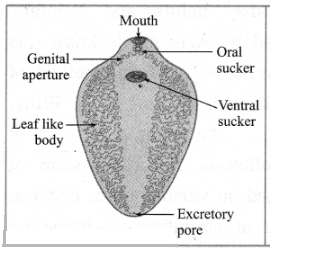
Sketch, label and classify the following organisms: Liverfluke.

Answer


Image
Classification:
Kingdom: Animalia
Division: Non-chordata
Phylum: Platyhelminthes
Example: Liverfluke

Need a full question paper?

Generate a complete, print-ready paper with questions like this in minutes — across 16+ boards, with answer keys.
Start Generating Free

Similar questions

Which are the various ways to minimize stress?
What are fatty acids? What are the different uses of fatty acids ?
You are given three resistances of 1,2 and 3 ohms. Show by diagrams, how with the help of these resistances you can get:
  1. $6\Omega$
  2. $\frac{6}{11}\Omega$
  3. $1.5\Omega$
Write all the capital letters of the alphabet which look the same in a plane mirror.
An element $X$ forms two oxides $XO$ and $XO_2$. The oxide XO has no action on litmus solution but oxide $XO_2$ turns litmus solution red.
  1. What is the nature of oxide $XO?$
  2. What is the nature of oxide $XO_2?$
  3. Would you call element $X$ a metal or a non-metal? Give reason for your choice.
  4. Can you give an example of element like $X?$ 
Write short notes :
Hope's apparatus
Three lenses having powers 2, 2.5 and 1.7 D are kept touching in a row. What is the total power of the lens combination?
How do the following change on going from left to right in a period of the periodic table?
  1. Chemical reactivity of elements.
  2. Nature of oxides of elements Give examples in support of your answer.
 Explain the types of reactions with reference to oxygen and hydrogen. Illustrate with examples.
Answer the following questions
The observations made by Swarali while doing the experiment are given below. Based on these write answers to the questions;
Swarali found that the light ray travelling from the denser medium to rarer medium goes away from the normal. If the angle of incidence (i) is raised by Swarali, the angle of refraction ( $r$ ) went on increasing. However, after certain value of the angle of incidence the light ray is seen to return back into the denser medium.

i. What is the specific value of $\angle i$ called?
ii. What is the process of reflection of incident ray into denser medium called?
iii. Draw the diagrams of three observations made by Swarali.