Question
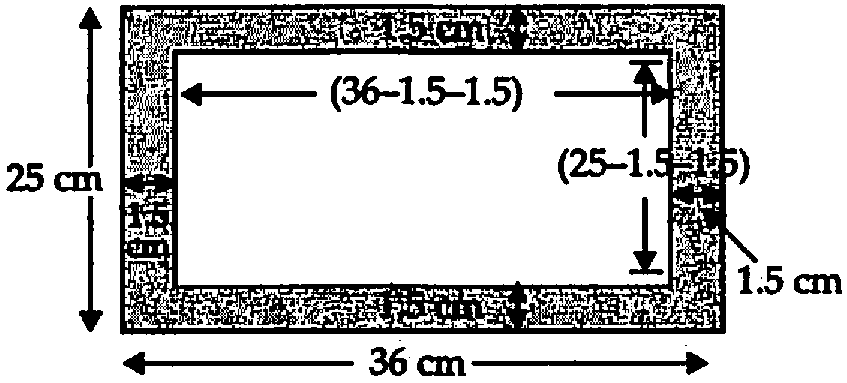
How many cubic centimetres of iron is required to construct an open box whose external dimensions are 36cm, 25cm and 16.5cm provided the thickness of the iron is 1.5cm. If one cubic cm of iron weighs 7.5g, find the weight of the box.

Answer

External dimenesions Internal dimenesions
$l_2 = 39cm$ $l_1 = 36 - 1.5 - 1.5 = 36 - 3 = 33cm$
$b_2 = 25cm$ $b_1 = 25 - 3 = 22cm$
$h_2 = 16.5cm$ $h_1 = 16.5 - 15 = 15cm$
hi
Volume of iron in the open box
$= l_2b_2h_2 - l_1b_1h_1$
$= (36 \times 25 \times 16.5) - (33 \times 22 \times 15)$
⇒ Volume of iron in the open box
$=9\times5\times11\Big[\frac{4\times5\times15}{10}-22\Big]$
$=45\times11[30-22]=495\times8=3960\text{cm}^3$
Volume of iron is $3960cm^3.$
So, $3960cm^3$​​​​​​​ of iron will weigh $\frac{3960\times75}{10}=396\times75\text{gm}$
$=\frac{396\times75}{1000}\text{kg}=\frac{297}{10}\text{kg}$
Hence, the weight of the box = 29.7kg.

Need a full question paper?

Generate a complete, print-ready paper with questions like this in minutes — across 16+ boards, with answer keys.
Start Generating Free

Similar questions

From a point P, two tangents PA and PB are drawn to a circle with centre O. If OP = diameter of the circle, show that $\triangle\text{APB}$ is equilateral.
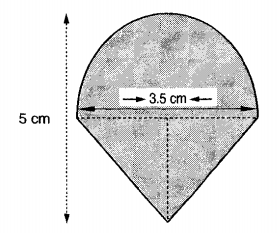
Rasheed got a playing top (lattu) as his birthday present, which surprisingly had no colour on it. He wanted to colour it with his crayons. The top is shaped like a cone surmounted by a hemisphere. The entire top is 5 cm in height and the diameter of the top is 3.5 cm. Find the area he has to colour. (Take $\pi = \frac {22}7$).
If $x =-4$ is a root of the equation $x^2+2 x+4 p=0$, find the values of k for which the equation $x ^2+ px (1+3 k )+$ $7(3+2 k)=0$ has equal roots.
Solve for x and y:
$a^2x + b^2y = c^2,$
$b^2x + a^2y = d^2$​​​​​​​
Prove the following identities:
$\frac{\sec\theta-\tan\theta}{\sec\theta+\tan\theta}=\frac{\cos^2\theta}{(1+\sin\theta)^2}$
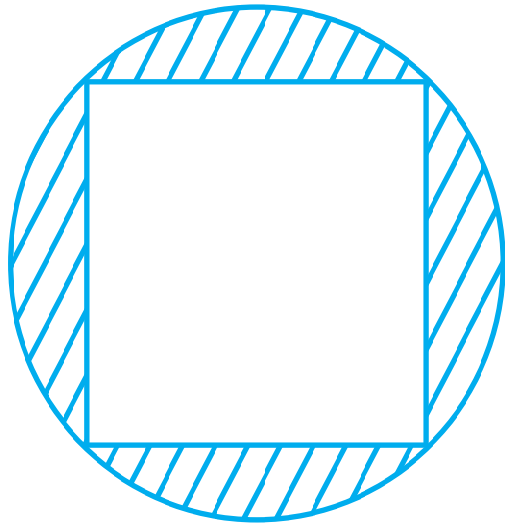
In Fig, a square of diagonal 8cm is inscribed in a circle. Find the area of the shaded region.
Draw a circle of radius 3cm. From a point P, 7cm away from the centre of the circle, draw two tangents to the circle. Also, measure the lengths of the tangents.
Solve the following quadratic equation:
$\frac{\text{x}-4}{\text{x}-5}+\frac{\text{x}-6}{\text{x}-7}=3\frac{1}{3},$ $\text{x}\neq5,7$

A fraction becomes $\frac { 9 } { 11 }$ if 2 is added to both numerator and denominator. If 3 is added to both numerator and denominator it becomes $ \frac { 5 } { 6 }$. Find the fraction by substitution method.

Prove that the points (-2, 5), (0, 1) and (2, -3) are collinear.