Questions

5 Marks Questions

Take a timed test

21 questions · self-marked practice — reveal the answer and mark yourself.

Question 15 Marks
Water flows at the rate of 10m/ minute through a cylindrical pipe 5mm in diameter. How long would it take to fill a conical vessel whose diameter at the base is 40cm and depth 24cm?
Answer
When a fluid (water) flows through a pipe of area of cross-section A with velocity $\upsilon,$ then volume of water coming from pipe in time t = Area of cross-section × Length $=\text{A}\times\upsilon.\text{t}$ $[\because\text{V}=\text{Area of base}\times\text{Height}]$Cylinder:
$\text{A}=\pi\text{r}^2$
$\text{r}=\frac{5\text{mm}}{2}=\frac{5}{2000}\text{m}$ $\text{r}=\frac{1}{400}\text{m}$Cone:
$\text{R}=\frac{40}{2}\text{cm}=0.2\text{m}$ $\text{H}=24\text{cm}=0.24\text{m}$ $\Rightarrow\ \upsilon=\frac{10}{60}\text{m/s}=\frac{1}{6}\text{m/s}$ $\therefore$ Volume of flowing water = Volume of cone ⇒ Area of base × height (dist.) $=\frac{1}{3}\pi\text{R}^2\text{H}$ $\Rightarrow\ \ \text{A}\times\upsilon.\text{t}=\frac{1}{3}\pi\text{R}^2\text{H}$ $\Rightarrow\ \ \pi\text{r}^2.\upsilon.\text{t}=\frac{1}{3}\pi\text{R}^2\text{H}$ $\Rightarrow\ \ \text{r}^2.\upsilon.\text{t}=\frac{1}{3}\text{R}^2\text{H}$ $\Rightarrow\ \ \frac{1}{400}\times\frac{1}{400}\times\frac{1}{6}\text{t}$ $=\frac{1}{3}\times0.2\times0.2\times0.24$ $\Rightarrow\ \ \text{t}=\frac{2\times2\times24\times400\times400\times6}{3\times10000}$ $\Rightarrow\ \ \text{t}=4\times24\times4\times4\times2\sec$ $=\frac{4\times24\times4\times4\times2}{60}\min=\frac{512}{10}=51.2\min$ $=51\min+0.2\min=51\min+0.2\times60\sec$ $\Rightarrow\ \ \text{t}=51\min\text{ and }12\sec.$ Hence, conical tank will fill in 51 min and 12 sec.
View full question & answer
Question 25 Marks
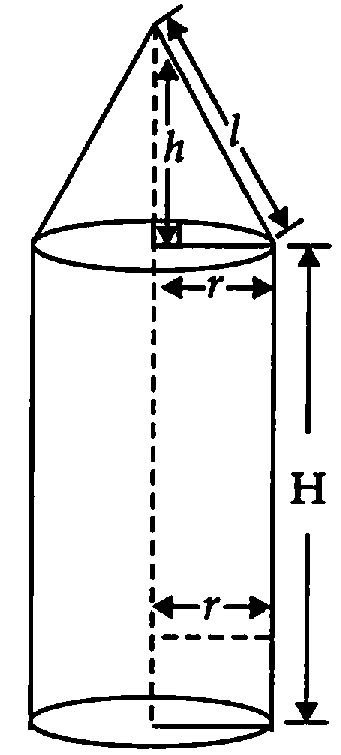
A rocket is in the form of a right circular cylinder closed at the lower end and surmounted by a cone with the same radius as that of the cylinder. The diameter and height of the cylinder are 6cm and 12cm, respectively. If the the slant height of the conical portion is 5cm, find the total surface area and volume of the rocket $[\text{Use }\pi=3.14].$
Answer
Cylinder:$\text{r}=\frac{6}{2}=3\text{cm}$
H = 12cm
$\therefore$ $l^2 = r^2 + h^2 or h^2 = l^2 - r^2$
Cone:
r = 3cm
l = 5cm
$= 5^2 - 3^2 = 25 - 9$
$\Rightarrow\ \ \text{h}=\sqrt{16}=4\text{cm}$
Now, Volume of rocket = Volume of cylinder + Volume of cone
$=\pi\text{r}^2\text{H}+\frac{1}{3}\pi\text{r}^2\text{h}=\pi\text{r}^2\Big[\text{H}+\frac{1}{3}\text{h}\Big]$
$=3.14\times3\times3\Big[12+\frac{1}{3}\times4\Big]$
$=3.14\times9\Big[\frac{40}{3}\Big]=3.14\times3\times40=376.8\text{cm}^3$
$\therefore$ Volume of Rocket $= 376.8cm^3​​​​​​​$​​​​​​​
Total surface area of rocket = Curved surface area of cylinder + Curved surface area of cone + Area of base of cylinder

[As it is closed (Given)]
$=2\pi\text{rH}+\pi\text{rl}+\pi\text{r}^2=\pi\text{r}[2\text{H}+\text{l}+\text{r}]$
$=3.14\times3[2\times12+5+3]$ $=3.14\times3\times32=301.44\text{cm}^2$
Hence, the surface area of rocket is $301.44cm^2.$
View full question & answer
Question 35 Marks
The barrel of a fountain pen, cylindrical in shape, is 7cm long and 5mm in diameter. A full barrel of ink in the pen is used up on writing 3300 words on an average. How many words can be written in a bottle of ink containing one fifth of a litre?
Answer
Let n times the barrel of pen is filled.
Radius of barrel, $\text{r}=\frac{5\text{mm}}{2}=\frac{5}{20}=\frac{1}{4}\text{cm}$
Height of barrel, h = 7cm
$\therefore$ n × Volume of barrel = Volume of Ink
$\Rightarrow\ \ \text{n}\times\pi\text{r}^2\text{h}=\frac{1}{5}\times\text{one litre}$
$\Rightarrow\ \ \text{n }\pi\text{r}^2\text{h}=\frac{1}{5}\times1000\text{cm}^3$
$\Rightarrow\ \ \text{n}\times\frac{22}{7}\times\frac{1}{4}\times\frac{1}{4}\times7=200\text{cm}^3$
$\Rightarrow\ \ \text{n}=\frac{200\times7\times4\times4}{22\times7}=\frac{1600}{11}$
Ink in one full barrel can write words = 3300
So, n barrels can write words = 3300n
$=3300\times\frac{1600}{11}=4,80,000$
Hence, the required number of words = 4,80,000 words.
View full question & answer
Question 45 Marks
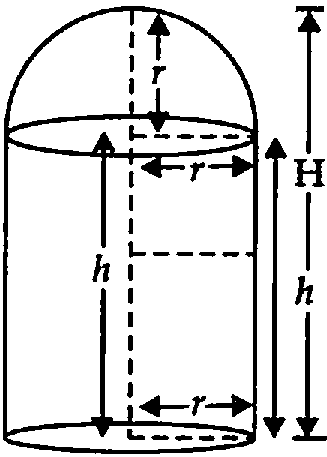
A building is in the form of a cylinder surmounted by a hemispherical vaulted dome and contains $41\frac{19}{21}\text{m}^3$ of air. If the internal diameter of dome is equal to its total height above the floor, find the height of the building?
Answer

Dome (hemisphere):
Radius = r
Cylinder:
Radius = r
H = 2r [given]
⇒ h + r = 2r
⇒ h = 2r - r = r
Volume of building $=41\frac{19}{21}=\frac{880}{21}\text{m}^3$
⇒ Volume of cylinder + Volume of hemisphere $=\frac{880}{21}\text{m}^3$
$\Rightarrow\ \ \pi\text{r}^2\text{h}+\frac{2}{3}\pi\text{r}^3=\frac{880}{21}$
$\Rightarrow\ \ \pi\text{r}^2\text{r}+\frac{2}{3}\pi\text{r}^3=\frac{880}{21}$ $[\because\text{h}=\text{r}]$
$\Rightarrow\ \ \frac{5}{3}\pi\text{r}^3=\frac{880}{21}$ $\Rightarrow\ \frac{5}3{}\times\frac{22}{7}\times\text{r}^3=\frac{880}{21}$
$\Rightarrow\ \ \text{r}^3=\frac{880\times3\times7}{21\times5\times22}\ \Rightarrow\ \text{r}^3=8$
$\Rightarrow\ \ \text{r}=2\text{m}$
Hence, height of the building is 2 × 2 = 4m. $[\because\text{H}=2\text{r (Given)}]$
View full question & answer
Question 55 Marks
Find the number of metallic circular disc with 1.5cm base diameter and of height 0.2cm to be melted to form a right circular cylinder of height 10cm and diameter 4.5cm.
Answer
Given that, lots of metallic circular disc to be melthed to form right circular cylinder. Here, a circular disc work as a circular cylinder.
Base diameter of metallic circular disc = 1.5cm
$\therefore$ Radius of metallic circular dise $=\frac{1.5}{2}\text{cm}$ $[\because\text{diameter}=2\times\text{radius}]$
and height of metallic circular disc i.e., = 0.2cm
$\therefore$ Volume of a circular disc $=\pi\times(\text{Radius})^2\times\text{Height}$
$=\pi\times\Big(\frac{1.5}{2}\Big)^2\times0.2$
$=\frac{\pi}{4}\times1.5\times1.5\times0.2$
Now, height of a right circular cylinder (h) = 10cm
and diameter of a right circular cylinder = 4.5cm
⇒ Radius of a right circular cylinder $(\text{r})=\frac{4.5}{2}\text{cm}$
$\therefore$ Volume of right circular cylinder $=\pi\text{r}^2\text{h}$
$=\pi\Big(\frac{4.5}{2}\Big)^2\times10=\frac{\pi}{4}\times4.5\times4.5\times10$
$\therefore$ Number of metallic circular disc $=\frac{\text{Volume of a right circular cylinder}}{\text{Volume of a metallic circular disc}}$
$=\frac{\frac{\pi}{4}\times4.5\times4.5\times10}{\frac{\pi}{4}\times1.5\times1.5\times0.2}$
$\frac{3\times3\times10}{0.2}=\frac{900}{2}=450$
Hence, the required number of metallic circular disc is 450.
View full question & answer
Question 65 Marks
A heap of rice is in the form of a cone of diameter 9m and height 3.5m. Find the volume of the rice. How much canvas cloth is required to just cover the heap?
Answer
Heap of rice is in shape of cone, so
$\text{r}=\frac{9}{2}\text{m}=4.5\text{m}$
$\text{h}=3.5\text{m}$
$\therefore\ \ \text{V}=\frac{1}{3}\pi\text{r}^2\text{h}=\frac{1}{3}\times\frac{22}{7}\times\frac{9}{2}\times\frac{9}{2}\times3.5$
$\Rightarrow\ \ \text{V}=\frac{22\times9\times9\times35}{3\times7\times2\times2\times10}=\frac{33\times9}{4}=\frac{297}{4}$
$\Rightarrow\ \ \text{V}=74.25\text{m}^3$
Hence, volume of rice $= 74.25m^3.$
For canvas:
Area of canvas = Curved surface area of cone
$=\pi\text{rl}$
But, $\text{l}^2=\text{r}^2+\text{h}^2=(4.5)^2+(3.5)^2=20.25+12.25$
$\Rightarrow\ \ \text{l}^2=32.50$
$\Rightarrow\ \ \text{l}=\sqrt{32.5}=5.7\text{m}$
$\therefore$ Area of canvas $=\frac{22}{7}\times4.5\times5.7=80.614$
⇒ Area of canvas $= 80.61m^2.$
View full question & answer
Question 75 Marks
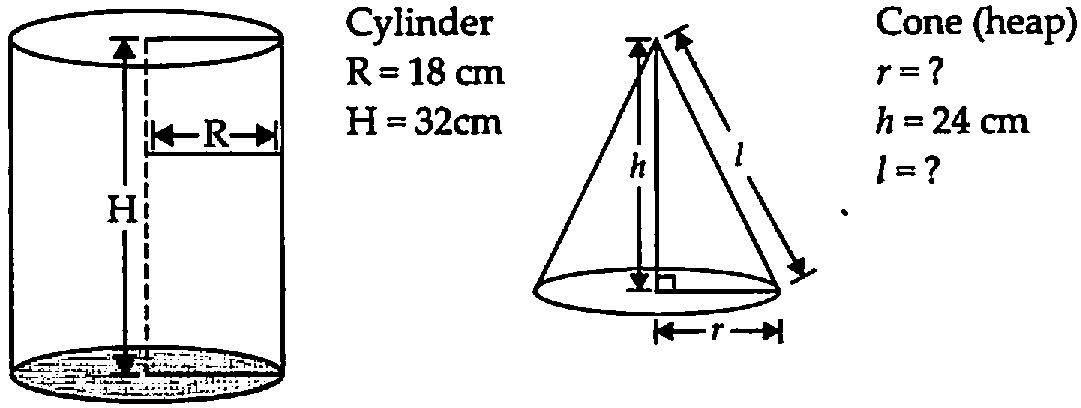
A cylindrical bucket of height 32cm and base radius 18cm is filled with sand. This bucket is emptied on the ground and a conical heap of sand is formed. If the height of the conical heap is 24cm, find the radius and slant height of the heap.
Answer
By identifying the shapes, we have cone and cylinder. On reshaping from cylindrical to conical, the volume of sand emptied out remains same.
$\therefore$ Volume of conical heap = Volume of cylinder $\Rightarrow\ \ \frac{1}{3}\pi\text{r}^2\text{h}=\pi\text{R}^2\text{H}$ $\Rightarrow\ \ \frac{1}{3}\text{r}^2\text{h}=\text{R}^2\text{H}$ $\Rightarrow\ \ \text{r}^2=\frac{3\text{R}^2\text{H}}{\text{h}}=\frac{3\times18\times18\times32}{24}$ $\Rightarrow\ \ \text{r}^2=18\times18\times2\times2$ $\Rightarrow\ \ \text{r}=18\times2\text{cm}=36\text{cm}$ Radius of conical heap is 36cm. Now, $\text{l}^2=\text{r}^2+\text{h}^2=36\times36+24\times24$ $\Rightarrow\ \ \text{l}^2=4\times4[9\times9+6\times6]$ $=4\times4[81+36]=4\times4\times114$ $\Rightarrow\ \ \text{l}=\sqrt{4\times4\times3\times3\times13}=4\times3\sqrt{13}$ $\Rightarrow\ \ \text{l}=12\sqrt{13}=12\times3.60555$ $\Rightarrow\ \ \text{l}=43.2666\text{cm}$ Hence, radius and slant height are 36cm and 43.2666cm respectively.
View full question & answer
Question 85 Marks
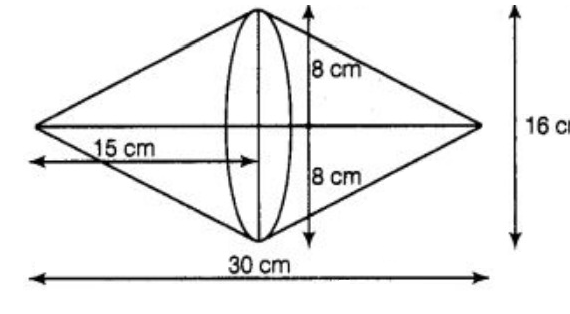
Two cones with same base radius 8cm and height 15cm are joined together along their bases. Find the surface area of the shape so formed.
Answer
If two cones with same base and height are joined together along their bases, then the shape so formed is look like as figure shown.

Given that, radius of cone, r = 8cm and height of cone, h = 15cm So, surface area of the shape so formed = Curved area of first cone + Curved surface area of second cone = 2.Surface area of cone [since, both cones are identical] $=2\times\pi\text{rl}=2\times\pi\times\text{r}\times\sqrt{\text{r}^2+\text{h}^2}$ $=2\times\frac{22}{7}\times8\times\sqrt{(8)^2+(15)^2}$ $=\frac{2\times22\times8\times\sqrt{64+225}}{7}$ $=\frac{44\times8\times\sqrt{289}}{7}$ $=\frac{44\times8\times17}{7}$ $=\frac{5984}{7}=854.85\text{cm}^2$ $=855\text{cm}^2\ (\text{approx})$ Hence, the surface area of shape so formed is $855cm^2.$
View full question & answer
Question 95 Marks
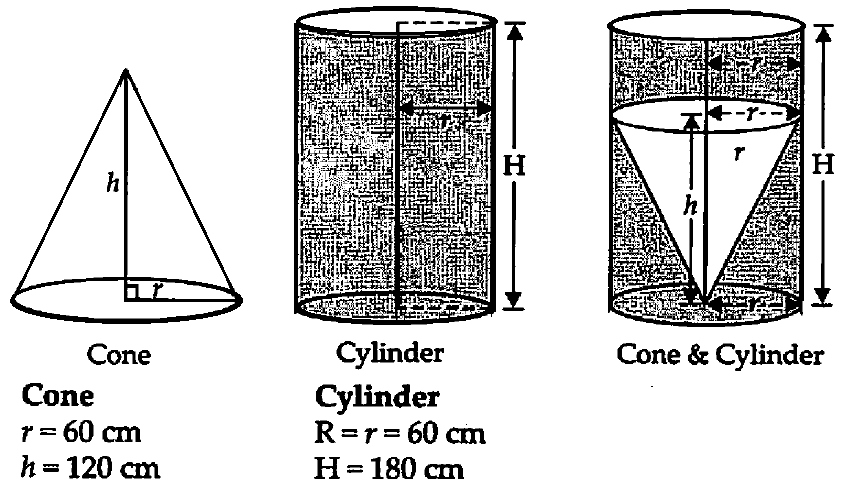
A solid right circular cone of height 120cm and radius 60cm is placed in a right circular cylinder full of water of height 180cm such that it touches the bottom. Find the volume of water left in the cylinder, if the radius of the cylinder is equal to the radius of the cone.
Answer


Cone is placed inside the cylindrical vessel full of water.
So, the volume of water from cylinder will over flow equal to the volume of cone.
Hence, the water left in cylinder = Volume of cylinder - Volume of cone (i)
Volume of water left after immersing the cone into cylinder full of water = Volume of cylider - Volume of cone
$=\pi\text{R}^2\text{H}-\frac{1}{3}\pi\text{r}^2\text{h}$
$\therefore$ Required volume of water in cylinder
$=\pi\text{r}^2\text{H}-\frac{1}{3}\pi\text{r}^2\text{h}$ $[\because\text{R}=\text{r}]$
$=\pi\text{r}^2\Big[\text{H}-\frac{1}{3}\text{h}\Big]$ $=\frac{22}{7}\times60\times60\Big[180-\frac{120}{3}\Big]$
$=\frac{22}{7}\times60\times60\times140\text{cm}^3$
$=\frac{22\times60\times60\times140}{7\times100\times100\times100}=\frac{22\times72}{1000}=\frac{1584}{1000}$
$\therefore$ Volume of water in cylinder $= 1.584m^3$​​​​​​​
Hence, required volume of water left $= 1.584m^3.$
View full question & answer
Question 105 Marks
How many spherical lead shots of diameter 4cm can be made out of a solid cube of lead whose edge measures 44m.
Answer
Given that, lots of spherical lead shots made out of a solid cube of lead.
$\therefore$ Number of spherical lead shots $=\frac{\text{Volume of a solid cube of lead}}{\text{Volume of a spherical lead shot}}\ \ \dots(\text{i})$
Given that, diameter of a spherical lead shot i.e., sphere = 4cm
⇒ Radius of a spherical lead shot $(\text{r})=\frac{4}{2}$
$\text{r}=2\text{cm}$ $[\because\text{diameter}=2\times\text{radius}]$
So, volume of a spherical lead shot i.e., sphere
$=\frac{4}{3}\pi\text{r}^3$
$=\frac{4}{3}\times\frac{22}{7}\times(2)^3$
$=\frac{4\times22\times8}{21}\text{cm}^3$
Now, since edge of a solid cude (a) = 44cm
So, volume of a solid cude $= (a)^3 = (44)^3 = 44 \times 44 \times 44cm^3$​​​​​​​
From Eq. (i),
Number of spherical lead shots $=\frac{44\times44\times44}{4\times21\times8}\times21$
$= 11 \times 21 \times 11 = 121 \times 21$
$= 2541$
Hence, the required number of spherical lead shots is 2541.
View full question & answer
Question 115 Marks
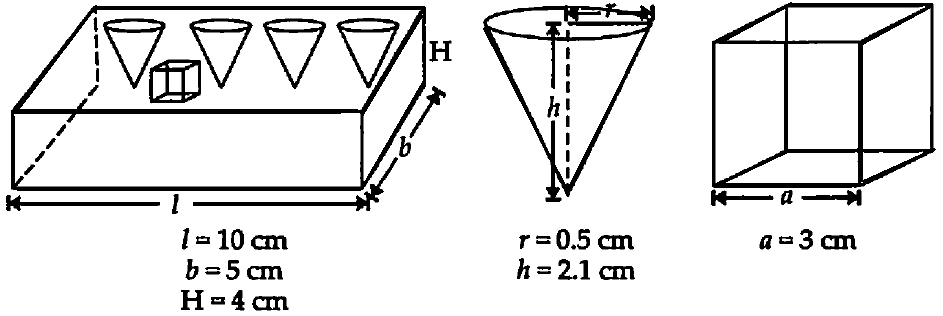
A pen stand made of wood is in the shape of a cuboid with four conical depressions and a cubical depression to hold the pens and pins, respectively. The dimension of the cuboid are 10cm, 5cm and 4cm. The radius of each of the conical depressions is 0.5cm and the depth is 2.1cm. The edge of the cubical depression is 3cm. Find the volume of the wood in the entire stand.
Answer
From a cuboidal piece of wood, depressions (4 cones and 1 cube) are made. So, the volume of wood = Volume of cuboid - Volume of 4 cones - Volume of 1 cube

Hence, the volume of the wood in the entire pen stand $=\text{l}\times\text{b}\times\text{h}-\Big(\frac{1}{3}\pi\text{r}^2\text{h}\Big)\times4-\text{a}^3$ $=10\times5\times4-\frac{4}{3}\times\frac{22}{7}\times\frac{5\times5\times21}{1000}-(3)^3$ $=200-\frac{11\times5\times4}{100}-27=200-2.20-27$ $=200-29.2=170.8\text{cm}^3$ So, the volume of the wood in the pen stand after making depressions is $170.8cm^3.$
View full question & answer
Question 125 Marks
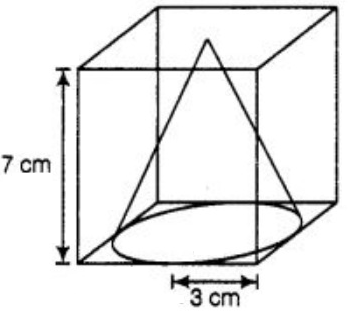
From a solid cube of side 7cm, a conical cavity of height 7cm and radius 3cm is hollowed out. Find the volume of the remaining solid.
Answer
Given that, side of a solid cude (a) = 7cm Height of conical cavity i.e., cone, h = 7cm

Since, the height of conical cavity and the side of cube is equal that means the conical cavity fit vertically in the cube. Radius of conical cavitu
i.e., cone, r = 3cm
⇒ Diameter = 2 × r = 2 × 3 = 6cm
Since, the diameter is less than the side of a cube that means the base of a conical cavity is not fit inhorizontal face of cube.
Now, volum of cube $= (side)^3 = a^3 = (7)^3 = 343cm^3$​​​​​​​ and volume of conical caviity
i.e., cone $=\frac{1}{3}\pi\times\text{r}^2\times\text{h}$
$=\frac{1}{3}\times\frac{22}{7}\times3\times3\times7$
$=66\text{cm}^3$
$\therefore$ Volume of remaining solid = Volume of cube - Volume of conical cavity $= 343 - 66 = 277cm^3​​​​​​​$​​​​​​​
Hence, the required volume of solid is $277cm^3.$
View full question & answer
Question 135 Marks
How many spherical lead shots each of diameter 4.2cm can be obtained from a solid rectangular lead piece with dimensions 66cm, 42cm and 21cm.
Answer
Given that, lots of spherical lead shots made from a solid rectangular lead piece.
$\therefore$ Number of spherical lead shots $=\frac{\text{Volume of solid rectangular lead piece}}{\text{Volume of a spherical lead shot}}\ \ \dots(\text{i})$
Also, given that diameter of a spherical lead shot i.e., sphere = 4.2cm
$\therefore$ Radius of a spherical lead shot, $\text{r}=\frac{42}{2}=2.1\text{cm}\ \ \Big[\because\text{radius}=\frac{1}{2}\text{diameter}\Big]$
So, volume of a spherical lead shot i.e., sphere
$=\frac{4}{3}\pi\text{r}^3$
$=\frac{4}{3}\times\frac{22}{7}\times(2.1)^3$
$=\frac{4}{3}\times\frac{22}{7}\times2.1\times2.1\times21$
$=\frac{4\times22\times21\times21\times21}{3\times7\times1000}$
Now, length of rectangular lead piece, l = 66cm
Breadth of rectangular lead piece, b = 42cm
Height of rectagular lead piece, h = 21cm
$\therefore$ Volume of a solid rectangular lead piece i.e., cuboid = l × b × h = 66 × 42 × 21
From Eq. (i),
Number of spherical lead shots $=\frac{66\times42\times21}{4\times22\times21\times21\times21}\times3\times7\times1000$
$=\frac{3\times22\times21\times2\times21\times21\times1000}{4\times22\times21\times21\times21}$
$=3\times2\times250$
$=6\times250=1500$
Hence, the required number of special lead shots is 1500.
View full question & answer
Question 145 Marks
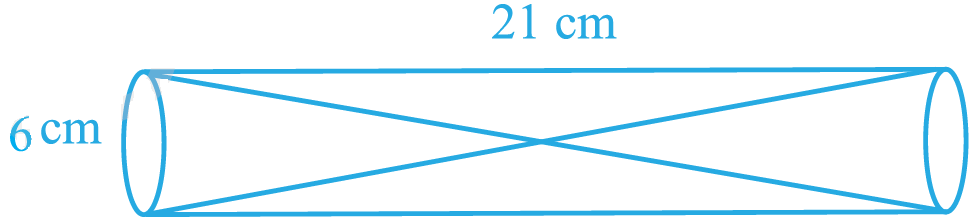
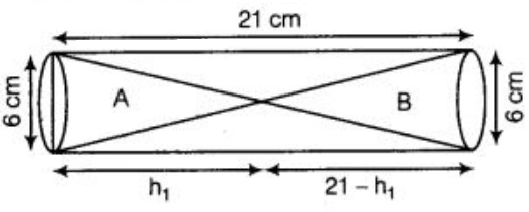
Two solid cones A and B are placed in a cylinderical tube as shown in the Fig. The ratio of their capacities are 2 : 1. Find the heights and capacities of cones. Also, find the volume of the remaining portion of the cylinder.
Answer
Let volume of cone A be 2 V and volume of cone B be V . Again, let height of the cone $A = h _1 cm$, then height of cone $B =(21$ $h _1$ )cm

Given, diameter of the cone = 6cm
$\therefore$ Radius of the cone
$=\frac{6}{2}=3\text{cm}$
Now, volume of the cone,
$\text{A}=2\text{V}=\frac{1}{3}\pi\text{r}^2\text{h}=\frac{1}{3}\pi(3)^2\text{h}_1$
$\Rightarrow\ \ \text{V}=\frac{1}{6}\pi\ 9\text{h}_1=\frac{3}{2}\text{h}_1\pi\ \ \dots(\text{i})$ and volume of the cone,
$\text{B}=\text{V}=\frac{1}{3}\pi(3)^2(21-\text{h}_1)=3\pi(21-\text{h}_1)\ \ \dots(\text{ii})$ From Eqs. (i) and (ii), $\frac{3}{2}\text{h}_1\pi=3\pi(21-\text{h}_1)$
$\Rightarrow\ \ \text{h}_1=2(21-\text{h}_1)$
$\Rightarrow\ \ 3\text{h}_1=42$
$\Rightarrow\ \ \text{h}_1=\frac{42}{3}=14\text{cm}$
$\therefore$ Height of cone, $B = 21 - h_1 = 21 - 14 = 7cm$
Now, volume of the cone, $\text{A}=3\times14\times\frac{22}{7}=132\text{cm}^3$ [using Eq. (i)] and volume of the cone,
$\text{B}=\frac{1}{3}\times\frac{22}{7}\times9\times7=66\text{cm}^3$ [using Eq. (ii)]
Now, volum of the cylinder $=\pi\text{r}^2\text{h}=\frac{22}{7}(3)^2\times21=594\text{cm}^3$
$\therefore$ Required volume of the remaining portion = Volume of the cylinder - (Volume of cone A + Volume of cone B)
$= 594 - (132 + 66) = 396cm^3.$
View full question & answer
Question 155 Marks
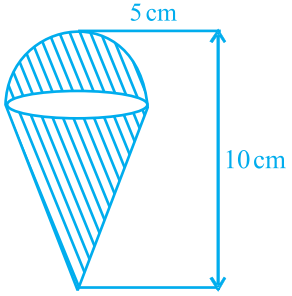
An ice cream cone full of ice cream having radius 5cm and height 10cm as shown in the Fig. Calculate the volume of ice cream, provided that its $\frac{1}{6}$ part is left unfilled with ice cream.
Answer
Given, ice-cream cone is the combination of a hemisphere and a cone.
Also, radius of hemisphere = 5cm
$\therefore$ Volume of hemisphere $=\frac{2}{3}\pi\text{r}^3=\frac{2}{3}\times\frac{22}{7}\times(5)^3$
$=\frac{5500}{21}=261.90\text{cm}^3$
Now, radius of the cone = 5cm
and height of the cone = 10 - 5 = 5cm
$\therefore$ Volume of the cone $=\frac{1}{3}\pi\text{r}^2\text{h}$
$=\frac{1}{3}\times\frac{22}{7}\times(5)^2\times5$
$=\frac{2750}{21}=130.95\text{cm}^3$
Now, total volum of ice-cream cone $= 261.90 + 130.95 = 392.85cm^3$​​​​​​​
Sinec, $\frac{1}{6}$ part is left unfilled with ice-cream.
$\therefore$ Required volume of ice-cream $=392.85-392.85\times\frac{1}{6}=392.85-65.475$
$=327.4\text{cm}^3.$
View full question & answer
Question 165 Marks
A wall 24m long, 0.4m thick and 6m high is constructed with the bricks each of dimensions 25cm × 16cm × 10cm. If the mortar occupies $\frac{1}{10}\text{th}$ of the volume of the wall, then find the number of bricks used in constructing the wall.
Answer
Given that, a wall is construted with the help of bricks and mortar.
$\therefore\ \ \text{Number of bricks}=\frac{(\text{Volume of wall})-\Big(\frac{1}{10}\text{th volume of wall}\Big)}{\text{Volume of a brick}}\ \ \dots(\text{i})$
Also, given that
Length of a wall (l) = 24m,
Thickness of a wall (b) = 0.4m,
Height of a wall (h) = 6m
So, volume of a wall constructed with the bricks = l × b × h
$=24\times0.4\times6=\frac{24\times4\times6}{10}\text{m}^3$
Now, $\frac{1}{110}\text{th}$ volume of a wall $=\frac{1}{10}\times\frac{24\times4\times6}{10}=\frac{24\times4\times6}{10^2}\text{m}^3$
and Length of a brick $(\text{I}_1)=25\text{cm}=\frac{25}{100}\text{m}$
Breadth of a brick $(\text{b}_1)=16\text{cm}=\frac{16}{100}\text{m}$
Height of a brick $(\text{h}_1)=10\text{cm}=\frac{10}{100}\text{m}$
So, volume of a brick $=\text{l}_1\times\text{b}_1\times\text{h}_1$
$=\frac{25}{100}\times\frac{16}{100}\times\frac{10}{100}=\frac{25\times16}{10^5}\text{m}^3$
From Eq. (i),
Number of bricks $=\frac{\Big(\frac{25\times4\times6}{10}-\frac{24\times4\times6}{100}\Big)}{\Big(\frac{25\times16}{10^5}\Big)}$
$=\frac{24\times4\times6}{100}\times9\times\frac{10^5}{25\times16}$
$=\frac{24\times4\times6\times9\times1000}{25\times16}$
$=24\times6\times9\times10=12960$
Hence, the required number used in constructing the wall is 12960.
View full question & answer
Question 175 Marks
Water flows through a cylindrical pipe, whose inner radius is 1cm, at the rate of 80cm/ sec in an empty cylindrical tank, the radius of whose base is 40cm. What is the rise of water level in tank in half an hour?
Answer
Main concept: Volume of flowing water $\text{A}.\upsilon.\text{t}$ Area of base = A = Area of cross-section of flowing water height = distance = speed × time $\upsilon.\text{t}$ Flowing water is filled in cylindrical tank. Hence, the volume of flowing water is equal to volume of water in cylindrcical tank.Flowing water:
$\text{A}=\pi\text{r}^2(\text{cylinder})$ $​​\upsilon=80\text{cm/s}$Cylinder:
R = 40cm H = x $\text{r}=1\text{cm and t}=\frac{1}{2}\text{hr}=\frac{1}{2}\times3600\sec=1800\sec$ $\therefore$ Volume of water in cylindrical tank = Volume of flowing water $\Rightarrow\ \ \pi\text{R}^2\text{H}=\text{A}.\upsilon.\text{t}$ $\Rightarrow\ \ \pi\text{R}^2\text{H}=\pi\text{r}^2\upsilon.\text{t}$ $\Rightarrow\ \ 40\times40\times\text{x}=1\times1\times80\times1800$ $\Rightarrow\ \ \text{x}=\frac{80\times1800}{40\times40}=5\times18=90\text{cm}$ Hence, the rise of water level in cylindrical tank is 90cm.
View full question & answer
Question 185 Marks
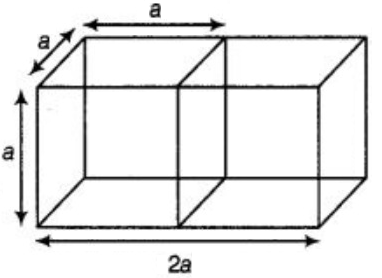
Two identical cubes each of volume $64cm^3 $are joined together end to end. What is the surface area of the resulting cuboid?
Answer
Let the length of side of a cube = a cm
Given, volume of the cube, $a^3 = 64cm^3$​​​​​​​
⇒ a = 4cm On joining two cubes,
we get a cuboid whose length, l = 2a cm breadth, b = a cm and height, h = a cm
Now, surface area of the resulting cuboid = 2(lb + bh + hl)
$= 2(2a.a + a.a + a.2a)$
$= 2(2a^2 + a^2 + 2a^2)$
$= 2(5a^2)$
$= 10a^2$
$= 10(4)^2$
$​​​​​​​= 160cm^2​​​​​​​$​​​​​​​
View full question & answer
Question 195 Marks
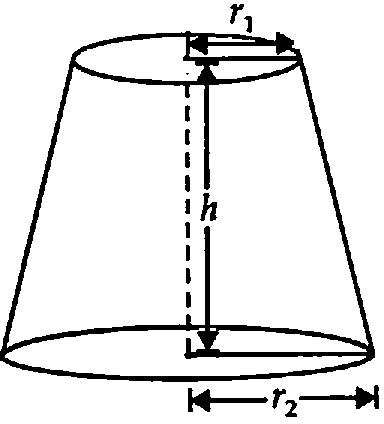
A milk container of height 16cm is made of metal sheet in the form of a frustum of a cone with radii of its lower and upper ends as 8cm and 20cm respectively. Find the cost of milk at the rate of Rs. 22 per litre which the container can hold.
Answer
Here, $r_1 = 8cm r_2 = 20cm h = 16cm$
$\therefore$ Volume of milk = Volume of frustrum as it is filles completely
$=\frac{1}{3}\pi\text{h}\big[\text{r}^2_1+\text{r}^2_2+\text{r}_1\times\text{r}_2\big]$
$=\frac{1}{3}\times\frac{22}{7}\times16[8^2+20^2+8\times20]$ $=\frac{22\times16}{21}[64+400+160]$
$=\frac{352}{21}\times624=\frac{352\times208}{7}=\frac{73216}{7}$
$= 10459.428cm^3​​​​​​​$​​​​​​​
= 10.459 litre Volume of milk
= 10.459 litre
$\therefore$ Cost of milk
= Rs. 22 × 10.459
= Rs. 230.107
Hence, the cost of milk
=Rs. 230.107.
View full question & answer
Question 205 Marks
Marbles of diameter 1.4cm are dropped into a cylindrical beaker of diameter 7cm containing some water. Find the number of marbles that should be dropped into the beaker so that the water level rises by 5.6cm.
Answer
Given, diameter of a marble = 1.4cm
$\therefore$ Radius of marble $=\frac{1.4}{2}=0.7\text{cm}$
So, volume of one marble $=\frac{4}{3}\pi(0.7)^3$
$=\frac{4}{3}\pi\times0.343=\frac{1.372}{3}\pi\text{ cm}^3$
Also, given diameter of beaker = 7cm
$\therefore$ Radius of beaker $=\frac{7}{2}=3.5\text{cm}$
Height of water level raised = 5.6cm
$\therefore$ Volume of the raised water in becaker $=\pi(3.5)^2\times5.6=68.6\pi\text{ cm}^3$
Now, required number of marbles $=\frac{\text{Volume of the raised water in beaker}}{\text{Volume of one spherical marble}}$
$=\frac{68.6\pi}{1.372\pi}\times3=150$
View full question & answer
Question 215 Marks
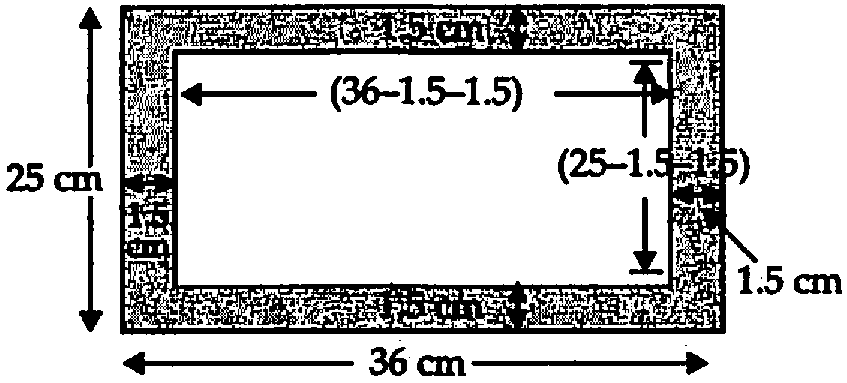
How many cubic centimetres of iron is required to construct an open box whose external dimensions are 36cm, 25cm and 16.5cm provided the thickness of the iron is 1.5cm. If one cubic cm of iron weighs 7.5g, find the weight of the box.
Answer
External dimenesions Internal dimenesions
$l_2 = 39cm$ $l_1 = 36 - 1.5 - 1.5 = 36 - 3 = 33cm$
$b_2 = 25cm$ $b_1 = 25 - 3 = 22cm$
$h_2 = 16.5cm$ $h_1 = 16.5 - 15 = 15cm$
hi
Volume of iron in the open box
$= l_2b_2h_2 - l_1b_1h_1$
$= (36 \times 25 \times 16.5) - (33 \times 22 \times 15)$
⇒ Volume of iron in the open box
$=9\times5\times11\Big[\frac{4\times5\times15}{10}-22\Big]$
$=45\times11[30-22]=495\times8=3960\text{cm}^3$
Volume of iron is $3960cm^3.$
So, $3960cm^3$​​​​​​​ of iron will weigh $\frac{3960\times75}{10}=396\times75\text{gm}$
$=\frac{396\times75}{1000}\text{kg}=\frac{297}{10}\text{kg}$
Hence, the weight of the box = 29.7kg.
View full question & answer
5 Marks Questions - Maths STD 10 Questions - Vidyadip