MCQ
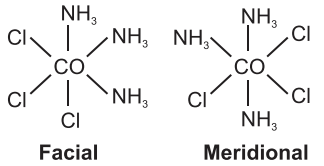
How many geometrical isomers are possible in given complex respectively:
$\left[CO\left(NH_3\right)_3 Cl_3\right] \&\left[Cr\left(C_2 O_4\right)_3\right]^{3-}$
  • 2,0
  • B
    3, 2
  • C
    3, 0
  • D
    0, 4

Answer

Correct option: A.
2,0
(A)
$\left[ Cr \left( C _2 O _4\right)_3\right]^{3-}$ has a bidendate ligand, So no geometrical isomers.
$\left[ CO \left( NH _3\right)_3 Cl _3\right]$ has facial \& Meridional isomers.
Image

Need a full question paper?

Generate a complete, print-ready paper with questions like this in minutes — across 16+ boards, with answer keys.

Start Generating Free

Similar questions

What is the correct representation of solubility product of $Ag_2CrO_4$ ?
An anion solution gives a white ppt. With $AgN{O_3}$ solution. The ppt. dissolves in dil. ammonia due to the formation of
Pauling's electronegativity values for elements are useful in predicting
For a chemical reaction $A + B \rightarrow$ Product, the order is $1$ with respect to $A$ and $B$.

Rate $mol\,L^{-1}\,s^{-1}$ $[A]$ $mol\,L^{-1}$ $[B]$ $mol\,L^{-1}$
$0.10$ $20$ $0.5$
$0.40$ $x$ $0.5$
$0.80$ $40$ $y$

What is the value of $x$ and $y ?$

Select the incorrect statement for dry cell
The energy of an electron in excited hydrogen atom is $-3.4 \,eV.$ Then, according to Bohr's theory the angular momentum of this electron in $Jsec$ is
When $50\,c{m^3}$ of a strong acid is added to $50\,c{m^3}$ of an alkali, the temperature rises by ${5\,^o}C$. If $250\,c{m^3}$ of each liquid are mixed, the temperature rise would be.....$^oC$
A given initial mass of $KClO_3$ on $50\%$ decomposition produces $67.2\ litre$ oxygen gas at $0\,^oC$ and $1\ atm$ . The other product of decomposition is $KCl$ . The initial mass of $KClO_3$ (in $gm$) taken is.
When ethyl iodide is heated with silver nitrate, the product obtained is
The Total pressure observed by mixing two liquid $A$ and $B$ is $350\,mm\,Hg$ when their mole fractions are $0.7$ and $0.3$ respectively.The Total pressure becomes $410 \,mm\,Hg$ if the mole fractions are changed to $0.2$ and $0.8$ respectively for $A$ and $B$. The vapour pressure of pure $A$ is $...........\,mm\,Hg$. (Nearest integer)

Consider the liquids and solutions behave ideally.