MCQ
How many gm of bromine will react with $21\, gm$ ${C_3}{H_6}$
  • $80$
  • B
    $160$
  • C
    $240$
  • D
    $320$

Answer

Correct option: A.
$80$
a
(a) $\mathop {\mathop {\mathop {C{H_3} - CH}\limits_{{\rm{Propane}}} }\limits_{{\rm{1 \,mole}}} }\limits_{{\rm{42 }}\,gms} = \,\,C{H_2}\,\, + \mathop {B{r_2}}\limits_{\mathop {1\,{\rm{mole}}}\limits_{42\,{\rm{ }}gms} } \to C{H_3} - \mathop {\mathop {\mathop {C{H_2}}\limits_{|\,\,\,\,\,\,\,\,} }\limits_{Br\,\,\,\,} - \mathop {\mathop {C{H_2}}\limits_{|\,\,\,\,\,\,\,\,} }\limits_{Br\,\,\,\,} }\limits_{{\rm{1, 2 - dibromo propane}}} $

$42\, gm$ of propene reacts with $160\, gms$ of bromine.

$\therefore $ $21\,gms$ of propene $\frac{{160}}{{42}} \times \,21 = 80\,gms$.

Need a full question paper?

Generate a complete, print-ready paper with questions like this in minutes — across 16+ boards, with answer keys.

Start Generating Free

Similar questions

A compound contains three elements $A, B$ and $C,$ if the oxidation of $A = + 2, B = + 5$ and $C = - 2$, the possible formula of the compound is 
Among the following marked proton of which compound shows lowest $pK _{ a }$ value?
Ionisation depends upon
What is the ratio of glyoxal to pyrualdehyde obtained in the above reaction ?

(figure) $\xrightarrow[{(2)\,Zn}]{{(1)\,{O_3}}}\mathop {\begin{array}{*{20}{c}}
  {\,\,\,\,O\,\,\,\,\,\,\,O\,\,} \\ 
  {\,||\,\,\,\,\,\,\,\,\,||} \\ 
  {H - C - C - H} 
\end{array}}\limits_{Glyoxal}  + $ $\mathop {\begin{array}{*{20}{c}}
  {\,\,\,O\,\,\,\,\,O\,\,} \\ 
  {\,||\,\,\,\,\,\,\,\,||} \\ 
  {C{H_3} - C - C - C{H_3}} 
\end{array}}\limits_{2,3 - Bu\tan edione}  + \mathop {\begin{array}{*{20}{c}}
  {\,\,\,\,\,\,O\,\,\,\,\,O} \\ 
  {\,\,\,\,\,\,||\,\,\,\,\,\,||} \\ 
  {C{H_3} - C - C - H} 
\end{array}}\limits_{Pyrualdehyde} $
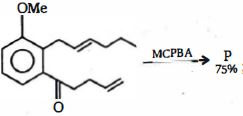
Product $(P)$ is
Which is the decreasing order of stability

$(i)$ $C{H_3} - \mathop C\limits^ + H - C{H_3}$

$(ii)$ $C{H_3} - \mathop C\limits^ + H - O - C{H_3}$

$(iii)$ $C{H_3} - \mathop C\limits^ + H - CO - C{H_3}$

Which pair show cis-trans isomerism
Which of the following orders correctly depicts the decreasing order of stability of carbanion?
Which one of the following equations does not correctly represent the first law of thermodynamics for the given processes involving an ideal gas? (Assume non -expansion work is zero)
The most common oxidation states of the most electronegative elements in their compounds are: