Question
How many multiples of $4$ lie between $10$ and $205$ ?

Answer

Let the number of multiples of $4$ lie between $10$ and $205$ be $n$.
$\therefore$ first multiples $(a) =12$
last multiples $( l )=204$
Common difference $( d )=4$
$\because l=a+(n-1) d$
$204=12+(n-1) 4$
$\Rightarrow 4(n-1)=204-12$
$\Rightarrow 4(n-1)=192 $
$\Rightarrow(n-1)=\frac{192}{4}=48$
$\Rightarrow n=48+1=49$
Hence, required number of multiples $=49$.

Need a full question paper?

Generate a complete, print-ready paper with questions like this in minutes — across 16+ boards, with answer keys.

Start Generating Free

Similar questions

Determine the $36^{\text {th }}$ term of the A.P. whose first two terms are -3 and 4 respectively.

In Figure, $\triangle$ODC $\sim$ $\triangle$OBA, $\angle$BOC = 125° and $\angle$CDO = 70°. Find $\angle$DOC, $\angle$DCO and $\angle$OAB.
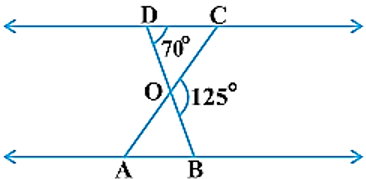
Image

If $A=B=60^{\circ}$, verify that $\sin (A-B)=\sin A \cos B-\cos A \sin B$
What is the diameter of a circle whose area is equal to the sum of the areas of two circles of diameters 10cm and 24cm?
Prove the following identites:
$\big(1+\cot^2\theta\big)\sin^2\theta=1$
ABCD is a trapezium in which AB || CD. The diagonals AC and BD intersect at O. Prove that: (i) $\triangle\text{AOB}\sim\triangle\text{COB}$ (ii) If OA = 6cm, OC = 8cm,
  1. $\frac{\text{Area}(\triangle\text{AOB)}}{\text{Area}(\triangle\text{COD})}$
  2. $\frac{\text{Area}(\triangle\text{AOD)}}{\text{Area}(\triangle\text{COD})}$
If $Q(0, 1)$ is equidistant from $P(5, -3)$ and $R(x, 6)$, find the values of x. Also find the distances $QR$ and $PR$.
Box A contains 25 slips of which 19 are marked Re 1 and other are marked Rs. 5 each. Box B contains 50 slips of which 45 are marked Re 1 each and others are marked Rs. 13 each. Slips of both boxes are poured into a third box and resuffled. A slip is drawn at random. What is the probability that it is marked other than Re 1?
Prove the following trigonometric identities.
$(\sin\theta+\cos\theta)(\tan\theta+\cos\theta)=\sec\theta+\text{cosec }\theta$
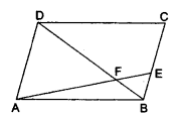
$\text{ABCD}$ is a parallelogram and $E$ is a point on $BC$ . If the diagonal $BD$ intersects $AE$ at $F$ , prove that
$A F \times F B=E F \times F D$
Image