Question
How many numbers greater than $24000$ can be formed by using digits $1, 2, 3, 4, 5 $when no digit is repeated

Answer

c
(c) The digits are $1, 2, 3, 4, 5$. We have to form number greater than $24000.$

Required number will be = (Total) -(Those beginning with $1$) -(Those beginning with $21$) -(Those beginning with $23$)

= $5\,!\, - \,4\,!\, - 3\,!\, - 3\,!\, = \,120 - 24 - 6 - 6 = 84$.

Need a full question paper?

Generate a complete, print-ready paper with questions like this in minutes — across 16+ boards, with answer keys.

Start Generating Free

Similar questions

If $\overrightarrow{ a } \cdot \overrightarrow{ b }=1, \overrightarrow{ b } \cdot \overrightarrow{ c }=2$ and $\overrightarrow{ c } \cdot \overrightarrow{ a }=3$, then the value of $[\vec{a} \times(\vec{b} \times \vec{c}), \vec{b} \times(\vec{c} \times \vec{a}), \vec{c} \times(\vec{b} \times \vec{a})]$ is
The sum of all the elements in the set $\{\mathrm{n} \in\{1,2, \ldots \ldots ., 100\} \mid$ $H.C.F.$ of $n$ and $2040$ is $1\,\}$ is equal to $.....$
The value of $\mathrm{k} \in \mathbb{N}$ for which the integral

$I_n=\int_0^1\left(1-x^k\right)^n d x, n \in \mathbb{N} \text {, satisfies } 147 I_{20}=148 I_{21}$ is :
The coefficients $a, b, c$ in the quadratic equation $a x^2+b x+c=0$ are from the set $\{1,2,3,4,5,6\}$. If the probability of this equation having one real root bigger than the other is $p$, then $216$ p equals:
Let the first three terms $2, p$ and $q$, with $q \neq 2$, of a $G.P.$ be respectively the $7^{\text {th }}, 8^{\text {th }}$ and $13^{\text {th }}$ terms of an $A.P.$ If the $5^{\text {th }}$ term of the $G.P.$ is the $\mathrm{n}^{\text {th }}$ term of the $A.P.$, then $\mathrm{n}$ is equal to
The three different face diagonals of a cuboid (rectangular parallelopiped) have lengths $39,40,41$. The length of the main diagonal of the cuboid which joins a pair of opposite corners is
In a survey of $220$ students of a higher secondary school, it was found that at least $125$ and at most $130$ students studied Mathematics; at least $85$ and at most $95$ studied Physics; at least $75$ and at most $90$ studied Chemistry; $30$ studied both Physics and Chemistry; $50$ studied both Chemistry and Mathematics; $40$ studied both Mathematics and Physics and $10$ studied none of these subjects. Let $\mathrm{m}$ and $\mathrm{n}$ respectively be the least and the most number of students who studied all the three subjects. Then $\mathrm{m}+\mathrm{n}$ is equal to .............................
The number of ways in which one or more balls can be selected out of $10$ white, $9$ green and $7$ blue balls are :-
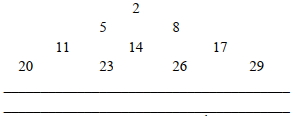
An arithmetic progression is written in the following way $Image$ The sum of all the terms of the $10^{\text {th }}$ row is..........
If $1+\left(2+{ }^{49} C _{1}+{ }^{49} C _{2}+\ldots .+{ }^{49} C _{49}\right)\left({ }^{50} C _{2}+{ }^{50} C _{4}+\right.$ $\ldots . .+{ }^{50} C _{ so }$ ) is equal to $2^{ n } . m$, where $m$ is odd, then $n$ $+m$ is equal to.