MCQ
How many positive real numbers $x$ satisfy the equation $x^3-3|x|+2=0$ ?
  • $1$
  • B
    $3$
  • C
    $4$
  • D
    $6$

Answer

Correct option: A.
$1$
a
(a)

We have,

Case $I$ $x > 0 \quad x^3-3|x|+2=0$

$\therefore \quad x^3-3 x+2=0$

$\Rightarrow \quad(x-1)(x-1)(x+2)=0$

$\Rightarrow x=1,-2$

$\text { Since, } x > 0$

$\therefore x \neq-2$

$x=1$

Case $II$ $x < 0$

$\therefore \quad x^3+3 x+2=0$

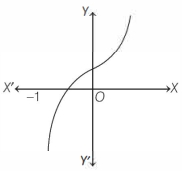
Graph of $x^3+3 x+2$

Clearly, from graph.

It has one solution lie between $(-1,0)$.

$\therefore$ Positive value of $x=1$

Hence, only one solutions.
Need a full question paper?

Generate a complete, print-ready paper with questions like this in minutes — across 16+ boards, with answer keys.

Start Generating Free

Similar questions

The first derivative of the function $(\sin 2x\cos 2x\cos 3x + {\log _2}{2^{x + 3}})$ with respect to $ x$  at $x = \pi $ is
$xy$ - plane divides the line joining the points $(2, 4, 5)$ and $(-4, 3, -2)$ in the ratio
A circle touches $x$ - axis and cuts off a chord of length $2l$ from $y$ - axis. The locus of the centre of the circle is
$\int_{}^{} {\frac{{x - 1}}{{{{(x + 1)}^3}}}{e^x}\;dx = } $
The sum of the squares of the roots of $|\mathrm{x}+2|^{2}+|\mathrm{x}-2|-2=0$ and the squares of the roots of $x^{2}-2|x-3|-5=0$, is
Let the co-ordinates of the two points $A\, \& \,B$ be $(1, 2)$ and $(7, 5)$ respectively. The line $AB$ is rotated through $45^o$ in anti clockwise direction about the point of trisection of $AB$ which is nearer to $B$. The equation of the line in new position is :
If the set of natural numbers is partitioned into subsets ${S_1} = \left\{ 1 \right\},\;{S_2} = \left\{ {2,\;3} \right\},\;{S_3} = \left\{ {4,\;5,\;6} \right\}$ and so on. Then the sum of the terms in ${S_{50}}$ is
The solution curve of the differential equation $y \frac{d x}{d y}=x\left(\log _e x-\log _e y+1\right), x>0, y>0 \text { passing }$ through the point$(\mathrm{e}, 1)$ is
${d \over {dx}}\left( {{{\sec x + \tan x} \over {\sec x - \tan x}}} \right) = $
An ordinary dice is rolled for a certain number of times. If the probability of getting an odd number $2$ times is equal to the probability of getting an even number $3$ times, then the probability of getting an odd number for odd number of times is