MCQ
$\int_{}^{} {\frac{{x - 1}}{{{{(x + 1)}^3}}}{e^x}\;dx = } $
  • A
    $\frac{{ - {e^x}}}{{{{(x + 1)}^2}}} + c$
  • $\frac{{{e^x}}}{{{{(x + 1)}^2}}} + c$
  • C
    $\frac{{{e^x}}}{{{{(x + 1)}^3}}} + c$
  • D
    $\frac{{ - {e^x}}}{{{{(x + 1)}^3}}} + c$

Answer

Correct option: B.
$\frac{{{e^x}}}{{{{(x + 1)}^2}}} + c$
b
(b)$\int_{}^{} {\frac{{x - 1}}{{{{(x + 1)}^3}}}{e^x}dx = \int_{}^{} {{e^x}\left( {\frac{{(x + 1)}}{{{{(x + 1)}^3}}} - \frac{2}{{{{(x + 1)}^3}}}} \right)\,dx} } $
$ = \int_{}^{} {{e^x}\left( {\frac{1}{{{{(x + 1)}^2}}} - \frac{2}{{{{(x + 1)}^3}}}} \right)\,dx} = \frac{{{e^x}}}{{{{(x + 1)}^2}}} + c$.
$\left\{ {\therefore \,\,\,\frac{d}{{dx}}\left( {\frac{1}{{{{(x + 1)}^2}}}} \right) = - \frac{2}{{{{(x + 1)}^3}}}} \right\}$

Need a full question paper?

Generate a complete, print-ready paper with questions like this in minutes — across 16+ boards, with answer keys.
Start Generating Free

Similar questions

Number of values of $m$ for which the lines $x + y - 1 = 0$, $(m - 1) x + (m^2 - 7) y - 5 = 0 \,\,\&\,\, (m - 2) x + (2m - 5) y = 0$ are concurrent, are
The point $B$ divides the arc $AC$ of a quadrant of a circle in the ratio $1 : 2$. If $O$ is the centre and $\overrightarrow {OA} = a$ and $\overrightarrow {OB} = b,$ then the vector $\overrightarrow {OC} $ is
If $\omega $ is cube root of unity, then root of the equation $\left| {\begin{array}{*{20}{c}}
  {x + 2}&\omega &{{\omega ^2}} \\ 
  \omega &{x + 1 + {\omega ^2}}&1 \\ 
  {{\omega ^2}}&1&{x + 1 + \omega } 
\end{array}} \right| = 0$ is 
Maximum value of ${\left( {{1 \over x}} \right)^x}$ is
The line $x + y = p$ meets the axis of $x\, \& \,y$ at $A\, \& \,B$ respectively . A triangle $APQ$ is inscribed in the triangle $OAB$, $O$ being the origin, with right angle at $Q . P$ and $Q$ lie respectively on $OB$ and $AB$ . If the area of the triangle $APQ$ is $3/8^{th}$ of the area of the triangle $OAB$, then $\frac{{A\,Q}}{{B\,Q}}$ is equal to :
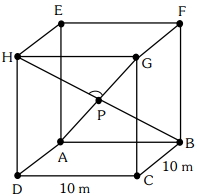
A hall has a square floor of dimension $10\, \mathrm{~m} \times 10\, \mathrm{~m}$ (see the figure) and vertical walls. If the angle $GPH$ between the diagonals $\mathrm{AG}$ and $\mathrm{BH}$ is $\cos ^{-1} \frac{1}{5}$, then the height of the hall (in $meters$) is :
The equation to the locus of the middle point of the portion of the tangent to the ellipse $\frac{{{x^2}}}{{16}}$$+$ $\frac{{{y^2}}}{9}$ $= 1$  included between the co-ordinate axes is the curve :
Let $f:R \to R,f\left( x \right) = a{x^3} + b{x^2} + cx + d,$ has no extreme value , then which of the following is always correct ?
If $A = \left[ {\begin{array}{*{20}{c}}\lambda &1\\{ - 1}&{ - \lambda }\end{array}} \right]$, then for what value of $\lambda ,\,{A^2} = O$
The value of $\sin 10^\circ + \sin 20^\circ + \sin 30^\circ + ... + $ $\sin 360^\circ $ is