Question
How many time constants will elapse before the current in a charging RC circuit drops to half of its initial value? Answer the same question for a discharging RC circuit.

Answer

$\frac{\text{Q}}{2}=\text{Q}\Big(1-\text{e}^{\frac{-\text{t}}{\text{CR}}}\Big)$
$\Rightarrow\frac{1}{2}=\Big(1-\text{e}^{\frac{-\text{t}}{\text{CR}}}\Big)$
$\Rightarrow\text{e}^{\frac{-\text{t}}{\text{CR}}}=\frac{1}{2}$
$\Rightarrow\frac{\text{t}}{\text{RC}}=\log2\Rightarrow\text{n}=0.69.$

Need a full question paper?

Generate a complete, print-ready paper with questions like this in minutes — across 16+ boards, with answer keys.
Start Generating Free

Similar questions

State Kirchhoff's laws and explain them by giving examples.###Explain that first law of Kirchhoff is equivalent to law of conservation of charge and the second law is a descriptive form of Ohm's law.###For a current carrying conductor, write Kirchhoff's laws of charge and energy conservation.
Write a short note on $n$-type semi-conductors.
The specification on a heater coil is 250V, 500W. Calculate the resistance of the coil. What will be the resistance of a coil of 1000W to operate at the same voltage?
A traffic policeman sounds a whistle to stop a car-driver approaching towards him. The car-driver does not stop and takes the plea in court that because of the Doppler shift, the frequency of the whistle reaching him might have gone beyond the audible limit of 20kHz and he did not hear it. Experiments showed that the whistle emits a sound with frequency close to 16kHz. Assuming that the claim of the driver is true, how fast was he driving the car? Take the speed of sound in air to be 330m/s. Is this speed practical with today's technology?
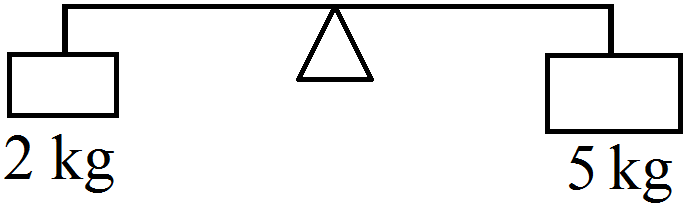
A light rod of length 1m is pivoted at its centre and two masses of 5kg and 2kg are hung from the ends as shown in figure. Find the initial angular acceleration of the rod assuming that it was horizontal in the beginning.

The specific heat capacities of hydrogen at constant volume and at constant pressure are 2.4cal-g-1 °C−1 and 3.4cal-g-1 °C-1 respectively. The molecular weight of hydrogen is 2g-mol-1 and the gas constant, R = 8.3 × 10⁷ erg°C-1 mol-1. Calculate the value of J.
A giant refracting telescope at an observatory has an objective lens of focal length 15 m. If an eyepiece lens of focal length 1.0 cm is used, find the angular magnification of the telescope. 
If this telescope is used to view the moon, what is the diameter of the image of the moon formed by the objective lens? The diameter of the moon is 3.42 x 10⁶ m and the radius of the lunar orbit is 3.8 x 10⁶ m.
A straight wire of length l can slide on two parallel plastic rails kept in a horizontal plane with a separation d. The coefficient of friction between the wire and the rails is $\mu.$ If the wire carries a current i, what minimum magnetic field should exist in the space in order to slide the wire on the rails?
A rod is inserted as the core in the current-carrying solenoid of the previous problem.
  1. What is the magnetic intensity H at the centre?
  2. If the magnetization I of the core is found to be 0.12Nm, find the susceptibility of the material of the rod.
  3. Is the material paramagnetic, diamagnetic or ferromagnetic?
Is it easier to take out a nucleon from carbon or from iron? Fi-om iron or from lead?