Question
Write a short note on $n$-type semi-conductors.

Answer

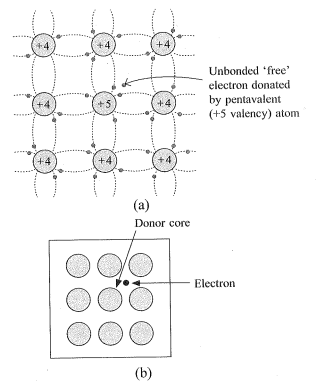
As shown in the Fig., to make this type of semi-conductor pure $S i$ or $G e$ is doped with a pentavalent element. (In the outer most orbit, there are 5 electrons in such atoms, So they are called pentavalent.)
Image
Example : Arsenic (As), Antimony (S $b$ ), Phosphorous (P) etc.
When an atom of +5 Valency element occupies the position of an atom in the crystal lattice of $S i$, four of its electrons bond with the four silicon neighbours while the fifth remains very weakly bound to its parent atom.
As a result the ionisation energy required to set this electron free is very small and even at room temperature the electron gains energy sufficient to be free and to move in the lattice of the semiconductor.
→For example :
the energy required to free this fifth electron is $\sim 0.01 eV$ for germanium and 0.05 eV for silicon, to separate the electron from its atom.
Thus the pentavalent dopant is donating one extra electron for conduction and hence it is known as donor impurity.
The number of electrons made available for conduction by dopant atoms depends strongly upon the doping level and it's is independent of any increase in ambient temperature.
In a doped semiconductor the total number of conduction electrons $n_e$ is due to the electrons contributed by donors and those generated intrinsically, while the total number of holes $n_h$ is only due to the holes from the intrinsic source.
Thus, with proper level of doping the number of conduction electrons can be made much larger than the number of holes.
Hence in an extrinsic semiconductor doped with pentavalent impurity, electrons become the majority carriers and the holes the minority carriers.
Charge of electron is negative. Hence from the first letter of the word 'negative', ' $n$ ', such semiconductors are known as $n$-type semiconductors.
For $n$-type semiconductors.
$n_e \gg n_h$

Need a full question paper?

Generate a complete, print-ready paper with questions like this in minutes — across 16+ boards, with answer keys.
Start Generating Free

Similar questions

The drift current in a reverse-biased p-n junction increases in magnitude if the temperatu,re of the junction is increased. Explain this on the basis of creation of hole-electron pairs.
Draw the graph of binding energy per nucleon against atomic mass number and draw conclusion of the graph.
  1. Show, giving a suitable diagram, how unpolarized light can be polarised by reflection.
  2. Two polaroids P1 and P2  are placed with their pass axes perpendicular to each other. Unpolarised light of intensity Io is incident on P1 A third polaroid P3 is kept in between P1 and P2 such that its pass axis makes an angle of $60^{\circ}$with that of P1. Determine the intensity of light transmitted through P1, P2 and P3.
Write the definition of wavefront. Using Huygens' principle, draw the shape of a plane wave incident on a convex lens and the refracted wave body.
###
(a) When a wave propagates from a rarer medium to a denser medium, then which characteristic of that wave does not change and why?
(b) The refractive indices of two mediums are $\mu_1$ and $\mu_2$, what will be the ratio of velocities in the wave in them?
A body of mass 2kg suspended through a vertical spring executes simple harmonic motion of period 4s. If the oscillations are stopped and the body hangs in equilibrium, find the potential energy stored in the spring.
A human body excretes (removes by waste discharge, sweating, etc.) certain materials by a law similar to radioactivity. If technetium is injected in some form in a human body, the body excretes half the amount in 24 hours. A patient is given an injection containing 99Tc. This isotope is radioactive with a half-life of 6 hours. The activity from the body just after the injection is $6\mu\text{Ci}.$ How much time will elapse before the activity falls to $3\mu\text{Ci}?$
State the underlying principle of working of a moving coil galvanometer. Write two reasons why a galvanometer can not be used as such to measure current in a given circuit. Name any two factors on which the current sensitivity of a galvanometer depends.
Suppose white light falls on a double slit but one slit is covered by a violet filter (allowing $\lambda=400\text{nm}$). Describe the nature of the fringe pattern observed.
A series LCR circuit is connected to an ac source. Using the phasor diagram, derive the expression for the impedance of the circuit. Plot a graph to show the variation of current with frequency of the source, explaining the nature of its variation.
A pendulum having a bob of mass m is hanging in a ship sailing along the equator from east to west. When the ship is stationary with respect to water the tension in the string is T0.
  1. Find the speed of the ship due to rotation of the earth about its axis.
  2. Find the difference between T0 and the earth's attraction on the bob.
  3. If the ship sails at speed v, what is the tension in the string? Angular speed of earth's rotation is $\omega$ and radius of the earth is R.