Question
How many two-digit numbers are duvisible by $3$?

Answer

The two-digit numbers divisible by $3$ start from
$12, 15, 18, 21, ..., 99$
Here,
$a = 12$
$d = 3$
$a_n = a + (n - 1)d$
$\Rightarrow 99 = 12 + (n - 1)(3)$
$\Rightarrow 99 = 12 + 3n - 3$
$\Rightarrow 90 = 3n$
$\Rightarrow n = 30$
This, $30$ two-digit number are divisible by $3$.

Need a full question paper?

Generate a complete, print-ready paper with questions like this in minutes — across 16+ boards, with answer keys.
Start Generating Free

Similar questions

Five cards ten, jack, queen, king and an ace of diamonds are shuffled face downwards. One card is picked at random.
  1. What is the probability that the card is a queen?
  2. If a king is drawn first and put aside, what is the probability that the second card picked up is the (i) Ace (ii) King?
A and B throw a pair of dice. If A throws 9, find B's chance of throwing a higher number.
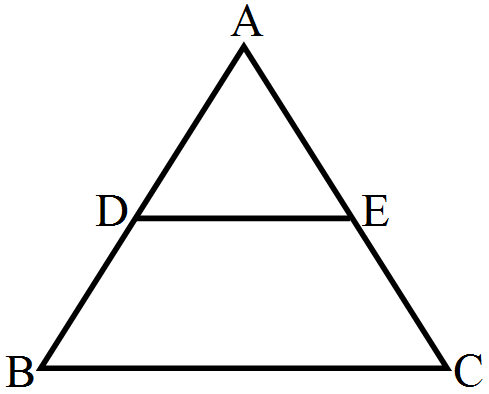
In a $\triangle\text{ABC,}$ P and Q are points on sides AB and AC respectively, such that PQ || BC. If AP = 2.4cm, AQ = 2cm, QC = 3cm and BC = 6cm, find the AB and PQ.
D and E are points on the sides AB and AC respectively of a $\triangle\text{ABC}.$ In the following cases, determine whether DE || BC or not.
AD = 5.7cm, DB = 9.5cm, AE = 4.8cm and EC = 8cm.
The $7^{th}$ term of an AP is $-4$ and its $13^{th}$​​​​​​​ term is $-16$. Find the AP.
If $\sec2\text{A}=\text{cosec}(\text{A}-42^\circ),$ where 2A is an acute angle, then find the value of A.
A balloon vendor has 2 red, 3 blue and 4 green balloons. He wants to choose one of them at random to give it to Pranali. What is the probability of the event that Pranali gets,
(1) a red balloon
(2) a blue balloon
(3) a green balloon.

Find the value of a and b for which the following systems of linear equations has an infinite number of solutions:
$2x + 3y = 7,$
$(a + b + 1)x + (a + 2b + 2)y = 4(a + b) + 1$
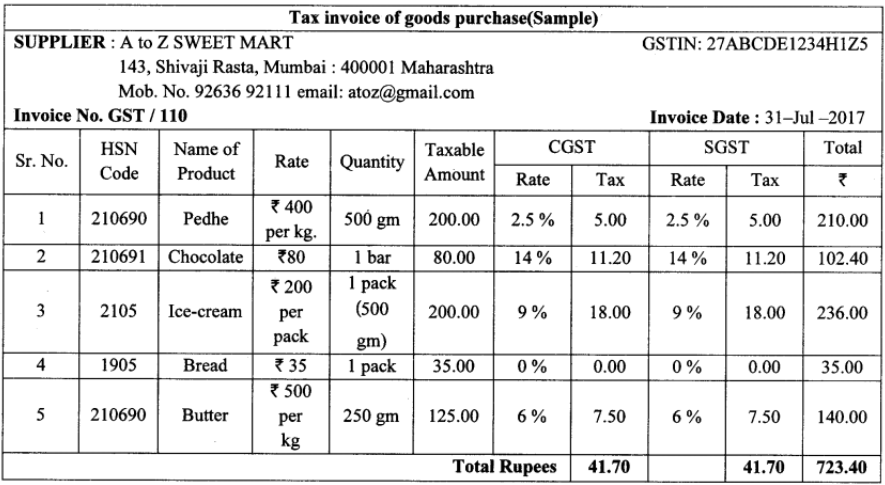
Observe the given bill and fill in the boxes with the appropriate number.
Image
Prove the following trigonometric identities.
$\frac{1+\sin\theta}{\cos\theta}+\frac{\cos\theta}{1+\sin\theta}=2\sec\theta$