Question
How many types of inertia are there? Explain by example.

Answer

 There are three types of inertia:
(i) Inertia of rest: When the object is at rest relative to its surroundings then it is called inertia of rest. This situation can be changed only by applying external force, e.g., if an object kept in a house remains at the same place for days or years unless someone moves it from its position by applying force, it is an example of inertia of rest.
(ii) Inertia of motion: When an object is moved on a frictionless surface or thrown into a vacuum, it will continue to move on its original path unless an external force is applied. In real situation, air or floor etc. create friction on a moving object hence we are not able to see frictionless motion. This type of inertia in which the object keeps moving is called the inertia of motion.
(iii) Inertia of direction: In the above example, we see that unless an external force acts, the object or particle keeps moving in its direction. This property of motion is called inertia of direction.
Need a full question paper?

Generate a complete, print-ready paper with questions like this in minutes — across 16+ boards, with answer keys.

Start Generating Free

Similar questions

A body of mass 6kg is floating in a liquid with $\frac23$ of its volume inside the liquid. Find ratio between the density of the body and density of liquid. Take g = 10m/ s2.
In a rotor, a hollow vertical cylinder rotates about its axis and a person rests against the inner wall. At a particular speed of the rotor, the floor below the person is removed and the person hangs resting against the wall without any floor.
If the radius of the rotor is 2m and the coefficient of static friction between the wall and the person is 0.2.
  1. Find the minimum speed at which the floor may be removed.
  2. What type of speciality is associated with this question? [take, g = 10m/ s2]
A solid sphere of mass m is released from rest from the rim of a hemispherical cup so that it rolls along the surface. If the rim of the hemisphere is kept horizontal, find the normal force exerted by the cup on the ball when the ball reaches the bottom of the cup.
A gas having volume of 1 liter at 80 cm mercury pressure expands to 1.190 liter in the adiabatic process. If the pressure of the gas is $6 2 . 6 ~ c m$ and it falls to then find the value of $\gamma$.
Define reversible and irreversible actions and write one example of each.
A uniform rope of length $L$, resting on a frictionless horizontal surface is pulled at one end by a force $F$. What is the tension in the rope at a distance 1 from the end where the force is applied?
Find the dimensions of Planck's constant h from the equation E = hv where E is the energy and v is the frequency.
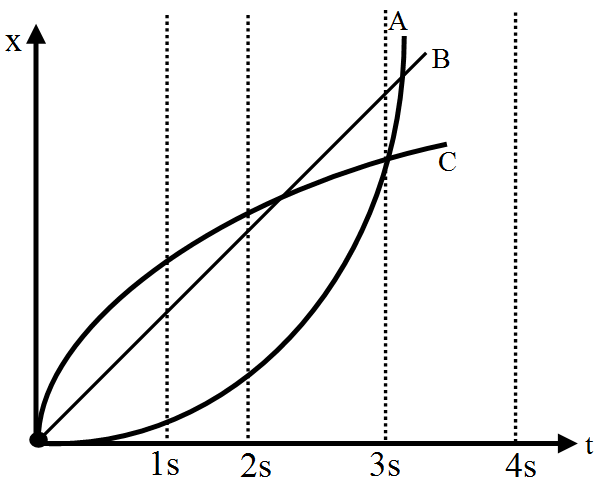
The position-time-graph in figure depicts the journey of three bodies A, B and C.

  1. At 1s, which has the greatest velocity?
  2. At 2s, which has travelled the farthest?
  3. When A meets C, is B moving faster or slower than A?
  4. Is there any time at which the velocity of A is equal to that of B?
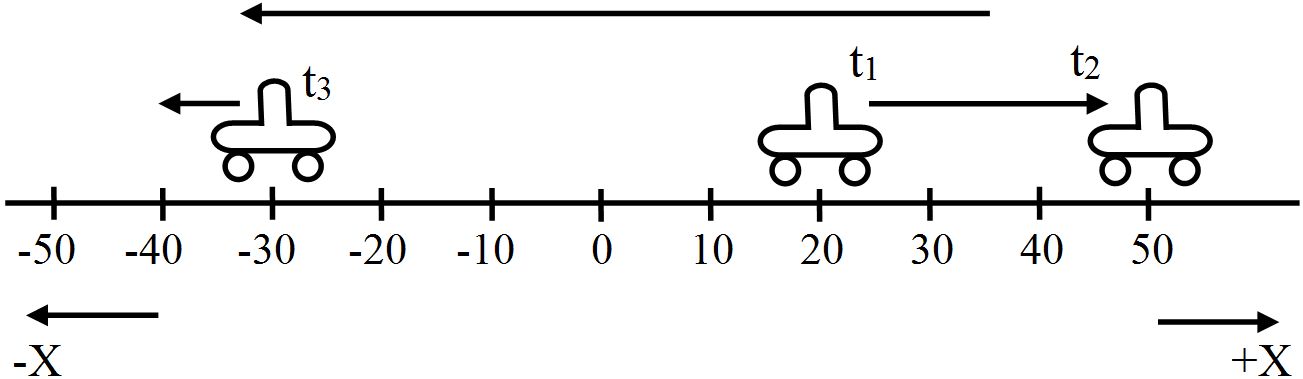
For the motion shown in the figure, find the displacement of car between the time intervals t1 and t3.

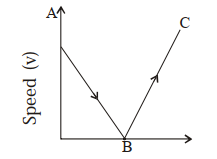
An object is thrown vertically upwards. After some time it returns to earth. Draw the speed time graph for the ball. (Note: Consider the air borne resistance as negligible here.)
Image