Question
  1. How may codons code for amino acids and how many are unable to do so?
  2. Why are codes said to be.
  1. Degenerate.
  2. Unambiguous.

OR

  1. How many codons code for amino acids and how many do not?
  2. Explain the following giving one example of each.
  1. Unambiguous and specific codon.
  2. Degeneration codon.
  3. Universal codon.
  4. Initiator codon.

Answer

  1. Out of 64 codons 61 code for amino acids and rest 3 codons do not code for any amino acids. These function as stop codons.
  2.  
  1. As codon is a triplet. Out of 64 codons, 6l code for 20 amino acids and 3 codons (UAA, UGA and UAG) do not code for any amino acids. Thus, they function as terminating or stop codons.
  2. Genetic code is uaambiguous and specific. Thus, one codon codes for only one amino acid, e.g. CCU codes only for proline and not for any other amino acid.
  3. Since, rhe number of codons is greater, all of thc amino acids, with exceptions of methionine (AUG) and tryptophan (UGG), are coded by more than one codon, a fearure referred to as the degenerecy of genetic code, e.g. GGU, GGC, GGA and GGG all specifr the same amino acid glycine.
  4. The codon is read in mRNA in a contiguous fuhion, i.e. without puncoration. Thus, the code is commaless.
  5. The genetic code is nearly universal, i.e. particular codon codes for the same amino acid in all organisms except in mitochondrial codons and few Protozoans.
  6. AUG is a codon with dual fi.rncdons. It codes for the amino acid methionine (met) and also acts as an intiator codon.

Need a full question paper?

Generate a complete, print-ready paper with questions like this in minutes — across 16+ boards, with answer keys.

Start Generating Free

Similar questions

Classify the following as examples of homology and analogy:
  1. Mouth parts of cockroach and butterfly.
  2. Hearts of rabbits and human beings.
  3. Eyes of octopus and mammals.
  4. Sweet potato and potato.
  5. Stings of honeybee and scorpion.
  6. Tendrils of Lathyrus and tendrils of Gloriosa.
Name the kind of organisms which constitute the pioneer community of xerarch and hydrarch succession, respectively.
"A population has been exhibiting genetic equilibrium."
Answer the following with regard to the above statement.
  1. Explain the above statement.
  2. Name the underlying principle.
  3. List any two factors which would upset the genetic equilibrium of the population.
  4. Take up any one such factor and explain how the gene pool will change due to factor.
There are certain complexities in eukaryotic transcription. Bring out the significance of such complexities.
Explain - Nucleoside & Nucleotide
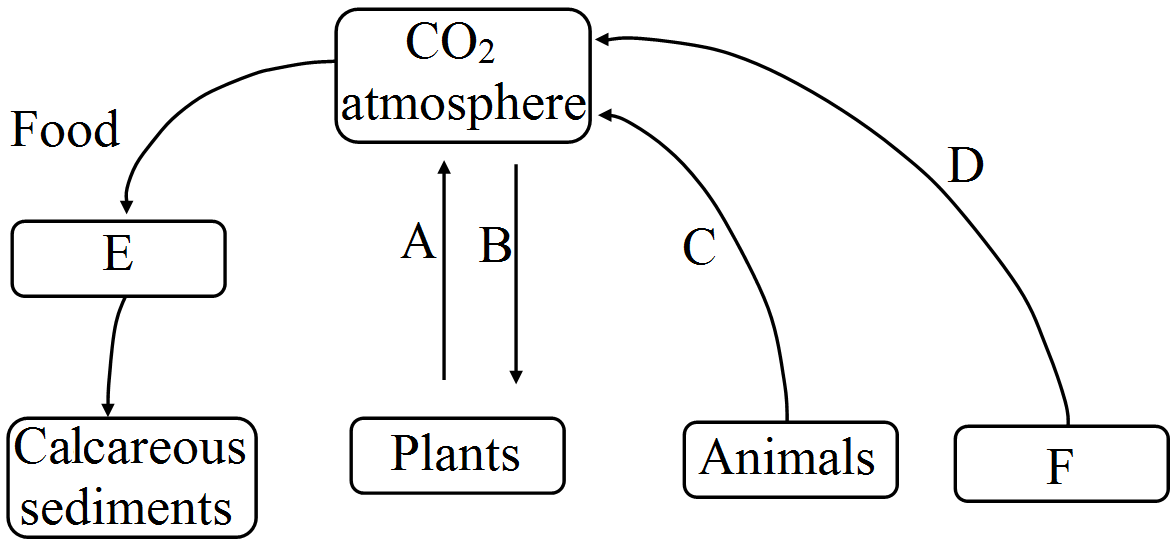
Complete the following model of carbon cycle by filling A, B, C, D, E and F.

The study of:
  1. Fossils of dinosaurs.
  2. Forelimbs of Cheeta, bat and human.
  3. Thorns of Bougainvillea and tendril of Cucurbita shows that evolution of life forms has indeed taken place on earth. Explain.
Explain biodiversity loss due to alien species invasions.###Among the reasons of biodiversity loss, how does extinction of indiginous species is carried out by invation of allian species? Explain.
A typical mammalian cell has 2.2m long DNA molecule, whereas the nucleus in which it is packed measures about 10m. Explain how such a long DNA molecule is packed within a tiny nucleus in the cell.
What is called antibody? Describe the structure of an antibody molecule.