Question
How much work will be required to bring a test charge q, one em along the equatorial axis of an electric dipole?

Answer

Since the potential at every point of the equatorial axis of a dipole is zero, therefore the potential difference between any two of its points $=0$, so the work $W =q \times \Delta V$ $=q \times 0=0$

Need a full question paper?

Generate a complete, print-ready paper with questions like this in minutes — across 16+ boards, with answer keys.
Start Generating Free

Similar questions

Calculate the energy equivalent of $1 g$ of substance.
What is the concept of direction of electric current ?
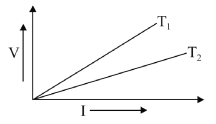
V-I graph of wire of any metal at two different temperatures $T _1$ and $T _2$ are shown in the given figure. Which of the two temperatures is higher and why?
Image
Electric current is flowing in north direction in an electric line. What will be direction of magnetic field due to electric current above the line?
Two alternating currents are given by, $\text{i}_\text{i}=\text{i}_0\sin\omega\text{t}$ and $\text{i}_\text{i}=\text{i}_0\sin\Big(\omega\text{t}+\frac{\pi}{3}\Big)$ Will the $\text{rms}$ values of the currents be equal or different?
Suppose you have three resistors, each of value $30\Omega.$ List all the different resistances you can obtain using them.
To measure the magnetic moment of a bar magnet, one may use:
  1. A tangent galvanometer.
  2. A deflection galvanometer if the earth's horizontal field is known.
  3. An oscillation magnetometer if the earth's horizontal field is known.
  4. Both deflection and oscillation magnetometer if the earth's horizontal field is not known.
A charged particle moving with a uniform velocity enters a magnetic field directed perpendicular to it, what will be the path of electron? How will its speed be affected?
A magnet of magnetic moment m is first cut perpendicular to its length and then perpendicular to its breadth into n equal parts, then calculate magnetic moment of each part.
A biconvex lens made of a transparent material of refractive index 1.25 is immersed in water of refractive index 1.33. Will the lens behave as a converging or a diverging lens? Give reason.