Questions

1 Marks Question

Take a timed test

52 questions · self-marked practice — reveal the answer and mark yourself.

Question 11 Mark
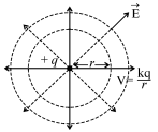
What is called equipotential surface?Draw the diagram of equipotential surface due point positive charge.
Answer
A surface on which the potential at every point is equal is called an equipotential surface.
Image
View full question & answer
Question 21 Mark
Calculate the electric potential at a point located at a distance of $9 \times 10^{-4} m$ due to a charge of $2 \times 10^{-9} C$
Answer
Ans. $\quad V =\frac{1}{4 \pi \epsilon_0} \times \frac{q}{r}$
$=\frac{9 \times 10^9 \times 2 \times 10^{-9}}{9 \times 10^{-4}}$
$=2 \times 10^4$ Volt
View full question & answer
Question 31 Mark
Write the value of the electric potential at the distance r from the centre of the dipole on the axis of the electric dipole of dipole moment p.
Answer
$V = \pm \frac{ KP \cos \theta}{r^2}$
On axis $\quad \theta=0^{\circ}$
$V = \pm \frac{ KP }{r^2}$ Ans.
View full question & answer
Question 41 Mark
In Millikan's experiment, $-6.4 \times 10^{-19}$ Coulomb charge is found on a charged drop, then write the number of electrons in that charged drop.
Answer
$q=n e$
$n=\frac{q}{e}=-\frac{6.4 \times 10^{-19}}{1.6 \times 10^{-19}}=4$ electron Ans.
View full question & answer
Question 51 Mark
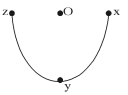
What will be the work done in bringing a point charge from x to points y and z respectively in the given figure?
Answer
Image
Points $z$ and $y$ are located on the same equipotential surface. The work done in moving the charge from $x$ to $y$ will be the same as the work done in moving the charge from $x$ to $z$. Therefore $W _y= W _z$
View full question & answer
Question 61 Mark
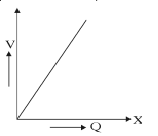
Draw a graph that shows the relationship between the charge $Q$ given to a capacitor of capacitance $C$ and its potential difference $V$.
Answer
$\text V =\frac{ Q }{ C } $
$\Rightarrow V \propto O$
$\left(\because \frac{ I }{ C }=\text { Constant }\right)$​​​​​​​
Image
View full question & answer
Question 71 Mark
A hollow metal sphere of radius 5 cm has been charged so much that potential at its surface becomes 10V. What will be the potential at the centre of this sphere?
Answer
The electric potential at the centre and surface of a hollow sphere is equal. Therefore, the potential at the centre of the sphere will be V = 10 volts.
View full question & answer
Question 81 Mark
Define potential difference and write its unit.
Answer
The potential difference between two points in an electric field is defined as the work done in moving a unit positive test charge from one point to another against the field. Its unit in S.I. system is volt (V) or J/C.
View full question & answer
Question 91 Mark
What effect does the dielectric medium have on the capacitance of a capacitor?
Answer
In the presence of dielectric medium the value of capacitance increases. But this increment depends on the condition that how much the middle part of the plates is filled with dielectric material, whether it is filled fully, partially or in the form of different layers.
View full question & answer
Question 101 Mark
Can there be a potential difference between two conductors of equal volume, even though both have the same positive charge?
Answer
Yes, because the size of two conductors of the same volume may be different, due to which the potential will be different due to the difference in capacitance, that is, there will be a potential difference between them.
View full question & answer
Question 111 Mark
What will have the effect of moving the plates of a charged capacitor away from each other, on the potential difference between the plates?
Answer
The potential difference between the plates will increase.
View full question & answer
Question 121 Mark
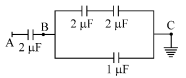
In the circuit shown below, the potential at point A is 100 volts. What will be the potential at point B?
Answer
Image
The potential at point B will be 50 volts.
View full question & answer
Question 131 Mark
The dielectric constant of the material kept between the plates of a capacitor is 5 and its capacitance is C. If it is replaced with a material having dielectric constant 20, then what will be the new capacitance of the capacitor?
Answer
The new capacitance of the capacitor will be four times the previous capacitance.
View full question & answer
Question 141 Mark
Two capacitors of equal capacitance C are combine in series. What will be the capacitance of the combination?
Answer
The capacitance of the combination in the series
$\frac{1}{C}=\frac{1}{C_1}+\frac{1}{C_2}$
Capacitance of the combination will be $=\frac{ C }{2}$.
View full question & answer
Question 151 Mark
A parallel combination of two capacitors of capacitance $3 \mu F$ and $5 \mu F$ is given charge Q . If the charge is Q at $3 \mu F$ and $Q _2$ at $5 \mu F$, then what will be the value of $\frac{ Q _1}{ Q _2} ?$
Answer
$\frac{Q_1}{Q_2}=\frac{C_1}{C_2}=\frac{3}{5}$
View full question & answer
Question 161 Mark
Write the formula for capacitance of parallel plate capacitor. What effect does the area of the plates have on capacitance?
Answer
Capacitance of parallel plate capacitor $C=\frac{\epsilon_0 A}{d}$
It is clear from the equation that the capacitance of a parallel capacitor is proportional to the area of the plates and inversely proportional to the distance between them. Capacitance can be increased by increasing the area A of the plates.
View full question & answer
Question 181 Mark
What will be the value of maximum and minimum capacitances oblained from the combinations of three capacitors. each of which has a capacitance of $6 \mu F$ ?
Answer
Maximum capacitance $=6 \mu F+6 \mu F+6 \mu F$
$ =18 \mu F $
Minimum capacitance $ \frac{1}{C}=\frac{1}{6}+\frac{1}{6}+\frac{1}{6}$
$=\frac{3}{6}=\frac{1}{2}$
$C=2 \mu F $
View full question & answer
Question 191 Mark
Write the definition of dielectric constant of a medium. What is its S.I. unit?
Answer
We know $C = C _0 \in_r$
or $\epsilon_r=\frac{ C }{ C _0}$
Therefore, the value of dielectric constant of a medium is equal to the ratio of the capacitance C of a parallel plate capacitor completely filled with dielectric material to the capacitance $C _0$ of air or vacuum. It does not have any unit.
View full question & answer
Question 201 Mark
What will be the value of 4 µF capacitance if a dielectric of dielectric constant 2 is completely filled between the plates of a parallel plate capacitor?
Answer
When the entire space between the plates is filled with a modium of dielectric constant $\epsilon_r$ then $C = C _0 \epsilon_r$
Therefore$C =4 \times 2=8 \mu F$
View full question & answer
Question 211 Mark
Calculate the potential at a point located at a distance $9 \times 10^{-2} m$ due to charge $4 \times 10^{-9} C$
Answer
Sol. Given :
$q=4 \times 10^{-9} C$
$r=9 \times 10^{-2} m$
As we know that:
Potential $V =\frac{1}{4 \pi \epsilon_0}\left(\frac{q}{r}\right)$
On putting values $V =\frac{9 \times 10^9 \times 4 \times 10^{-9}}{9 \times 10^{-2}}$
$\because \frac{1}{4 \pi \epsilon_0}=9 \times 10^9 Nm ^2 C ^{-2}$
$V =4 \times 10^2$ Volt $\quad$ Ans.

View full question & answer
Question 221 Mark
A capacitor of capacity C is charged with a potential difference V. What will be the value of electric flux passing through the surface around the capacitor?
Answer
Zero, since the electric field is only between the two plates of the capacitor.
View full question & answer
Question 231 Mark
If the area of one plate of a parallel plate capacitor is halved, will the device work as a capacitor?
Answer
No, if the area of one plate of a parallel plate capacitor is halved, the capacitance of the capacitor will be reduced to half, hence that device will not work.
View full question & answer
Question 241 Mark
How does the value of capacitance depend on the condition of the dielectric material when the space between the plates of a parallel plate capacitor is partially filled with a dielectric material?
Answer
Doesn't depend.
View full question & answer
Question 251 Mark
+Q charge is given on the positive plate of a capacitor and-Q charge is given on the negative plate. What will be the total charge on the capacitor?
Answer
+Q. when we give +Q charge to one plate of the capacitor, then due to electrical induction, the other plate gets a -Q charge due to it being connected to the earth. The total charge on the capacitor is zero.
View full question & answer
Question 261 Mark
Write the definition of SI unit of capacitance.
Answer
By giving one coulomb of charge to a conductor, if its potential increases by one volt, then its capacitance is called one farad.
View full question & answer
Question 271 Mark
Write the unit of capacitance and its dimensional formula.
Answer
Farad is the SI unit of capacitance, it'sdimensional formula is $\left[ M ^{-1} L^{-2} T^4 A^2\right]$.
View full question & answer
Question 281 Mark
What is meant by electrical capacitance of a conductor?
Answer
The ability of a conductor to accept electrical charge is called its electrical capacitance.
View full question & answer
Question 291 Mark
What is meant by dielectric? Which is the dielectric among silicon, mica and carbon?
Answer
Dielectrics are those non-conducting materials in which electrical effects are transmitted without movement of charges. Mica is a dielectric material.
View full question & answer
Question 301 Mark
What is the difference between a conductor and a non-conductor?
Answer
When an electric potential difference is established at the ends of a conductor, charge flows easily in it, whereas this does not happen in a non-conductor. The number of free electrons is very high in conductors, whereas this number is negligible in non-conductors.
View full question & answer
Question 311 Mark
Define its potential energy at a point placed at a distance from a charge q in an external electric field.
Answer
The potential energy of a charge $q$ at a distance $r$ from it in an external electric field $U =q, V(r)$
View full question & answer
Question 321 Mark
How much work will be required to bring a test charge q, one em along the equatorial axis of an electric dipole?
Answer
Since the potential at every point of the equatorial axis of a dipole is zero, therefore the potential difference between any two of its points $=0$, so the work $W =q \times \Delta V$ $=q \times 0=0$
View full question & answer
Question 331 Mark
Does the electric potential increase or decrease along the line of electric force?
Answer
The direction of the line of electric force is the direction of the electric field. Therefore the electric potential decreases in this direction.
View full question & answer
Question 341 Mark
When an electric dipole is kept perpendicular to an electric field, what will be its electric potential energy?
Answer
$U =-p E \cos \theta$ and
Here $\theta=90^{\circ}$
Therefore $U =-p E \times 0=0$
View full question & answer
Question 361 Mark
At $\vec{r}_1$ and $\vec{r}_2$ duc to two point charges $Q_1$ and $Q _2$ respectively at any point whose position vector is $\vec{r}$. Write the expression for electric potential $(\vec{r})$
Answer
$V (\vec{r})=\frac{1}{4 \pi \epsilon_0}\left[\frac{Q_1}{\vec{r}-\vec{r}_1}\right]+\frac{1}{4 \pi \epsilon_0}\left[\frac{Q_2}{\vec{r}-\vec{r}_2}\right]$
View full question & answer
Question 371 Mark
Two equipotential surfaces do not intersect each other. Why?
Answer
If two equipotential surfaces intersect each other, it means that there will be two different values of electric potential at the intersection point, which is not possible.
View full question & answer
Question 381 Mark
Does the positive or negative electric potential depend on the nature of the test charge? explain.
Answer
No, this does not depend on the nature of the test charge but only on the nature of the source charge.
View full question & answer
Question 391 Mark
Define potential at a point.
Answer
Potential at any point in the electric field is the amount of work that has to be done to bring a unit positive charge from infinity to that point without acceleration.
View full question & answer
Question 401 Mark
The potential on any two parallel surfaces is equal. The distance between them is r. If a charge is moved from one surface to another, what will be the work done in this situation?
Answer
Work done will be zero because both the surfaces are at the same potential.
View full question & answer
Question 421 Mark
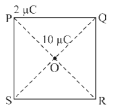
A charge of $10 \mu C$ is placod at the centre of a square PQRS. How much workwill have to be done in bringing a point charge of $2 \mu C$ placed at its comer P to Q ?
Answer
Zero, because $V _P= V _{ Q }$ and P and Q are at the same distance from the charge $10 \mu C$ located at centre O .
Image
View full question & answer
Question 431 Mark
Do electrons try to move to a higher potential region or a lower potential region, why?
Answer
Electrons try to move to higher potential regions because they are negatively charged.
View full question & answer
Question 441 Mark
Does the electric potential increase or decrease when moving along the lines of electric force?
Answer
Potential decreases
View full question & answer
Question 451 Mark
What is the shape of equipotential surfaces due to the following? (a) Due to point charge (b) Due to uniform electric field.
Answer
(a) Concentric sphere drawn considering point charge as centre.
(b) Planes parallel to each other perpendicular to the lines of electric force.
View full question & answer
Question 461 Mark
Define the unit of electric potential.
Answer
The unit of electric potential is the volt, which is defined as follows: "If one joule of work has to be done in bringing one coulomb test positive charge from infinity to a point under the electric field opposite to the direction of the field, then at that point the value of electric potential will be one volt."
View full question & answer
Question 471 Mark
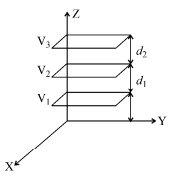
Draw three equipotential surfaces corresponding to the field whose magnitude increases uniformly, but remains constant along the z-direction. How are these surfaces different from those that lie along the z- direction of a constant electric field?
Answer
Image
$E _2=\frac{ V _3- V _2}{d_2}$
$E _1=\frac{ V _2- V _1}{d_1}$
If E is uniform then $d_1=d_2$|
For a uniform field, the potential on every plane will be the same
View full question & answer
Question 481 Mark
Name the physical quantity whose unit is Joule/Coulomb. Is it a vector quantity or a scalar?
Answer
Electric potential or electric potential difference, scalar.
View full question & answer
Question 491 Mark
Can the electric field at any point be zero, while the electric potential at the same point may not be zero? Give examples.
Answer
Yes, (i) At the midpoint of the line joining two charges of equal magnitude and similar nature, the electric field is zero, not the electric potential.
(ii) The electric field inside a charged spherical shell is zero, Not electric potential.
View full question & answer
Question 501 Mark
Can the electric potential at any point in vacuum be zero, even though the electric field at that point is not zero?
Answer
Yes, (i) At the midpoint of the line joining two charges of equal magnitude and opposite nature, the electric potential is zero, not the electric field.
(ii) In the equatorial position of an electric dipole, the electric potential is zero, not the electric field.
View full question & answer
Question 511 Mark
The potential difference between two points is 20 volts. How much work will be required to move $4 \times 10^{-4}$ coulombs charge from one point to another?
Answer
Work $(W)=$ Charge $(q)$ $\times$ potential difference (V)
$=4 \times 10^{-4} \times 20=8 \times 10^{-3}$ joules
View full question & answer
Question 521 Mark
Electric potential V in any field is constant. What can you say about the electric field E there?
Answer
We would say that the electric field E in that region will be zero.
View full question & answer