Question
How resistivity of material depends on its temperature. Write its empirical formula.

Answer

$\rightarrow $The resistivity of a material depends on temperature. Different materials do not exhibit the same dependence on temperature.
$\rightarrow $Over a limited range of temperatures (not too large), the resistivity of a metallic conductor is given by,
$\rightarrow \rho_{ T }= \rho _0\left[1+\alpha\left( T - T _0\right)\right]$
where,
$\rho _{ T }=$ the resistivity at temp. $T$
$\rho _0=$ the resistivity at reference temp.
$\alpha=$ temperature co-efficient of resistivity
$ \text { (unit }{ }^{\circ} C ^{-1} \text { or } K ^{-1} \text { ) }$
$T =$ given temperature
$T _0=$ reference temperature

Need a full question paper?

Generate a complete, print-ready paper with questions like this in minutes — across 16+ boards, with answer keys.
Start Generating Free

Similar questions

An optical fibre $(\mu=1.72)$ is surrounded by a glass coating $(\mu=1.50).$ Find the critical angle for total internal/ reflection at the fibre-glass interface.
Can a gravitational field be added vectorially to an electric field to get a total field?
A small metal sphere with $+Q$ charge is placed in the cavity of a larger uncharged metal sphere. As shown in the Fig. Find the value of electric field intensity at point $P_1$ and $P_2$ from Gauss's law.
A particle of mass 0.3kg is subjected to a force F = -kx with k = 15N/m. What will be its initial acceleration if it is released from a point x = 20cm?
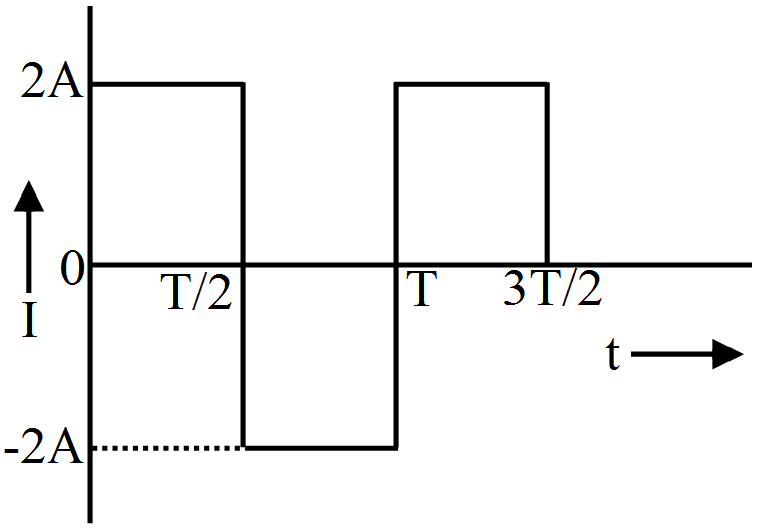
What is the rms value of alternating current shown in figure?
Suppose the initial charge on the capacitor in Exercise 7.7 is 6mC. What is the total energy stored in the circuit initially? What is the total energy at later time?
What is the Brewster angle for air to glass transition? (Refractive index of glass = 1.5.)
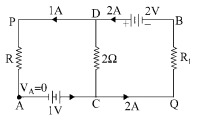
In the given figure, point A is at zero potential. Use Kirchhoff's rules to find out the potential at B.
Image
Two point sources of sound are kept at a separation of 10cm. They vibrate in phase to produce waves of wavelength 5.0cm. What would be the phase difference between the two waves arriving at a point 20cm from one source-
  1. On the line joining the sources.
  2. On the perpendicular bisector of the line joining the sources?
A point charge is taken from a point A to a point B in an electric field. Does the work done by the electric field depend on the path of the charge?