Question
How to use Kirchhoff's rules ?

Answer

First, label currents in each resistor by symbol I and a directed arrow to indicate that a current flows along the resistor in the direction indicated.
If ultimately I is to be positive, the actual current in the resistor is in the direction of the arrow.
If I turns out to be negative, the current actually flows in a direction opposite to the arrow.
For each source (i.e cell or some other source of electrical power) the positive and negative terminals are labelled as well as a directed arrow with a symbol for the current flowing through the cell.
The potential difference of the cell $V = V ( P )$ $- V ( N )=\varepsilon- I r$ which is between the positive terminal P and negative terminal N .
If while labelling the current through the cell goes from P to N then $V =\varepsilon+ Ir$.

Need a full question paper?

Generate a complete, print-ready paper with questions like this in minutes — across 16+ boards, with answer keys.
Start Generating Free

Similar questions

A proton and an a particle are accelerated through the same potential difference. Which one of the two has (i) greater de-Broglie wavelength, and (ii) less kinetic energy? Justify your answer.
It is said that the separation between the two charges forming an electric dipole should be small. Small compared to what?
The torque on a current loop is zero if the angle between the positive normal and the magnetic field is either $\theta=0^\circ$ or $\theta=180^\circ$ In which of the two orientations, the equilibrium is stable?
If a person lives on the average 100 years in his rest frame how long does he live in the earth frame if he spends all his life on a spaceship going at 60% of the speed of light.
A $U-$ tube containing a liquid is accelerated horizontally with a constant acceleration $a_0.$ If the separation between the vertical limbs is $1,$ find the difference in the heights of the liquid in the two arms.
A potential difference of 12 volt is applied across the ends of 0.24 m long conductor. Calculate the drift velocity of the electrons. Mobility of electron is $5.6 \times 10^{-6} m^2 V^{-1} s^{-1}$.
A block of mass $2.00\ kg$ moving at a speed of $10.0\ m/s$ accelerates at $3.00\ m/s^2$ for $5.00s.$ Compute its final kinetic energy.
$a$. Show that the time period $(T)$ of oscillations of a freely suspended magnetic dipole of magnetic moment $(m)$ in a uniform magnetic field $(B)$ is given by $T=2 \pi \sqrt{\frac{I}{m B}},$ where $I$ is a moment of inertia of the magnetic dipole.
$b$. Identify the following magnetic materials:
$i$. A material having susceptibility $\left(\chi_m\right)=-0.00015$.
$ii.$ A material having susceptibility $\left(\chi_m\right)=10^{-5}$.
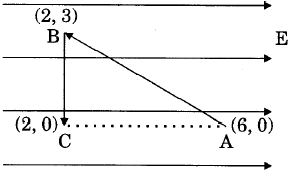
A test charge $'q\ '$ is moved without acceleration from $A$ to $C$ along the path from $A$ to $B$ and then from $B$ to $C$ in electric field $E$ as shown in the figure. $(i)$ Calculate the potential difference between $A$ and $C. (ii)$ At which point $($of the two$)$ is the electric potentialmore and why?
A farsighted person cannot see objects placed closer to 50cm. Find the power of the lens needed to see the objects at 20cm.