Questions

2 Marks Questions

Take a timed test

25 questions · self-marked practice — reveal the answer and mark yourself.

Question 12 Marks
Write a short note on mobility of charge carriers.
Answer
Conductivity of conductor arises from mobile charge carriers.
In metals, electrons are mobile charge carriers. In an electrolyte they are positive and negative ions while in an ionised gas, they are electrons and positive charged ions. In semi conductors, free electrons and holes are mobile charge carriers.
"The magnitude of the drift velocity per unit electric field is called the mobility ( $\mu$ )."
$\mu=\frac{\left|\overrightarrow{v_d}\right|}{ E }$
The SI unit of mobility is $m ^2 / V s$ and practical unit is $cm ^2 / Vs$
Dimensional formula of mobility is $M ^{-1} L^0 T^2 A^1$
Using drift velocity $\left|\vec{v}_d\right|=\frac{E e}{m} \cdot \tau$ in equation (1).
we get,
$\begin{aligned}
\mu & =\frac{\frac{e E}{m} \tau}{ E } \\
\therefore \mu & =\frac{e \tau}{m}
\end{aligned}$
where $\tau$ is the average collision time for electrons.
View full question & answer
Question 22 Marks
Write the statements of Kirchhoff's laws.
Answer
The statements of Kirchhoff"s laws are as follows:
(1) Junction rule : "At any junction, the sum of the currents entering the junction is equal to the sum of currents leaving the junction."
(2) Loop rule : "The algebraic sum of changes in potential around any closed loop involving resistors and cells in the loop is zero."
Kirchhoff's junction rule works on the law of conservation of charge and loop rule works on the law of conservation of energy.
View full question & answer
Question 32 Marks
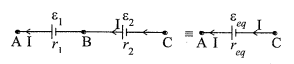
Explain series connection of cells. Derive the formula for equivalent emf and equivalent internal resistance for series connection of cell.
Answer
Image

The figure shows the series connection of two cells. The emf of two cells are $\varepsilon_1$ and $\varepsilon_2$ respectively and their internal resistences are $r_1$ and $r_2$ respectively. The current I is passing through this combination.
View full question & answer
Question 42 Marks
What is electric current ? Explain about it.
Answer
$\rightarrow$ To understand electric current, imagine a small area held normal $($Perpendicular$)$ to the direction of flow of charges.
$\rightarrow$ Both the positive and the negative charges may flow forward and backward across the area.
$\rightarrow$ Let $q_{+}$ be the net amount of positive charge that flows in the forward direction across the area Similarly, let $q_{-}$be the net amount of negative charge flowing across the area in the forward direction.
$\rightarrow$ The net amount of charge flowing across the area in the forward direction in the time interval $t$ , is
$q=q_{+}-q_{-}$
$\rightarrow$ For steady current, electric charge is proportional to time. so,
$\therefore q \propto t$
$\therefore I =\frac{q}{t}$
$\rightarrow$ Electric current : "The amount of electric charge passing perpendicularly through the cross$-$section of a conductor per unit time is called electric current."
$\rightarrow$ An electric current which does not change with time is called steady current.
$\rightarrow$ Currents are not always steady. In that case, average value or instantaneous value of current has to be considered.
$\rightarrow$ Let $\Delta Q$ be the net charge flowing across $a ^{\prime}$ cross$-$ section of a conductor during the time interval $\Delta t$, then the average current flowing through the conductor is
$< I >=\frac{\Delta Q }{\Delta t}$
$\rightarrow$ The current at time $t$ across the cross$-$ section of the conductor is defined as the value of the ratio of $\Delta Q$ to $\Delta t$ in the limit of $\Delta t$ tending to zero. So, instantaneous current
$I =\lim _{\Delta t \rightarrow 0} \frac{\Delta Q }{\Delta t}$
$\therefore I =\frac{d Q }{d t}$
$\rightarrow$ The unit of electric current is ampere $(A)$ and current is a scalar quantity.
$\rightarrow$ An ampere is typically the order of magnitude of currents in domestic appliances.
$\rightarrow$ An average lighting carries currents of the order of tens of thousands of amperes $\left(\sim 10^4 A\right.).$
$\rightarrow$ Currents in nerves of our body are in the order of microamperes. $\left(\sim 10^{-6} A\right)$
View full question & answer
Question 52 Marks
Explain from where does the dissipated power in the resistor come form. 
###
Write a short note on electric cell.
Answer
→Electric cell :
We need an external source to keep a steady current through the conductor.

Image
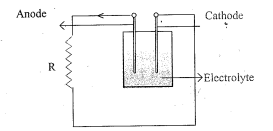
This external source supplies the required power. To explain this a, simple circuit with a cell is shown in the figure.
As shown in the figure, when external resistor is connected with a cell, the energy is dissipated in the form of heat across the resistor. This energy comes from the chemical energy of the cell.
As long as this cell supplies chemical energy to the circuit, the circuit receives power.
View full question & answer
Question 62 Marks
Why are cells combined ? Also, how can the combination of cells be done?
Answer
Desired current or voltage cannot be obtained with the help of a single cell. In such circumstances, the required current or voltage can be obtained by combining more than one cell.
The combination of cells can be done in three ways :
(1) Series connection (or combination)
(2) Parallel connection
(3) Mixed connection
View full question & answer
Question 72 Marks
Write the definition of electric current and mention its types.
Answer
→"The amount of electric charge passing through the cross-section perpendicularly through the cross-section of a conductor per unit time is called electric current (I)."
There are two types of electric current.
(1) momentary current
(2) steady current
View full question & answer
Question 82 Marks
Explain network, junction point (branch point) and loop.
Answer
Simple circuits can be easily understood by using ohm's law only.
"If the components of circuit like resistors, capacitors, inductors and electric cells are connected to each other in a very complex way, then such a circuit cannot be studied just by using ohm's law. Such a complex circuit is called a network."
Junction point (branch point) : The point in a network, where more than two conductors meet is called a junction point (or branch point)
Loop : A closed circuit formed by conductors is called loop.
View full question & answer
Question 92 Marks
What is conductivity ? On which what factors does it depend and also write its unit and dimension.
Answer
Definition : "Reciprocal of resistivity is called conductivity."
$\therefore \sigma=\frac{1}{ρ}$
Unit of conductivity $\frac{1}{\Omega m }$ or $\mho m ^{-1}(\mho$ is called mho)
Dimensional formula of conductivity is $M ^{-1} L^{-3} T^3 A^2$
The conductivity depends on type of material and temperature. It does not depend on dimension.
View full question & answer
Question 102 Marks
Explain why current is not formed in solid conductors in the absence of electric field.
Answer
In metals, current is carried by free electrons in the background of fixed positive ions.
In absence of electric field, the electrons will be moving due to thermal energy. During this, they collide with the fixed ions.
An electron colliding with an ion emerges with the same speed as before the collision but the direction of its velocity after the collision is completely random.
Thus on an average, the number of electrons travelling in any direction will be equal to the number of electrons travelling in the opposite direction.
So, there will be no net current inside the conductor in the absence of electric field.
View full question & answer
Question 112 Marks
State the sign convention for applying Kirchhoff's loop rules.
Answer
(1) If our journey through the resistor is in the direction of flow of current, IR ( $= V$ potential) should be considered negative and if the direction of journey and the direction of current are opposite to each other, IR should be considerd positive (while writing on the left side of the equation.)
    (2) The emf of a battery should be considered positive while moving from negative terminal to the positive terminal of a battery (while writing on the left side of the equation.) The emf of a battery should be considered negative while moving from positive to the negative terminal of a battery.
The direction of the electric current can be arbitrarily chosen while using Kirchhoff's rules to analyze any network. If we shall get negative value of the current, the direction of current which is arbitrarily chosen is opposite to the actual direction of current.
View full question & answer
Question 122 Marks
Explain the classification of material in terms of resistivity.
Answer
All materials fall under any one of these categories :
(1) conductor
(2) semi conductors and
(3) insulator.
Among conductors, semi conductors and insulators, conductors have the lowest resistivity and insulators have the highest resistivity.
The resistivity of metals (conductors) is in the range of $10^{-8} \Omega m$ to $10^{-6} \Omega m$.
The resistivity of an insulator is $10^{18}$ times higher than the metals.
The resistivity of a semi conductor lies between the conductor and the insulator.
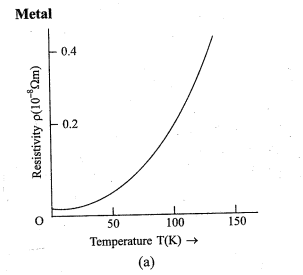
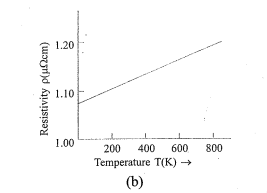
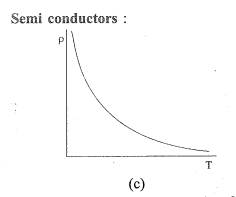
By increasing the temperature within a certain limit, the resistivity of metals increases with temperature while the resistivity of semi conductors decreases with temperature.
The resistivity of semi conductors is also affected by presence of small amount of impurities.
This feature is useful to make electronic devices from the semi conductors.
View full question & answer
Question 132 Marks
Why is transmission of electric power at very far distance done at very high voltage ?
Answer
Electric power is transmitted via transmission cables from power stations to homes and factories, so power is dissipated in the cable.
To minimise the power loss in the transmission cables, consider a device to which a power P is to be delivered via transmission cables having resistance $R_c$.
Assume V is the voltage across the device and current I through it.
Power dissipated by the device is $P = VI \ldots$ (1)
Suppose, the connecting wire from the power station to the device has a resistance $R _c$ then the power dissipated in the connecting wires is $P _{ c }= I ^2 R _{ c }$
but from equation (1) $I=\frac{P}{V}$
$\therefore \quad P _c=\frac{ P ^2 R _c}{V^2}$
Thus, the power $P _c$ dissipated in the wire connecting the device to the power station is inversely proportional to $V ^2 .\left( P _c \propto \frac{1}{V^2}\right)$.
So, to reduce the power loss, high voltage current is passed through the wire/cable at very far distance.
View full question & answer
Question 142 Marks
Write the important points for series connection of cells.
Answer
When the current leaves each cell from the positive terminal then :
(1) The equivalent emf of a series combination of $n$ cells is just the sum of their individual emfs.
(2) The equivalent internal resistance of a series combination of $n$ cells is just the sum of their individual internal resistances.
(3) In this type of combination, if the current leaves the cell from negative terminal then to obtain equivalent emf, the emf of that cell is taken negative.
View full question & answer
Question 152 Marks
Explain current formed in solid conductors in presence of external electric field.
Answer
Image

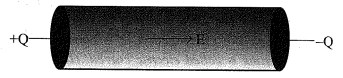
A cylindrical conductor of radius R is shown in the figure, Two thin insulating discs (or dielectric discs) of same radius are placed at the ends of this cylinder. The charges on these discs are $+Q$ and - Q respectively.
An electric field will be created and it is directed from the positive charge $+Q$ towards the negative charge $-Q$.
Due to this electric field, the electrons will be accelerated towards + Q . Such motion continues until the electron neutralizes the charge + Q . This will constitute an electric current.
When this disc is neutralized by the electrons, electrons stop moving. As a result, no current flows. Hence in the considered situation, there will be a current for a short peroid.
Now we can imagine a mechanism where the ends of the cylinder are supplied with fresh charges to make up for any charges neutralized by electrons moving inside the conductor.
In that case, there will be a steady electric field in the conductor. This will result in a continuous current rather than a current for a short period of time.
Electric cells or batteries can maintain a steady electric field that results in a steady current inside the conductor.
View full question & answer
Question 162 Marks
How to use Kirchhoff's rules ?
Answer
First, label currents in each resistor by symbol I and a directed arrow to indicate that a current flows along the resistor in the direction indicated.
If ultimately I is to be positive, the actual current in the resistor is in the direction of the arrow.
If I turns out to be negative, the current actually flows in a direction opposite to the arrow.
For each source (i.e cell or some other source of electrical power) the positive and negative terminals are labelled as well as a directed arrow with a symbol for the current flowing through the cell.
The potential difference of the cell $V = V ( P )$ $- V ( N )=\varepsilon- I r$ which is between the positive terminal P and negative terminal N .
If while labelling the current through the cell goes from P to N then $V =\varepsilon+ Ir$.
View full question & answer
Question 172 Marks
When can the internal resistance of the cell can be neglected? Derive the formula for the current when cell is connected to the external resistance $R$.
Answer
In practical calculations, when the current I is such that $\varepsilon>> I r$ then the internal resistance of the cell can be neglected.
The actual values of the internal resistances of cells vary from cell to cell. For example, the internal resistance of dry cells is much higher than the common electrolytic cells.
If V is the potential difference across external resistor $R$, then from ohm's law.
$V = IR$
Using above equation in $V =\varepsilon- Ir$
$\begin{array}{ll}
\therefore & IR =\varepsilon- I r \\
\therefore & \varepsilon= I ( R +r) \\
\therefore & I =\frac{\varepsilon}{r+ R }
\end{array}$
If $R =0$, the maximum current that can be drawn from a cell is :
$\therefore \quad I _{\max }=\frac{\varepsilon}{r}$
View full question & answer
Question 182 Marks
By explaining the $($Electric$)$ current density, derive Ohm's law in vector form.
Answer
$\rightarrow$ Current density : "The electric current flowing per unit cross sectional area perpendicular to the current is called the $($electric$)$ current density $(\vec{j}) . "$
$\rightarrow$ Suppose current $I$ is flowing through the cross sectional area $A$ , then electric current density
$\therefore j=\frac{ I }{ A }$
$\rightarrow$ The $SI$ unit of current density is $\frac{ A }{ m ^2}$.
$\rightarrow$ It is a vector quantity and the dimensional formula is $M ^0 L^{-2} T^0 A^1$.
$\rightarrow$ If the magnitude of uniform electric field in the conductor of length $l$ is $E ,$ then the potential difference across its ends, $V = E l$
$\rightarrow$ According to the ohm's law
$\text{V = IR}$
but $R =\frac{ \rho l}{A}$
$V =\frac{ I\rho l}{A}$
$\therefore E l =\frac{ I\rho l}{A}$
$\therefore E =\frac{ I\rho }{ A } (\because V = E l)$
$\rightarrow$ Using equation $(1),$
$\therefore E =j \rho$
$\rightarrow$ The reciprocal of resistivity is called the conductivity of material.
$\therefore \sigma=\frac{1}{\rho }$
$\rightarrow$ where $\sigma=$ conductivity of material from equation $(2)$ and $(3),$
$\therefore E =\frac{j}{\sigma}$
$\therefore j=\sigma E$
$\rightarrow$ This equation can be written in vector form
$\therefore \vec{j}=\sigma \overrightarrow{ E }$
$\rightarrow$ This equation is called vector form of Ohm's law.
View full question & answer
Question 192 Marks
Write and explain Kirchhoff's junction rule.
Answer
$\rightarrow$ Kirchhoff's junction rule : "At any junction, the sum of the currents entering the junction is equal to the sum of currents leaving the junction."
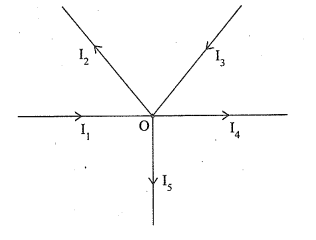
$\rightarrow$ Consider junction $O$ of a network as shown in the figure.

Image
$\rightarrow$ The currents meeting at the junction point $O$ are $I _1, I _2, I _3, I _4$ and $I _5$ respectively.
Their directions are represented by arrows in the figure.
$\rightarrow$ Let $Q_1, Q_2, Q_3, Q_4$, and $Q_5$ be charges flowing through the cross$-$sectional area of conductors at time $t$ respectively.
$\rightarrow$ Thus,
$I _1=\frac{ Q _1}{t} \therefore Q _1= I _1 t$
$I _2=\frac{ Q _2}{t} \therefore Q _2= I _2 t$
$I _3=\frac{ Q _3}{t} \therefore Q _3= I _3 t$
$I _4=\frac{ Q _4}{t} \therefore Q _4= I _4 t$
$I _5=\frac{ Q _5}{t} \therefore Q _5= I _5 t$
$\rightarrow$ From the figure, the total electric charge entering the junction is $Q_1+Q_3$ while $Q_2+Q_4+Q_5$ amount of electric charge is leaving the junction in time $t$.
$\rightarrow$ According to the law of conservation of charge,
$Q _1+ Q _3= Q _2+ Q _4+ Q _5$
$\therefore I _1 t+ I _3 t= I _2 t+ I _4 t+ I _5 t$
$\therefore I _1+ I _3= I _2+ I _4+ I _5$
$\rightarrow$ Thus at the junction the sum of the currents entering the junction is equal to the sum of currents leaving the junction.
View full question & answer
Question 202 Marks
Explain Ohm's law.
Answer
→Statement of Ohm's law :
"Under a definite physical condition, the current (I) flowing through the conductor is directly proportional to the potential difference (V) applied across its ends."
This law was discovered by G.S. Ohm.
Imagine a conductor in which a current I is flowing and the potential difference between the ends of the conductor is V .
According to Ohm's law
$\begin{aligned}
V & \propto I \\
\therefore \quad V & = RI
\end{aligned}$
Where R is the constant of proportionality. It is called the resistance of the conductor.
The SI unit of resistance is ohm and it is denoted by $\Omega$.
The resistance depends on the
(i) material
(ii) temperature and
(iii) dimensions of the conductor.
View full question & answer
Question 212 Marks
Explain how current is formed in conductors.
Answer
If an electric field is applied to conductor, an electric charge inside the conductor will experience a force. If electric charges are free to move then they constitute an electric current.
In nature such free electric charges are located in the upper layer of atmosphere called the ionosphere.
In atoms and molecules, the electrons and the positively charged nuclei are bound to each other by electric force so, electrons are not free to move.
Electrons are bound in some objects, so they do not accelerate even when an electric field is applied.
In metals, the electrons are free to move within the material; but the motion of electrons is random. Due to this random motion no electric current is observed.
When an external electric field is applied to them, á force is exerted on electrons, so all of them move in one direction which will create an electric current.
In solid conductors, the current is carried by free electrons. where as in electrolytic solution both positive and negative ions develop electric current.
In gases, the current is carried by ions, while in semi conductors free electrons and holes create electric current.
View full question & answer
Question 222 Marks
Write the definition of electric current and ampere $(A)$ and different units of electric current.
Answer
$\rightarrow$ Electric current : "The amount of electric charge passing perpendicularly through the cross $-$ section of a conductor per unit time is called electric current $(I)."$
$\rightarrow 1$ Ampere : "If $IC$ of charges flowing through any cross $-$ section of a conductor in $1$ second, then the current is said to be $1 $ ampere."
$\rightarrow$ Different units of electric current are,
$1 mA=10^{-3} A$
$1 \mu A =10^{-6} A$
$1 nA =10^{-9} A$
View full question & answer
Question 232 Marks
Draw $ৎ \rightarrow$ T graph for metals, alloys and semi conductor and explain.
View full question & answer
Question 242 Marks
How resistivity of material depends on its temperature. Write its empirical formula.
Answer
$\rightarrow $ The resistivity of a material depends on temperature. Different materials do not exhibit the same dependence on temperature.
$\rightarrow $ Over a limited range of temperatures $($not too large$),$ the resistivity of a metallic conductor is given by,
$\rightarrow \rho_{ T }= \rho _0\left[1+\alpha\left( T - T _0\right)\right]$
where,
$\rho _{ T }=\text { the resistivity at temp. } T$
$\rho _0=\text { the resistivity at reference temp. }$
$\alpha=\text { temperature co-efficient of resistivity }$
$ \text { (unit }{ }^{\circ} C ^{-1} \text { or } K ^{-1} \text { ) }$
$T =\text { given temperature }$
$T _0=\text { reference temperature }$
View full question & answer
Question 252 Marks
What is resistivity ? On What factors does it depend and write its unit and dimensional formula.
Answer
Resistance of material
$R =\frac{ ρ l}{A}$
where $ρ =$ resistivity of conductor
$\therefore ρ=\frac{R A}{l}$
If we take $A =1$ unit $\left( A =1 m^2\right)$ and $l=1$ unit $(l=1 m)$ then $\rho= R$.
Definition : Resistance of a conductor having unit cross- sectional area and unit length is called resistivity.
The magnitude of resistivity depends on the type of material and temperature but it does not depend on the dimensions of material.
The unit of resistivity is $\Omega m$ and its dimensional formula $M ^1 L^3 T^{-3} A^{-2}$.
View full question & answer