Question
How will you bring about following conversions:
(a) Methane to methanol
(b) Ethane to ethanol (acetaldehyde)
(c) Methane to methanoic acid

Answer

(a) Methane to methanol:
$
2 CH _4+ O _2 \xrightarrow[200^{\circ} C ]{ cu } 2 CH _3 OH
$
(b) Ethane to ethanal(acetaldehyde):
$
2 C _2 H _6+ O _2 \xrightarrow[200^{\circ} Cu ]{ Cu } 2 C _2 H _5 OH
$
$
C _2 H _5 OH \xrightarrow[\text { acidic }]{ K _2 Or _2 O _7} CH _3 CHO
$
(c) Methane to methanoic acid:
$
2 CH _4+ O _2 \xrightarrow[200^{\circ} Cl ]{ Cu } 2 CH _3 OH
$
$
CH _3 OH \xrightarrow[\text { acidic }]{ K _2 Or _2 O _7} HCHO \xrightarrow[\text { acidic }]{ K _2 Or _2 O _7} HCOOH
$

Need a full question paper?

Generate a complete, print-ready paper with questions like this in minutes — across 16+ boards, with answer keys.

Start Generating Free

Similar questions

An organic compound with vapour density $= 94$ contains $C = 12.67\%, H = 2.13\%$ and $Br = 85.11\%.$ Find the molecule formula. $[$Atomic mass $C = 12, H = 1, Br = 80]$
Chlorine, nitrogen, ammonia and sulphur dioxide gases are collected under the same conditions of temperature and pressure.
Copy the following table which gives the volumes of the gases collected, and the number of molecules (X) in 20L of nitrogen.You are to complete the table by giving the number of molecules in th e other gases, in terms of X.
Gas Volume(litres) Number of molecules
Chlorine 10  
Nitrogen 20 X
Ammonia 20  
Sulphur dioxide 5  
Answer the following question:
Write the chemical formula of one main ore of iron and aluminium.
A compound X when treated with an organic acid Y (having vinegar-like smell) in the presence of the acid Z, forms a compound P which has a fruity smell.
(a) Identify X, Y, and Z
(b) Write the structural formula of X and Y.
(c) What type of compound P is?
(d)Name the above reaction.
(e) If compound X and Y both have 2 carbon atoms. Write the reaction.
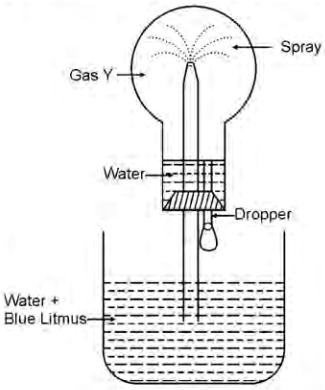
Study the figure given alongside and answer the questions that follow :
Image
(i) Name the experiment illustrated here.
(ii) Identify the gas Y.
(iii) What property of gas Y demonstrated by this experiment?
(iv) Explain the observations of the experiment.
Compare the properties of a typical metal and a non- metal on the basis of the following:
(a) electronic configuration
(b) nature of oxides
(c) oxidizing or reducing action
(d) conductivity of heat and electricity
Complete the following table and write one equation for each to justify the statement :
Reactants Products Method
Soluble base + Acid (dil) Salt + water Neutralisation Titration
Metal + Non-metal Salt (soluble/insoluble) ……………
Insoluble base + .......... Salt (soluble) + water …………….
Active metal + Acid (dil) ………… + ………… …………….
Soluble salt solution (A) + Soluble salt solution (B) Precipitated salt + Soluble salt …………….
Carbonate/ bicarbonate + Acid (dil) Salt + ………. + ………… Decomposition of carbonate
Chlorides/nitrates + Acid (conc) …………. + ………… Decomposition of chlorides and nitrates

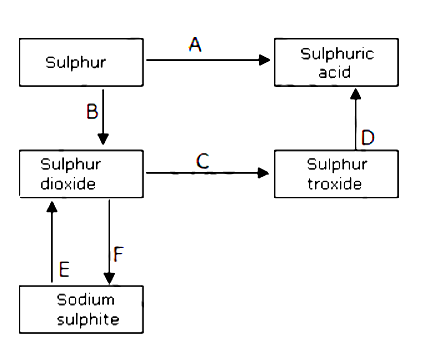
(i) Name the catalyst which helps in the conversion of sulphur dioxide to sulphur trioxide in step $C.$
(ii) In the contact process for the manufacture of sulphuric acid, sulphur trioxide is not converted to sulphuric acid by reacting it with water. Instead a two-step procedure is used. Write the equations for the two steps involved in $D.$
(iii) What type of substance will liberate sulphur dioxide from sodium sulphite in step $E?$​​​​​​​
(iv) Write the equation for the reaction by which sulphur dioxide is converted to sodium sulphite in step $F ?$
Two oxides of a metal $(M)$ have $20.12\%$ and $11.19\%$ oxygen. The formula of the first oxide is $MO$. Determine the formula of the second oxide.
Give one use each of four different compounds of ammonia.