How will you bring about the following conversion?
Ethanol to ethyl fluoride.
Ethanol to ethyl fluoride.
Download our app for free and get started
Propene to propyne.
$\text{HC}_3-\text{HC}_2-\text{OH}\xrightarrow[-\text{POCL}_3,-\text{HCL}]{\text{PCL}_5}\text{CH}_3-\text{CH}_2-\text{Cl}\ \\ \text{Ethanol}\ \ \ \ \ \ \ \ \ \ \ \ \ \ \ \ \ \ \ \ \ \ \ \ \ \ \ \ \ \ \ \ \ \ \ \ \ \ \ \ \ \ \ \ \ \ \ \ \text{Chloroethane}\\ \ \ \ \ \ \ \ \ \ \ \ \ \ \ \ \ \ \ \ \ \ \ \ \ \ \ \ \ \ \ \ \ \ \ \ \ \ \ \ \ \ \ \ \ \ \ \ \ \ \ \ \ \ \ \ \ \ \ \ \ \ \ \ \ \ \ \ \ \ \ \Bigg\downarrow\text{AgF}\\ \ \ \ \ \ \ \ \ \ \ \ \ \ \ \ \ \ \ \ \ \ \ \ \ \ \ \ \ \ \ \ \ \ \ \ \ \ \ \ \ \ \ \ \ \ \ \ \ \ \ \ \ \ \ \ \ \ \text{HC}_3-\text{HC}_2-\text{F}\\ \ \ \ \ \ \ \ \ \ \ \ \ \ \ \ \ \ \ \ \ \ \ \ \ \ \ \ \ \ \ \ \ \ \ \ \ \ \ \ \ \ \ \ \ \ \ \ \ \ \ \ \ \ \ \ \ \ \ \ \text{Ethyl fluoride}$
$\text{HC}_3-\text{HC}_2-\text{OH}\xrightarrow[-\text{POCL}_3,-\text{HCL}]{\text{PCL}_5}\text{CH}_3-\text{CH}_2-\text{Cl}\ \\ \text{Ethanol}\ \ \ \ \ \ \ \ \ \ \ \ \ \ \ \ \ \ \ \ \ \ \ \ \ \ \ \ \ \ \ \ \ \ \ \ \ \ \ \ \ \ \ \ \ \ \ \ \text{Chloroethane}\\ \ \ \ \ \ \ \ \ \ \ \ \ \ \ \ \ \ \ \ \ \ \ \ \ \ \ \ \ \ \ \ \ \ \ \ \ \ \ \ \ \ \ \ \ \ \ \ \ \ \ \ \ \ \ \ \ \ \ \ \ \ \ \ \ \ \ \ \ \ \ \Bigg\downarrow\text{AgF}\\ \ \ \ \ \ \ \ \ \ \ \ \ \ \ \ \ \ \ \ \ \ \ \ \ \ \ \ \ \ \ \ \ \ \ \ \ \ \ \ \ \ \ \ \ \ \ \ \ \ \ \ \ \ \ \ \ \ \text{HC}_3-\text{HC}_2-\text{F}\\ \ \ \ \ \ \ \ \ \ \ \ \ \ \ \ \ \ \ \ \ \ \ \ \ \ \ \ \ \ \ \ \ \ \ \ \ \ \ \ \ \ \ \ \ \ \ \ \ \ \ \ \ \ \ \ \ \ \ \ \text{Ethyl fluoride}$

Download our appand get started for free
Experience the future of education. Simply download our apps or reach out to us for more information. Let's shape the future of learning together!No signup needed.*
Similar Questions
- 1View SolutionArrange each set of compound in order of increasing boiling points.
1-Chloropropane, Isopropyl chloride, 1-Chlorobutane. - 2View SolutionOut of o-and p-dibromobenzene which one has higher melting point and why?
- 3View SolutionWrite the IUPAC name of.
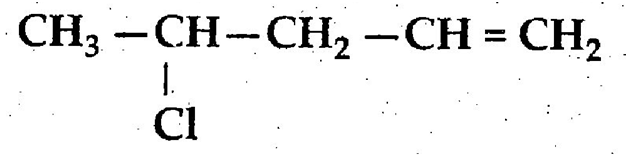
- 4View SolutionHow will you bring about the following conversion?
But-1-ene to but-2-ene. - 5View SolutionHow the following conversion can be carried out?
Ethanol to but-1-yne. - 6Write the structure of the major organic product in each of the following reaction:View Solution
$\text{CH}_3\text{CH}_2\text{CH}_2\text{OH}+\text{SOCl}_2\xrightarrow{}$ - 7Write the structure of the major organic product in each of the following reaction:View Solution
$\text{CH}_3\text{CH}=\text{C}(\text{CH}_3)_2+\text{HBr}\xrightarrow{}$ - 8A hydrocarbon $\ce{C_5H_{10}}$ does not react with chlorine in dark but gives a single monochloro compound $\ce{C_5H_9Cl}$ in bright sunlight. Identify the hydrocarbon.View Solution
- 9View SolutionWhat are ambident nucleophiles? Explain with an example.
- 10View SolutionHow will you bring about the following conversion?
Propene to propyne.