Question
How will you demonstrate the solubility of ammonia in water? Explain.

Answer

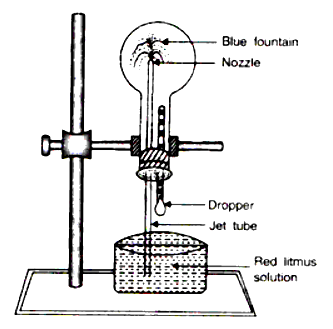
Ammonia is highly soluble in water. This can be demonstrated by Fountain
experiment.
• We take a round bottom flask filled with ammonia gas.
• The flask is closed with a two holed rubber stopper, one for the jet tube and the other for a dropper filled with water.
• The flask is fixed to the stand in an inverted position .
• The free end of the jet tube is dipped into a beaker containing red litmus
solution .
• When the bulb of dropper is pressed, it is observed that red litmus solution rises up and strikes the wall of the flask and spreads in form of fountain, which is blue in colour.
Need a full question paper?

Generate a complete, print-ready paper with questions like this in minutes — across 16+ boards, with answer keys.

Start Generating Free

Similar questions

Four elements A, B, C, D and E have the following electron arrangements in their atoms:
A2, 8, 6
B2, 8, 8
C2, 8, 8, 1
D2,7
E2, 8, 2
(i) What type of bond is formed when 'A' combines with 'C'?
(ii) Which two elements will combine to form a covalent bond?
(iii) Which element is not able to form any type of bond?
(iv) Draw electron dot structure of bond formation of 'A' molecule.
(v) Which ion will be formed by 'D' to attain stability? Justify with the chemical equation.
The usefulness of a fertilizer depends upon percentage of nitrogen present in it. Find which of the following is a better fertilizer:
$(a)$ Ammonium nitrate $[NH_4NO_3]$
$(b)$ Ammonium phosphate $[(NH_4)_3PO_4(N=14,H=1,O=16,P=31)]$
$O_2$ is evolved by heating $\text{KCIO}_3$ using $\text{MnO}_2$​​​​​​​ as a catalyst.
$2 KCI _3 \xrightarrow{ Mno _2} 2 KCl +3 O _2$
$(i)$ Calculate the mass of $\text{KClO}_3$ required to produce $6.72$ litre of $O_2$​​​​​​​ at $\text{STP}$.
$(ii)$ Calculate the number of moles of oxygen present in the above volume and also the number of molecules
$(iii)$ Calculate the volume occupied by $0.01\  mole$ of $CO_2$​​​​​​​ at $\text{STP}$
The reaction of potassium permanganate $(VII)$ with acidified iron $(II)$ sulphate is given below :
$2KMno_4 + 10FeSO_4 + 8H_2O \rightarrow K_2SO_4 + 2MnSO_4 + 5Fe2(SO_4)_3 + 8H_2O$
If $15.8g$ of potassium permanganate $(VII)$ was used in the reaction, calculate the mass of iron $(II)$ sulphate used in the above reaction.
Explain the term $: Mole$
Propane burns in air according to the following equation :
$C_3H_{8 }+ 5O_{2 }\rightarrow 3CO_2 + 4H_2O$
What volume of propane is consumed on using $1000 \ cm^3$ of air, considering only $20\%$ of air contains oxygen?
(a) Give only one suitable chemical test to identify the following gases.
(i)Ammonia
(ii) Sulphur dioxide
(iii)Hydrogen Chloride
(iv)Chlorine
(v)Carbon Dioxide
(vi)Oxygen
(vii)Hydrogen
(b) Select a basic gas mentioned in Q. 1 (a). How is the basic nature suspected?
(c) Select acidic gases from the gases mentioned in Q .1 (a). How is the acidic nature suspected?
(d) The two gases $A$ and $B$ are bleaching agents. $A$ is greenish-yellow and bleaches due to its oxidizing property while $B$ is a colourless gas that bleaches due to reduction. Identify $A$ and $B$ ?
(e) Which gas turn blue cobalt chloride paper light pink?
Give one similarity in the test between (i) $Cl _2$ and HCl (ii) $SO _2$ and $CO _2$.
$1.56 g$ of sodium peroxide reacts with water according to the following equation:
$2 Na _2 O _2+2 H _2 O 4 NaOH + O _2$
Calculate:
(a) mass of sodium hydroxide formed,
(b) The volume of oxygen liberated at S.T.P.
(c) Mass of oxygen liberated.
A metal article is to be electroplated with silver. The electrolyte selected is sodium argentocyanide.
(a) What kind of salt is sodium argento cyanide?
(b) Why is it preferred to silver nitrate as an electrolyte?
(c) State one condition to ensure that the deposit is smooth, firm and long lasting.
(d) Write the reaction taking place at the cathode.
(e) Write the reaction taking place at the anode.
How is an aqueous solution of ammonia prepared? Stage two advantages of method used.