Question types

9.1 Ammonia question types

168 questions across 6 question groups — pick any mix to generate a Chemistry paper with step-by-step answer keys.

168
Questions
6
Question groups
5
Question types
Sample Questions

9.1 Ammonia questions

One sample from each question group in this chapter. Select any group above to see the full set with answer keys.

Q 1MCQ1 Mark
Ammonia can be obtained by adding water to:
  • A
    Ammonium chloride
  • B
    Ammonium nitrite
  • Magnesium nitride
  • D
    Magnesium nitrate

Answer: C.

View full solution
Q 2MCQ1 Mark
In the Habers process for the manufacture of $NH_3$, iron is used as catalyst and molybedenum as promoter. The function of promoter is
  • A
    To Increase the rate of combination of gases
  • B
    To raise the activation energy of the reaction
  • To increase the activity of the catalyst
  • D
    To increase the yield of ammonia.

Answer: C.

View full solution
Q 3MCQ1 Mark
Liquid ammonia is used in refrigeration because of its
  • A
    High dipole moment
  • B
    Baricity
  • C
    Stability
  • High heat of vaporization

Answer: D.

View full solution
Q 4MCQ1 Mark
The other products obtained along with water where $NH_3$ is passed over heated CuO are
  • A
    $Cu \left( NH _2\right)_2$ and $H _2$
  • B
    $\left[ Cu \left( NH _3\right)_4\right]_2+\text { and } O _2$
  • Cu and $N _2$
  • D
    None of these

Answer: C.

View full solution
Q 5MCQ1 Mark
Ammonia is commercially prepared by
  • Haber's process
  • B
    Ostwald process
  • C
    Contact process
  • D
    Head chamber process

Answer: A.

View full solution
Copy and complete the following table relating to important industrial process.
Name of the process Temperature Catalyst Equation for the catalyzed reaction
Habers Process      
View full solution
State your observation for the following cases (i) Ammonia gas is burnt in an atomosphere of oxygen in the absence of a catalyst (ii) Glass rod dipped in ammonium hydroxide is brought near the mouth of the concentrated hydrochloric acid bottle
View full solution
Write the equations for the following reactions, which result in the formation of ammonia:
(i) A mixture of ammonium chloride and slaked lime is heated.
(ii) Aluminium nitride and water.
View full solution
Is ammonia denser than air? Which property of ammonia is demonstrated by the Fountain experiment? Write the balanced equation for the reaction between ammonia and sulphuric acid.
View full solution
Industrially, ammonia is obtained by direct combination of nitrogen and hydrogen.
(i) Write balanced equation for the direct combination of nitrogen and hydrogen.
(ii) Which of the metals - iron, platinum, copper - catalyse this direct combination?
(iii) Is the formation of ammonia promoted by high pressure or low pressure?
View full solution
Look at the following reaction :
A. Nitrogen + metal → compound X
B. X + water → ammonia + another compound
C. Ammonia + metal oxide → metal + water + N2
(i) One metal that can be used for reaction in A is magnesium.
(a) Write the formula of the compound X, that is formed.
(b) Write the balanced equation for reaction B, where Xis the compound formed.
( c) Which property of ammonia is demonstrated by reaction C?
View full solution
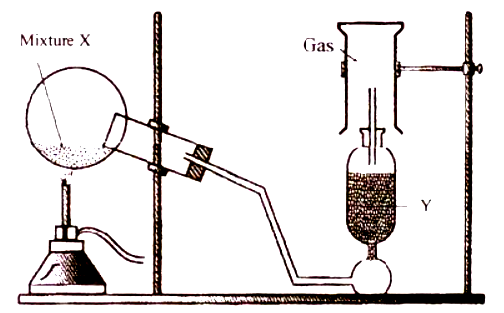
The diagram shows an experimental set-up for the laboratory prepration of a pungent smelling gas. The gas is alkaline in nature.

(i) Nature the gas collected in the jar.(ii) Write the balance equation for the above preparation.(iii) How is the gas being collected?(iv) Name the drying agent used.(v) How will you find that the jar is full of gas?
View full solution
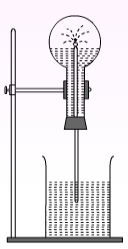
The diagram shows a simple arrangement of the fountain experiment:
Image
(i) Name the two gases you have studied which can be used in this experiment(ii) What is the common properly demonstrated by this experiment
View full solution
The questions below are related to the manufacture of ammonia. (i) Name the process (ii) In what ratio must the reactants be taken (iii) Name the catalyst used (iv) Give the equation for the manufacture of ammonia (v) Ammonia can act as a reducing agent write a relevant equation for such a reaction.
View full solution

Generate a 9.1 Ammonia paper free

Pick question groups from the list above, set marks and difficulty, and export a branded PDF with step-by-step answer keys. First 3 chapters free — no signup.

Download App