Question
How will you infer with the help of an experiment that the same current flows through every part of the circuit containing three resistances in series connected to a battery?
Answer

Perform an activity to show that in series combination of resistors, same current flows through each resistor.

  1. Connect three resistors of resistances R1 = 1Ω, R2 = 2Ω and R3 = 3Ω in series.
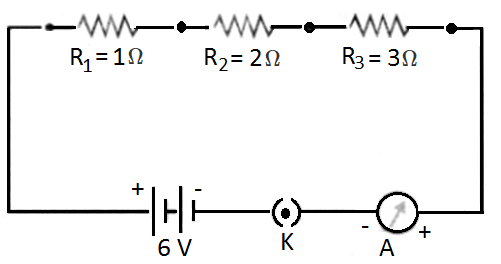
  2. Connect the series combination of resistors with a battery of 6V, a plug key K and an ammeter A as shown in figure.

  1. Note the reading of ammeter after plugging the key. Let it be I.
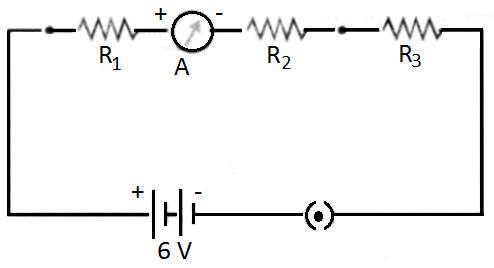
  2. Now disconnect ammeter and connect it in between the resistors R1 and R2 as shown in figure.

​​​​​​​

  1. Again plug the key and note the reading of ammeter. It is found that again it is I.
  2. Now disconnect the ammeter and connect it in between the resistors R2 and R3.
  3. Plug the key and note the reading of ammeter. Again it is found to be I.

Need a full question paper?

Generate a complete, print-ready paper with questions like this in minutes — across 16+ boards, with answer keys.

Start Generating Free

Similar questions

The speed of light in vacuum and in two different glasses is given in the table below:
Medium
Speed of light
Vacuum
Flint glass
Crown glass
3.00× 10⁸m/ s
1.86× 10⁸m/ s
1.97× 10⁸m/ s
  1. Calculate the absolute refractive indexes of flint glass and crown glass.
  2. Calculate the relative refractive index for light going from crown glass to flint glass.
Define magnetic field lines. Describe an activity to draw a magnetic field line outside a bar magnet from one pole to another pole.
One-half of a convex lens is covered with a black paper. Will this lens produce a complete image of the object? Verify your answer experimentally. Explain your observations.
State and explain Maxwell’s right-hand thumb rule.
a. List four characteristics of the image formed by a concave lens of focal length 20 cm when the object is placed at a distance of 40 cm from its optical centre.
b. The size of image of an object by a convex lens of focal length 20 cm is observed to be reduced to $\frac{1}{3} \mathrm{rd}$ of its size. Find the distance of the object from the optical centre of the lens.
How can we explain the reddish appearance of sun at sunrise or sunset? Why does it not appear red at noon?
The image of a candle flame placed at a distance of 30cm from a spherical lens is formed on a screen placed on the other side of the lens at a distance of 60cm from the optical centre of the lens. Identify the type of lens and calculate its focal length. If the height of the flame is 3cm, find the height of its image.
Explain the phenomenon of electromagnetic induction. Describe an experiment to show that a current is set up in a closed loop when an external magnetic field passing through the loop increases or decreases.
  1. What is meant by 'power of a lens'?
  2. State and define the S.I. unit of power of a lens.
  3. A convex lens of focal length 25 cm and a concave lens of focal length 10 cm are placed in close contact with each other. Calculate the lens power of this combination.
Explain why, though both a plane mirror and a sheet of paper reflect light but we can see the image of our face in a plane mirror but not in a sheet of paper.