Question
How will you separate a mixture containing kerosene and petrol (difference in their boiling points is more than 25ºC), which are miscible with each other?
Answer

A mixture of two miscible liquids having a difference in their boiling points more than 25°C can be separated by the method of distillation. Thus, kerosene and petrol can be separated by distillation.


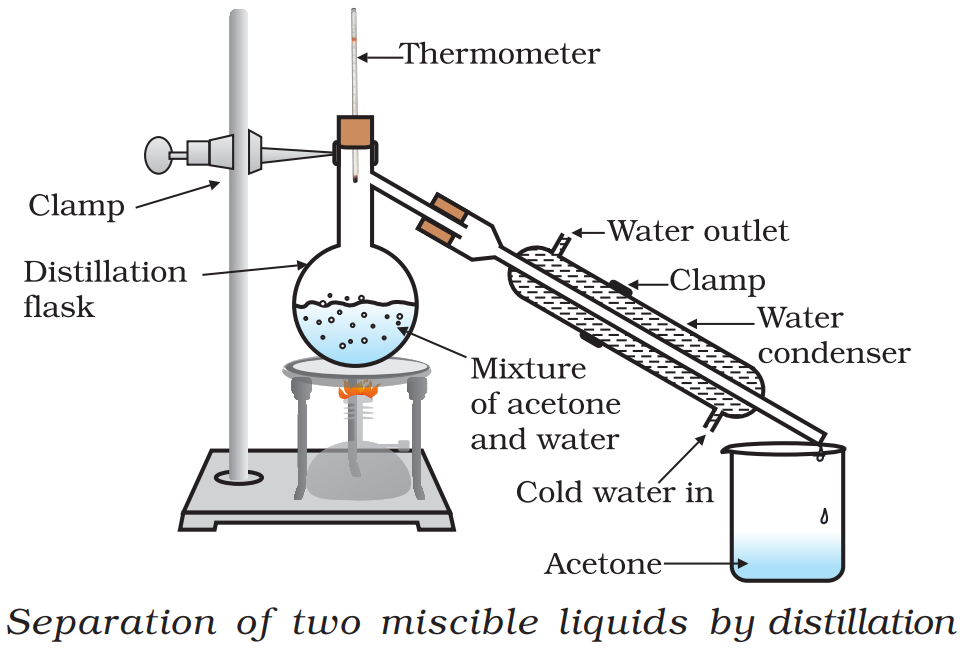
In this method, the mixture of kerosene and petrol is taken in a distillation flask with a thermometer fitted in it. We also need a beaker, a water condenser, and a Bunsen burner. The apparatus is arranged as shown in the above figure. Then, the mixture is heated slowly. The thermometer should be watched simultaneously. Kerosene will vaporize and condense in the water condenser. The condensed kerosene is collected from the condenser outlet, whereas petrol is left behind in the distillation flask.

Need a full question paper?

Generate a complete, print-ready paper with questions like this in minutes — across 16+ boards, with answer keys.
Start Generating Free

Similar questions

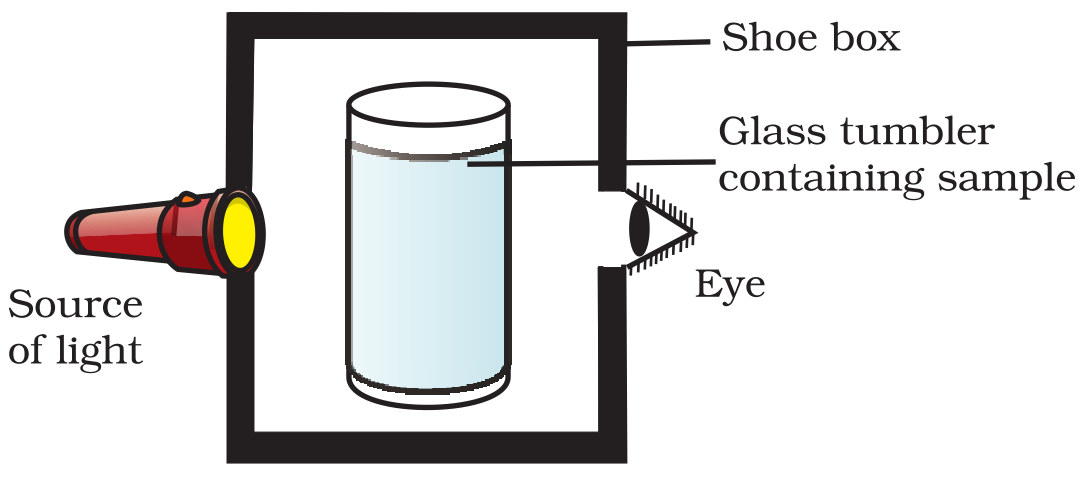
A group of students took an old shoe box and covered it with a black paper from all sides. They fixed a source of light (a torch) at one end of the box by making a hole in it and made another hole on the other side to view the light. They placed a milk sample contained in a beaker/ tumbler in the box as shown in the they were amazed to see that milk taken in the tumbler was illuminated. They tried the same activity by taking a salt solution but found that light simply passed through it?


  1. Explain why the milk sample was illuminated. Name the phenomenon involved.
  2. Same results were not observed with a salt solution. Explain.
  3. Can you suggest two more solutions which would show the same effect as shown by the milk solution?
Pressure and temperature determine the state of a substance. Explain this in detail.
How will you separate camphor, common salt and iron nails from their mixture?
Draw a flow sheet diagram showing the separation of various components of a mixture containing camphor, sand and iron filings.
You are given a mixture of water, groundnut oil and common salt. How will you separate groundnut oil and common salt from it?
By which physical process the fragrance of burning an incense stick spreads all around?

In what way is the Rutherford’s atomic model different from that of Thomson’s atomic model?

An atom of an element X may be written as $^{9}_4\text{X} $
  1. What does the figure 9 indicate?
  2. What does the figure 4 indicate?
  3. What is the number of protons in atom X?
  4. What is the number of neutrons in atom X?
  5. What is the number of electrons in atom X?
  6. How many electrons are there in the outermost shell of an atom of element X?
  7. Write the symbol of ion formed by an element Z is 2, 8, 8.
There is a large group of materials P which can be divided into three groups Q, R, and S on the basis of their properties. The substances belonging to group Q can be solids, liquids or gases. The solids belonging to group Q are usually electrical insulators. Most of the substances of group R are solids which are good conductors of electricity. The substances belonging to group S are neither insulators like Q nor good conductors like R. The properties of S are intermediate between those of Q and R.
  1. What could the group of materials P be?
  2. Name the substances Q. Give two examples of such substances.
  3. Name the substances R. Write two examples of such substances.
  4. Name the substances S. Give two examples of such substances.
  5. Out of Q, R and S, which substances are malleable and ductile?
Draw a labelled diagram of the fractional distillation apparatus used for separating a mixture of alcohol and water.