Questions

Answer the questions.[Che-5M]

🎯

Test yourself on this topic

42 questions · timed · auto-graded

Question 15 Marks
You are provided with a mixture containing sand, iron filings, ammonium chloride and sodium chloride. Describe the procedures you would use to separate these constituents from the mixture?
Answer
Components of the given mixture can be separated by the following methods:
  1. By using a magnet: Moving a magnet over the mixture will result in iron fillings getting stuck to the magnet. Thus, iron will be separated from the mixture.
  2. Sublimation: The remaining mixture is heated in a china dish. Ammonium chloride is a sublimating substance and hence it will evaporate without passing through the liquid phase. Crust of ammonium chloride can be collected by placing an inverted funnel on top of the china dish.
  3. Sedimentation, decantation and filtration: The remaining mixture is dissolved in water and allowed to settle for some time. Sand, being insoluble in water, settles at the bottom. The liquid is decanted in another beaker. The liquid is then filtered to remove any traces of sand.
  4. Evaporation: The liquid is now a solution of salt in water. This is heated in a beaker so that the water evaporates. Once all the water evaporates, salt remains in the beaker.
View full question & answer
Question 25 Marks
You are given a mixture of water, groundnut oil and common salt. How will you separate groundnut oil and common salt from it?
Answer
The mixture of water, groundnut oil and common salt is put in a separating funnel and allowed to stand for some time. The mixture separates into two layers according to the densities of water and groundnut oil. Water is heavier than groundnut oil. So, water forms lower layer while groundnut oil forms upper layer. On opening the stop clock of separating funnel, the lower layer of water comes out first and collected in beaker leaving behind groundnut oil in the funnel. Now, solution of water and common salt is heated. Water gets evaporated leaving behind solid common salt.
View full question & answer
Question 35 Marks
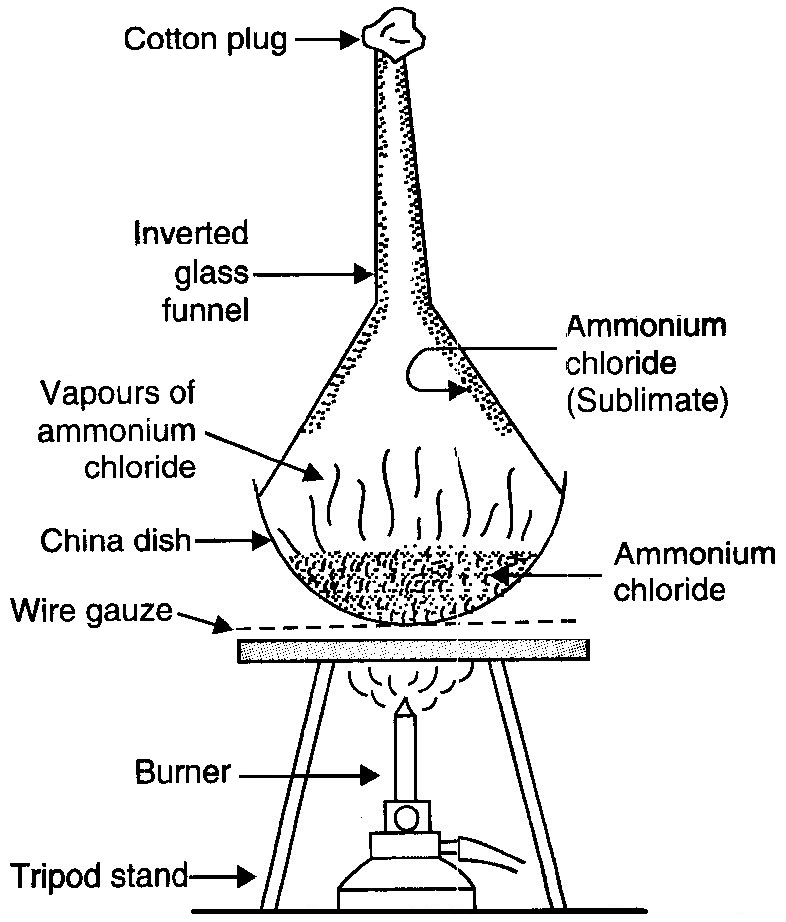
With the help of a labelled diagram, describe the method of separating ammonium chloride from a mixture of ammonium chloride and common salt. Mention the difference in the properties of ammonium chloride and sodium chloride which has made this separations possible.
Answer
The mixture of common salt and ammonium chloride is taken in a china dish and placed on a tripod stand. The china dish is covered with an inverted glass funnel. A loose cotton plug is put in the upper, open end of the funnel to prevent the ammonium chloride vapours from escaping into the atmosphere. The china dish is heated by using a burner. On heating the mixture, ammonium chloride changes into white vapours. These vapours rise up and get converted into solid ammonium chloride on coming in contact with the cold, inner walls of the funnel. In this way, pure ammonium chloride collects on the inner sides of the funnel in the form of a sublimate and can be removed. Common salt does not change into vapours on heating, so it remains behind in the china dish and can be separated out.


Ammonium chloride sublimes on heating whereas common salt does not sublime on heating. So, we can separate ammonium chloride from a mixture of common salt and ammonium chloride by the process of sublimation.
View full question & answer
Question 45 Marks
Which separation techniques will you apply for the separation of the following?
  1. Sodium chloride from its solution in water.
  2. Ammonium chloride from a mixture containing sodium chloride and ammonium chloride.
  3. Small pieces of metal in the engine oil of a car.
  4. Different pigments from an extract of flower petals.
  5. Butter from curd.
  6. Oil from water.
  7. Tea leaves from tea.
  8. Iron pins from sand.
  9. Wheat grains from husk.
  10. Fine mud particles suspended in water.
Answer
  1. Sodium chloride from its solution in water → Evaporation.
  2. Ammonium chloride from a mixture containing sodium chloride and ammonium chloride → Sublimation.
  3. Small pieces of metal in the engine oil of a car → Centrifugation or filtration or decantation.
  4. Different pigments from an extract of flower petals → Chromatography.
  5. Butter from curd → Centrifugation.
  6. Oil from water → Using separating funnel.
  7. Tea leaves from tea → Filtration.
  8. Iron pins from sand → Magnetic separation.
  9. Wheat grains from husk → Winnowing.
  10. Fine mud particles suspended in water → Centrifugation.
View full question & answer
Question 55 Marks
What is fractional distillation? What is the use of fractionating column in fractional distillation?
Answer
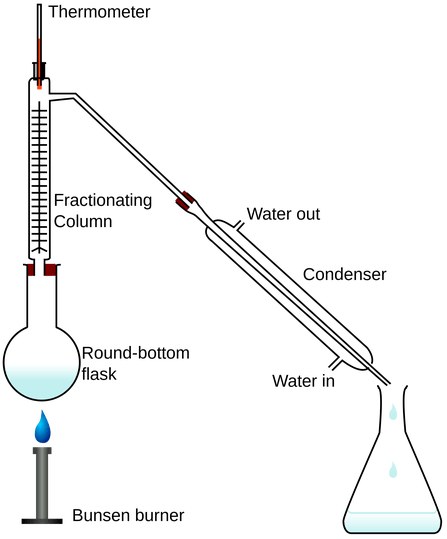
Fractional distillation is the process of separating two or more miscible liquids (liquids which mix together in all proportions and form a single layer) by distillation, the distillate being collected in fractions boiling at different temperatures. The separation of two liquids by fractional distillation depends on the difference in their boiling points. It is carried out by using a fractionating column. Fractionating column is a long vertical glass tube filled with glass beads. The glass beads provide a large surface area for hot vapours to cool and condens repeatedly. It provides different temperature zones inside it, the highest temperature being at the bottom of the column and the lowest temperature near its top. It is fitted in the neck of the distillation flask.
View full question & answer
Question 65 Marks
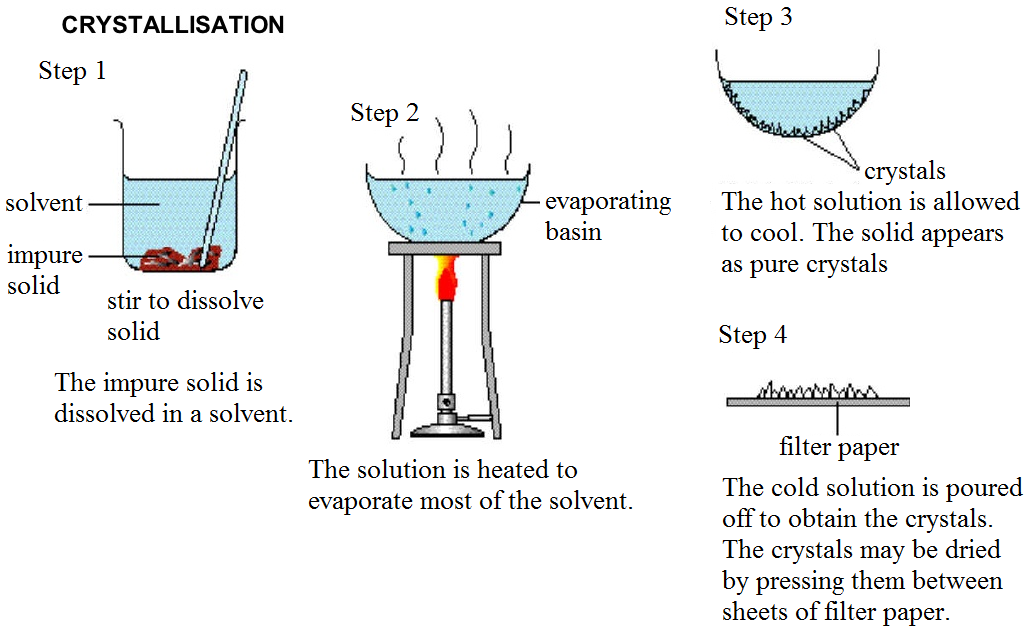
What is crystallisation? How can this technique be used to purify impure copper sulphate?
View full question & answer
Question 75 Marks
There is a large group of materials P which can be divided into three groups Q, R, and S on the basis of their properties. The substances belonging to group Q can be solids, liquids or gases. The solids belonging to group Q are usually electrical insulators. Most of the substances of group R are solids which are good conductors of electricity. The substances belonging to group S are neither insulators like Q nor good conductors like R. The properties of S are intermediate between those of Q and R.
  1. What could the group of materials P be?
  2. Name the substances Q. Give two examples of such substances.
  3. Name the substances R. Write two examples of such substances.
  4. Name the substances S. Give two examples of such substances.
  5. Out of Q, R and S, which substances are malleable and ductile?
Answer
  1. Group of materials P is element.
  2. Q is a non-metal.

Examples: Carbon(s), and bromine (l)

  1. R is a metal, as most of them are good conductors of heat and electricity.

Examples: Copper, and aluminum

  1. S is a metalloid, as they have intermediate properties of those of metals and non-metals.

Examples: Arsenic, and antimony

  1. R is a metal, therefore, it is malleable and ductile.
View full question & answer
Question 85 Marks
There are three substances X, Y and Z. The substance X does not have a fixed melting point or boiling point and it still shows the individual properties of its constituents. The substance Y is a pure substance which occurs in nature as such. The substance Y has a fixed melting point and boiling point but it cannot be broken down into simpler substances by any chemical means. The substance Z is also a pure substance whose properties are entirely different from those of its constituents. The substance Z can, however, be divided by electrolysis into two substances which belong to the same class of substances as Y.
  1. What type of substance could X be? Name one substance like X.
  2. What type of substance could Y be? Name one substance like Y.
  3. What type of substance could Z be? Name one substance like Z.
  4. Whish process involves absorption or release of an appreciable amount of energy: formation of substance X or formation of substance Z?
  5. Name the three groups into which all the substances like Y are divided on the basis of their properties.
Answer
  1. ​​Substance X does not have a fixed melting or boiling point. Moreover, it shows the properties of its constituents. So, it must be a mixture. Sugar solution in water is a substance like X.
  2. Substance Y has a fixed melting or boiling point but it cannot be split into simpler substances by chemical processes. Hence, it must be an element. Hydrogen is a substance like Y.
  3. Substance Z is also a pure substance whose properties are entirely different from those of its constituents. Hence, it must be a compound. Sugar is a substance like Z.
  4. Formation of Z(a compound) involves absorption or release of an appreciable amount of energy.
  5. The three groups are metals, non-metals and metalloids. All the substances like Y are divided into these groups on the basis of their properties.
View full question & answer
Question 95 Marks
State the main points of difference between homogeneous and heterogeneous mixtures.
Answer
Those mixtures in which the substances are completely mixed together and are indistinguishable from one another, are called homogeneous mixtures. They have a uniform composition throughout its mass. All the homogeneous mixtures are called solutions.
Examples: Sugar solution, salt solution, copper sulphate solution, etc.
Those mixtures in which the substances remain separate and one substance is spread throughout the other substance as small particles, droplets or bubbles, are called heterogeneous mixtures. Heterogeneous mixture does not have a uniform composition throughout its mass.
Example: Starch solution, soap solution.
View full question & answer
Question 105 Marks
Pragya tested the solubility of three different substances at different temperatures and collected the data as given below (results are given in the following table, as grams of substance dissolved in 100 grams of water to form a saturated solution).
Substance DissolvedTemperature in K
283293313333353
Solubility
Potassium nitrate213262106167
Sodium chloride3636363737
Potassium chloride3535404654
Ammonium chloride24374155
66
  1. What mass of potassium nitrate would be needed to produce a saturated solution of potassium nitrate in 50 grams of water at 313K?
  2. Pragya makes a saturated solution of potassium chloride in water at 353K and leaves the solution to cool at room temperature. What would she observe as the solution cools? Explain.
  3. Find the solubility of each salt at 293K. Which salt has the highest solubility at this temperature?
  4. What is the effect of change of temperature on the solubility of a salt?
Answer
  1. Mass of potassium nitrate required to produce a saturated solution in 100g of water at 313K = 62g

Mass of potassium nitrate required to produce a saturated solution in 50g of water = ?

Required amount = 62 × 50100 = 31

Hence 31g of potassium nitrate is required.

  1. When the solution cools down, Pragya observes salt crystals of potassium chloride precipitating.
  1. Solubility of each salt at 293K is as follows:
  • Potassium nitrate → 21g
  • Sodium chloride → 36g
  • Potassium chloride → 35g
  • Ammonium chloride → 24g

It is observed that the potassium chloride salt has the highest amount of solubility when compared to any other salt at 293K.

  1. Effect of change of temperature in the solubility of salts:

It is observed from the given table that the solubility of the salt increases with the increase in temperature. This means that when a salt reaches its saturation point at a particular temperature, more salt can be dissolved yet by increasing the temperature of the solution.

View full question & answer
Question 115 Marks
List five characteristics by which compounds can be distinguished from mixtures.
Answer
MIXTURES
COMPOUNDS
i
A mixture can be separated into constituents by the physical processes.
i
A compound cannot be separatwd into its constituents by the physical processes.
ii
A mixture shows the properties its contituents.
ii
The properties of a compound are entirely different from those of its constituents.
iii
Energy is usually neither given out nor absorbed in the preparation of a mixture.
iii
Energy is usually given or absorbed during the preparation of a compound.
iv
The composition of a mixture is variable.
iv
The composition of a compound is fixed.
v
A mixture does not have a fixed melting point, boiling point, etc.
v
A compound has a fixed melting boiling point etc.
View full question & answer
Question 125 Marks
Iron powder and sulphur powder were mixed together and divided into two parts A and B. When part A was heated strongly over a burner, then a substance C was formed. The part B was, however, not heated at all. When dilute hydrochloric acid was added to substance C, then gas D was evolved and when dilute hydrochloric acid was added to part B then gas E was evolved.
  1. What type of substance is B?
  2. What type of substance is C?
  3. Name the gas (i) D, and (ii) E?
  4. Write one characteristic property of gas D.
Answer
  1. Here, iron powder and sulphur powder are mixed together. B is a mixture (Fe + S).
  2. Here, iron powder and sulphur powder are mixed together and heated strongly on a burner. So, C is the compound iron sulphide(FeS).
  3.  
  1. Here, dilute HCl was added to C (iron sulphide)to obtain D, which is hydrogen sulphide gas.

$\text{FeS}+2\text{HCl}\xrightarrow{\ \ \ \ \ \ \ \ \ \ \ }\text{FeCl}_2+\text{H}_2\text{S}$

  1. When dilute HCl is added to B, Fe present in the mixture reacts with the acid to form hydrogen gas.

$\text{Fe}+\text{HCl}\xrightarrow{\ \ \ \ \ \ \ \ \ \ \ }\text{FeCl}_2+\text{H}_2$

  1. Gas D smells like rotten egg.
  2. When a burning stick is held in the gas, the gas itself catches fire with blue flame and a ‘pop’ sound. In the process, the burning stick extinguishes.
View full question & answer
Question 135 Marks
Iron filings and sulphur were mixed together and divided into two parts, ‘A’ and ‘B’. Part ‘A’ was heated strongly while Part ‘B’ was not heated. Dilute hydrochloric acid was added to both the Parts and evolution of gas was seen in both the cases. How will you identify the gases evolved?
Answer
As part ‘A’ is heated, a compound FeS is formed by the reaction between iron filings and sulphur. When dilute HCI is added to part A, FeS will react with dil HC1 to form FI2S gas which has smell of rotten eggs and will turn lead acetate paper black.
Fe (s) + S(s) → FeS(s)
FeS(s) + 2HCI(dil) → FeCI2(ag) + H2S(g)
$(\text{CHjCOO)}_2\text{Pb(ag)}\ \ +\ \ \ \text{H}_2\text{S(g)}\ \xrightarrow{\ \ \ \ \ \ \ \ \ \ \ \ \ \ \ \ \ \ \ \ }\ \text{PbS(s)}\ \ \ \ +\ \ \ \ \ 2\text{CH}_3\text{COOH}\\ \ \ \ ^\text{Lead acetate}\ \ \ \ \ \ \ \ \ \ \ \ \ \ \ \ \ \ \ \ \ \ \ \ \ \ \ \ \ \ \ \ \ \ \ \ \ \ \ \ \ \ \ \ \ \ \ \ \ \ \ \ \ \ \ \ \ ^\text{Black ppt}\ \ \ \ \ \ \ \ \ \ \ \ \ \ \ \ \ ^\text{Acetic acid}$
As part ‘S’ is not heated, so 8 is a mixture of iron filings and sulphur powder. When dil, HCI is added to it, iron filings react with dill. HCI to form H2(g) which burns with a ‘pop’ sound if burning match stick is brought near it.
Fe(s) + 2HCI(dil) → FeCI2(ag) + H2(g)
View full question & answer
Question 145 Marks
How would you prepare a saturated solution of sodium chloride in water at 25°C? What will happen if this solution is cooled to 10°C?
Answer
Take some water in a beaker and heat it slowly with the help of burner. Now, start adding sodium chloride salt to the hot water with a spoon and stir it with a glass rod continuously so that sodium chloride goes on dissolving in water. Take the temperature of water up to 25°C and then keeping this temperature constant, go on adding sodium chloride till no more sodium chloride dissolves in it and some undissolved crystals will be left at the bottom. The contents of the beaker are now filtered and the clear solution obtained is the saturated solution of sodium chloride at 25°C. If the temperature is lowered from 25°C to 10°C, then some of the crystals of sodium chloride will separate out from the solution in the form of solute crystals.
View full question & answer
Question 155 Marks
How will you separate the components of a mixture containing two miscible liquids? Give experimental details.
Answer
Miscible liquids: Those liquids which mix together in all proportions and form a single layer are called miscible liquids.
Example: Alcohol and water are miscible liquids because they mix together in all proportions and form a single layer on mixing. A mixture of miscible liquids is separated by the process of fractional distillation.
Separation by fractional distillation:
Fractional distillation is the process of separating two (or more) miscible liquids by distillation, the distillate being collected in fractions boiling at different temperatures. A mixture of two miscible liquids can be separated by the process of fractional distillation. The separation of two liquids by fractional distillation depends on the difference in their boiling points. Fractional distillation is carried out by using a fractionating column.
Example: Alcohol and water are miscible liquids. The boiling point of alcohol is 78ºC and the boiling point of water is 100ºC. Since the boiling points of alcohol and water different, therefore, a mixture of alcohol and water can be separated by fractional distillation. The mixture of alcohol and water is heated in a distillation flask fitted with a fractionating column. When the mixture is heated, both alcohol and water form vapours as their boiling points approach. The alcohol vapour and water vapour rise up in the fractionating column. The upper part of the fractionating column is cooler, so as the hot vapours rise up in the column, they get cooled, condense and trickle back into the distillation flask.


The more volatile liquid distils over first, and the less volatile liquid distils over later. A mixture of alcohol and water can be separated by fractional distillation.
View full question & answer
Question 165 Marks
How will you separate common salt, sand and iron filings from their mixture?
Answer
Mixture of common salt, sand and iron filings can be separated by using magnet first. A horse-shoe magnet is moved on the surface of the mixture. The iron filings are attracted by the magnet, they cling to the poles of the magnet and get separated. This process is repeated a number of times till complete separation of iron filings occur leaving behind mixture of common salt and sand. The mixture of common salt and sand is then dissolved in water and then filtered with the help of filter paper. Sand remains as residue on the filter paper while common salt solution is obtained as filtrate .The filtrate is then evaporated to get crystals of common salt.
View full question & answer
Question 175 Marks
How will you separate camphor, common salt and iron nails from their mixture?
Answer
A horse-shoe magnet is moved on the surface of the mixture of camphor, common salt and iron nails. The iron nails are attracted by the magnet, they cling to the poles of the magnet and get separated. This process is repeated a number of times till complete separation of iron nails occur leaving behind mixture of camphor and common salt. Mixture of camphor and common salt is heated. Camphor sublimes on heating leaving behind common salt and can be recovered in the form of sublimate by cooling its vapours.
View full question & answer
Question 185 Marks
How will you separate a mixture of mercury, oil and water?
Answer
Mercury, oil and water are immiscible liquids and have different densities. Mixture of mercury, oil and water will be put in separating funnel and allowed to stand for sometimes. The mixture separates into three layers according to the densities of mercury, oil and water. On opening the stop clock of separating funnel, the lower layer formed by mercury comes out first and collected in beaker leaving behind other two layers. Similarly, again on opening the stop clock of separating funnel, the lower layer of water comes out first and collected in beaker leaving behind oil in the funnel.
View full question & answer
Question 195 Marks
How will you separate a mixture of kerosene oil and water? Explain with the help of a labeled diagram
Answer
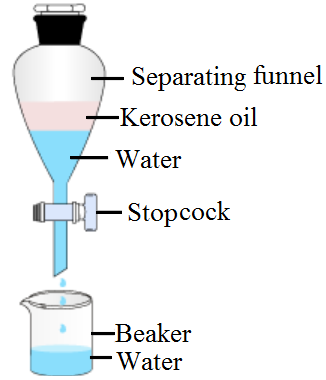
The mixture of water and kerosene is put in separating funnel and allowed to stand for some time. The mixture separates into two layers according to the densities of water and kerosene. Water is heavier than kerosene. So, water forms lower layer while kerosene forms upper layer. On opening the stop clock of separating funnel, the lower layer of water comes out first and collected in beaker leaving behind kerosene.


Separation of kerosene oil and water mixture by separating funnel.
View full question & answer
Question 205 Marks
How will you separate a mixture of iron filings, chalk powder an common salt?
Answer
Mixture of iron filings, chalk powder and common salt can be separated by using magnet first. A horse-shoe magnet is moved on the surface of the mixture. The iron filings are attracted by the magnet, they cling to the poles of the magnet and get separated. This process is repeated a number of times till complete separation of iron filings occur leaving behind mixture of chalk powder and common salt. The mixture of chalk powder and common salt is then dissolved in water and then filtered with the help of filter paper. Chalk powder remains as residue on the filter paper while common salt solution is obtained as filtrate .The filtrate is then evaporated to get crystals of common salt.
View full question & answer
Question 215 Marks
How will you separate a mixture of common salt, sulphur powder and sand?
Answer
At first, the mixture of common salt, sulphur powder and sand is shaken with carbon disulphide. Sulphur dissolves in carbon disulphide whereas common salt and sand remain un-dissolved. The solution is then filtered, common salt and sand mixture is obtained as residue. On evaporating the filtrate, carbon disulphide solvent is eliminated and solid sulphur remains behind. Now, the common salt and sand mixture is shaken with water. Common salt gets dissolved in water. The solution is then filtered, sand is obtained as residue. The filtrate is then evaporated to get crystals of common salt.
View full question & answer
Question 225 Marks
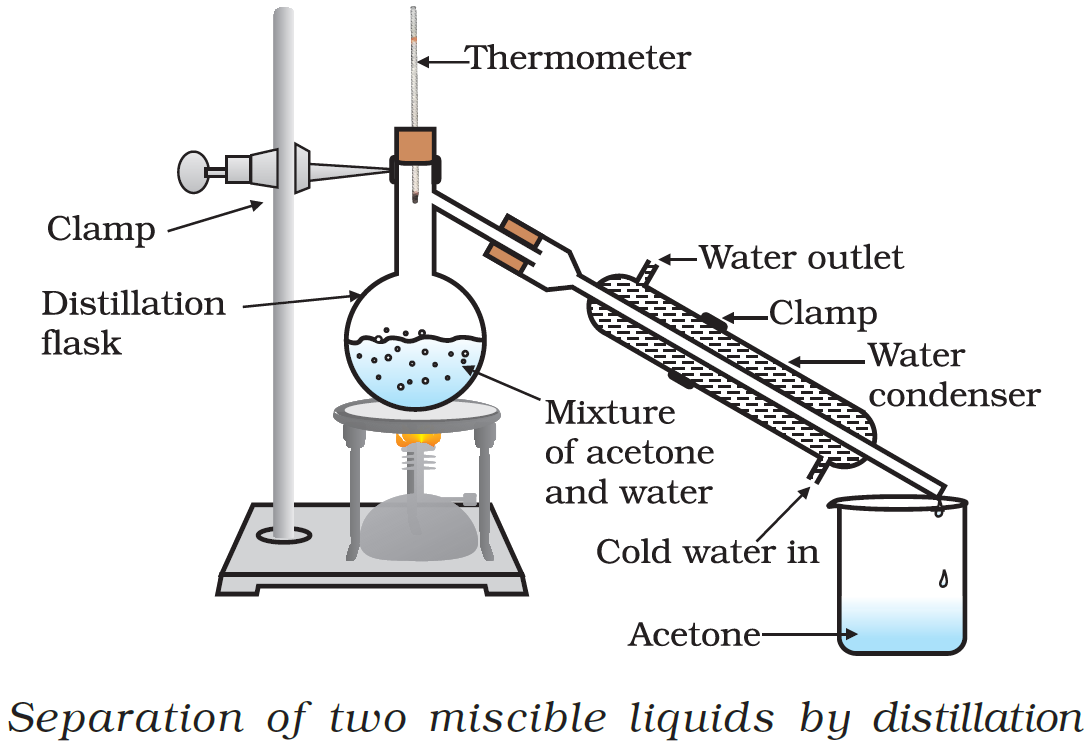
How will you separate a mixture containing kerosene and petrol (difference in their boiling points is more than 25ºC), which are miscible with each other?
Answer
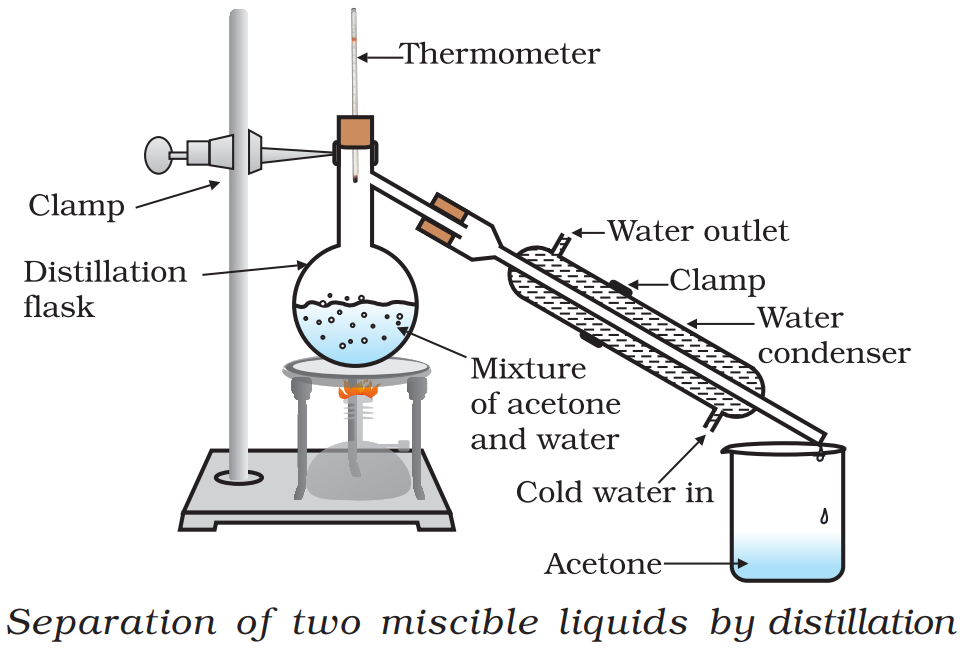
A mixture of two miscible liquids having a difference in their boiling points more than 25°C can be separated by the method of distillation. Thus, kerosene and petrol can be separated by distillation.


In this method, the mixture of kerosene and petrol is taken in a distillation flask with a thermometer fitted in it. We also need a beaker, a water condenser, and a Bunsen burner. The apparatus is arranged as shown in the above figure. Then, the mixture is heated slowly. The thermometer should be watched simultaneously. Kerosene will vaporize and condense in the water condenser. The condensed kerosene is collected from the condenser outlet, whereas petrol is left behind in the distillation flask.
View full question & answer
Question 235 Marks
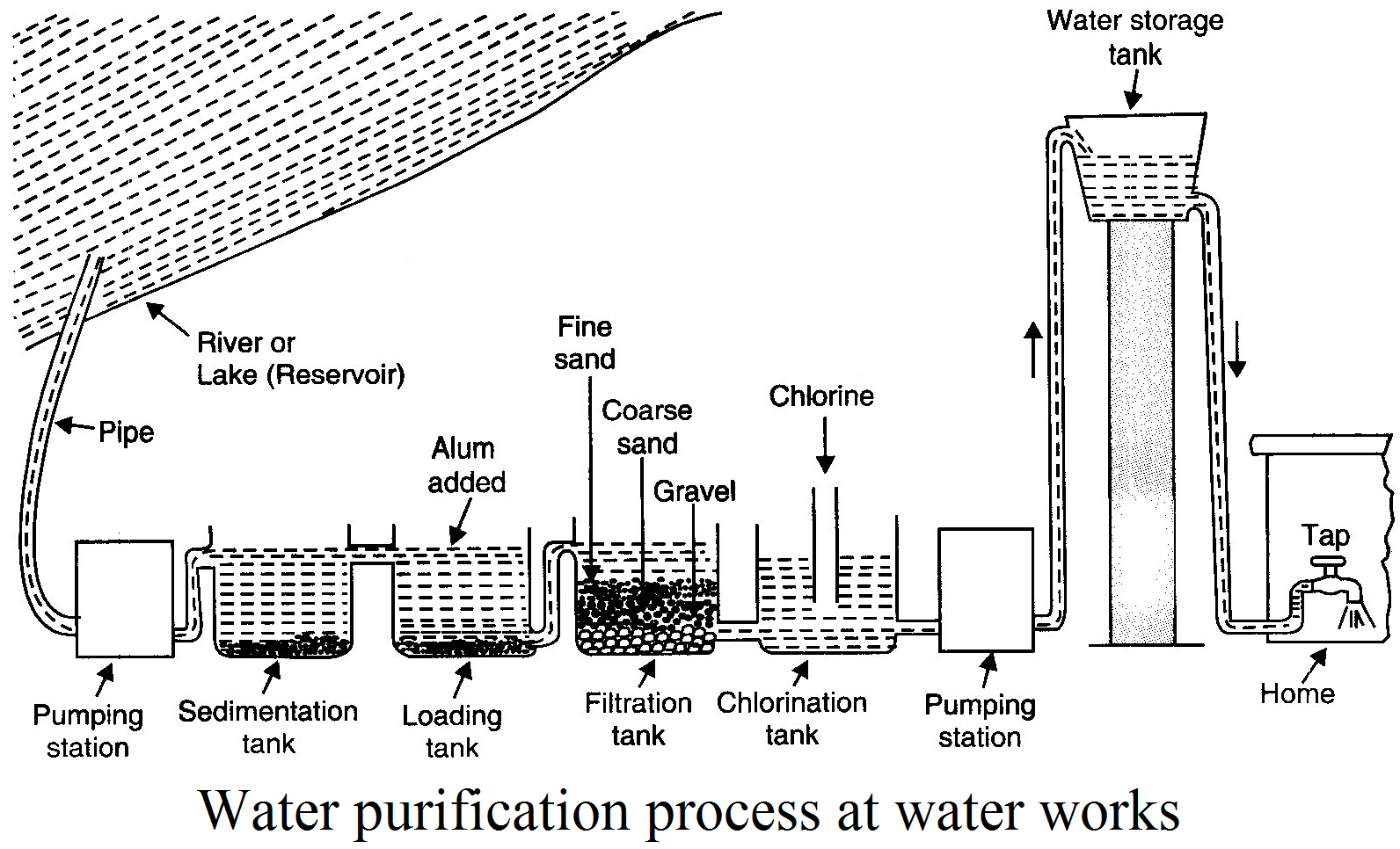
How is water purified on a large scale at water works? Explain with the help of a labelled diagram. Name the substance which is added to kill germs in the drinking water supply?
View full question & answer
Question 245 Marks
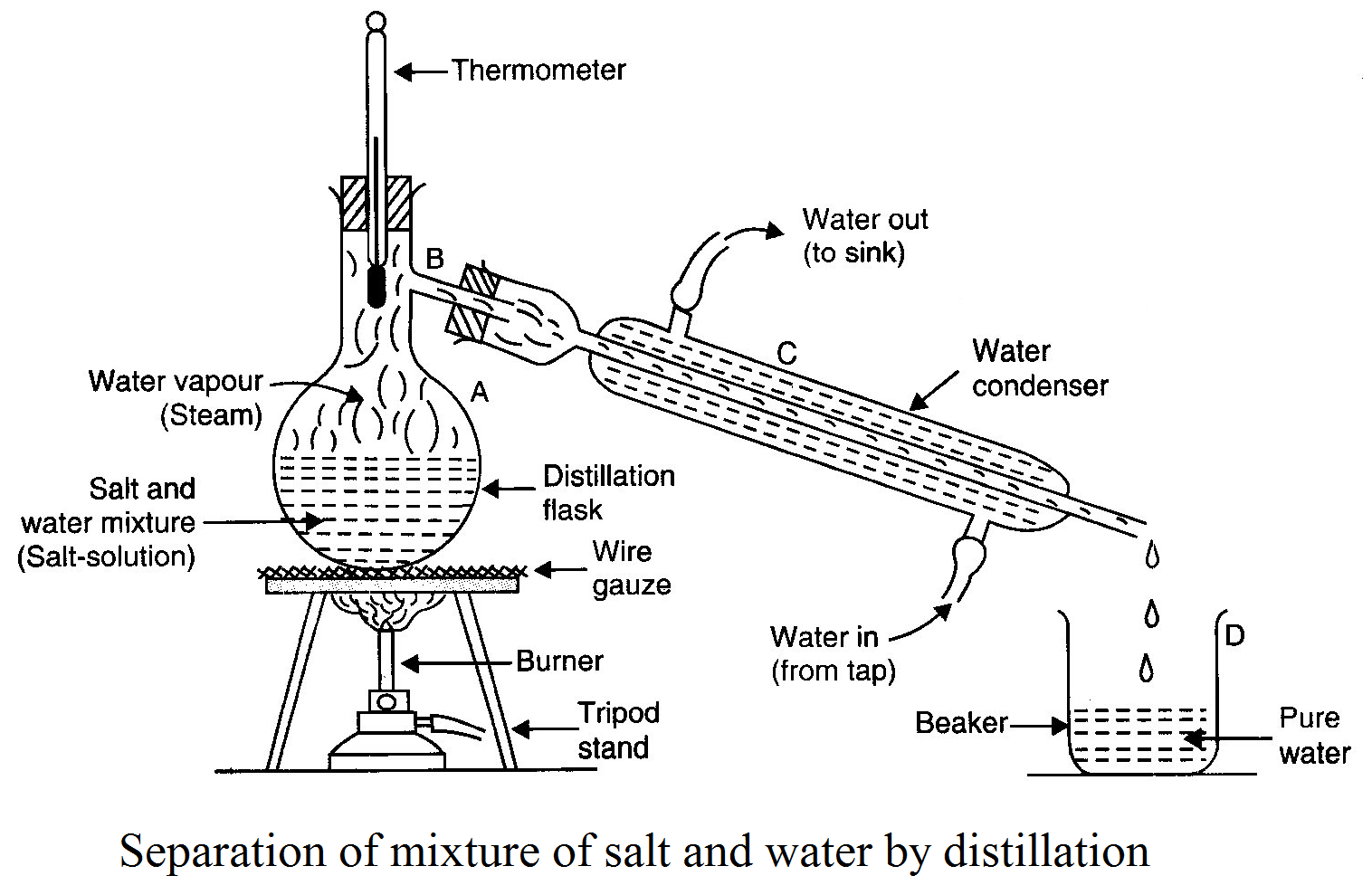
How can you obtain pure water from a salt-water mixture (or salt-solution)? Draw a meat and labelled diagram of the apparatus you would use to obtain pure water from a salt-water mixture (or salt-solution).
View full question & answer
Question 255 Marks
How are sol, solution and suspension different from each other?
Answer
PropertySolSolutionSuspension
NatureHeterogenousHomogenousHeterogenous
Particle size10-7-10-5cmLess than 1nmMore than 100nm
StabilityQuite stableVery stableUnstable
Tyndall effectyesnoyes/no
AppearanceGenerally clearclearopaque
visibilityVisible with an ultra microscopeNot visibleVisible with naked eye
DiffusionDiffuses very slowlyDiffuses rapidlyDo not diffuse
SettlingGet settled in centrifugationDo not settleSettle on their own
ExampleMilk, blood, smokeSalt and sugar in waterSand in water, dusty air
View full question & answer
Question 265 Marks
Give the main differences between physical changes and chemical changes.
Answer
PHYSICAL CHANGECHEMICAL CHANGE
iNo, new substance is formed in a physical change.iNew substance is formed in a chemical change.
iiIt is a temporart change.iiA chemical change is a permanent change.
iiiIt is easily reversible.iiiThis process is usually irreversible.
ivVery little heat or light energy is usually absorbed or given out in this process.ivA lot of heat or light energy is absorbed or given out in this process.
vMass of substance does not alter.vMass of substance does alter in this process.
View full question & answer
Question 275 Marks
Fractional distillation is suitable for separation of miscible liquids with a boiling point difference of about 25K or less. What part of fractional distillation apparatus makes it efficient and possess an advantage over a simple distillation process. Explain using a diagram.
View full question & answer
Question 285 Marks
Explain how, nitrogen, oxygen and argon gases are separated form air.
Answer
Air is mixture of gases like nitrogen, oxygen, argon, carbon dioxide, helium, neon, krypton, xeon etc. The various gases of air are separated from one another by fractional distillation of liquid air. This separation is based on the fact that different gases of air have different boiling points(in liquid form).
The air is first filtered to remove dust, then water vapour and carbon dioxide are removed. Air is compressed to a high pressure and then cooled. The cooled air is then allowed to expand quickly into a chamber through a jet. This cools the air even more. This process of compression, cooling and rapid expansion of air is repeated again and again to make the air more and more cool so that it becomes liquid air. Now, the liquid air is fed into a tall fractionating column and warmed up slowly.
Liquid nitrogen has lowest boiling point of -196°C. So, on warming, it boils off first to form nitrogen gas and is collected at the upper part of the fractional distillation column. Liquid argon has a slightly higher boiling point of -186°C. So, it boils off next and collected as argon gas in the middle part of fractional distillation column. Liquid oxygen has a still higher boiling point of -183°C. So, liquid oxygen boils off last and collected as oxygen gas at the bottom of fractional distillation column.
View full question & answer
Question 295 Marks
Draw a labelled diagram of the fractional distillation apparatus used for separating a mixture of alcohol and water.
View full question & answer
Question 305 Marks
Draw a flow sheet diagram showing the separation of various components of a mixture containing camphor, sand and iron filings.
Answer
The three components are shown in their pure states, then combined into the water to form a heterogeneous mixture. The salt dissolves, the other solids do not.
Using the fact that the iron is magnetic, the magnet can be used to separate the iron fillings from the mixture by moving teh magnet around in the container. Keeping the magnet in a plastic bag makes it easy to separate the filings from the magnet when you pull it out.
View full question & answer
Question 315 Marks
Discuss the method of separating a mixture containing chalk powder, iron fillings and naphthalene.
Answer
Mixture of chalk powder, iron filings and naphthalene can be separated by using magnet and then by sublimation. A horse-shoe magnet is moved on the surface of the mixture. The iron filings are attracted by the magnet, they cling to the poles of the magnet and get separated. This process is repeated a number of times till complete separation of iron filings occur leaving behind mixture of chalk powder and naphthalene. Then, mixture of chalk powder and naphthalene is heated. Naphthalene sublimes on heating leaving behind chalk powder and can be recovered in the form of sublimate by cooling its vapours.
View full question & answer
Question 325 Marks
Differentiate between a saturated and an unsaturated solution. How will you test whether a given solution is saturated or not?
Answer
A solution in which no more solute can be dissolved at that temperature is called a saturated solution while a solution in which more quantity of solute can be dissolved without raising its temperature is called an unsaturated solution. To test the saturation or unsaturation of a solution, more solute may be added to the solution. If that solute gets dissolved in the solution then the solution will be unsaturated. To test whether a given solution is saturated or not, add some more solute to the solution and try to dissolve it by stirring. If solute does not dissolve in the given solution, then it will be a saturated solution.
View full question & answer
Question 335 Marks
Describe the various steps involved in the separation of iodine, iron filings and salt from a mixture.
Answer
Mixture of iodine, iron filings and salt can be separated by using magnet and then by sublimation. A horse-shoe magnet is moved on the surface of the mixture. The iron filings are attracted by the magnet, they cling to the poles of the magnet and get separated. This process is repeated a number of times till complete separation of iron filings occur leaving behind mixture of iodine and salt. Then, mixture of iodine and salt is heated. Iodine sublimes on heating leaving behind salt and can be recovered in the form of sublimate by cooling its vapours.
View full question & answer
Question 345 Marks
Describe the various steps involved in the purification of water for city water supply.
Answer
  1. Pre-Treatment: Pumps bring "raw" or untreated water, often from lakes or rivers, into the purification plant through screens that exclude fish, weeds, branches and large pieces of debris. Screening may not be necessary for groundwater. The plant may aerate the water at this point to increase the oxygen content and thus help remove problematic odors and tastes.
  2. Coagulation & Flocculation: The purpose of these two steps is to clear water of the small particles that cause it to be turbid or cloudy. Turbidity renders the water hard to disinfect. The water is rapidly agitated to disperse coagulant chemicals throughout it. The small particles, including many bacteria, begin to form large clumps called flocs or floccules. In flocculation, the water is mixed gently so that these clumps combine and precipitate out further.
  3. Sedimentation: The water and flocs are pumped into sedimentation basins. Here, the flocs settle beneath the water so that they can be removed. About 85 to 90 percent of the suspended particles responsible for turbidity are removed at this point, including large amounts, but not all, of the bacteria.
  4. Filtration: In filtration, the water flows through a multilayer medium such as quartz sand, activated carbon or anthracite coal in order to remove up to 99.5 percent of the solid materials remaining in it, whether flocs, microbes or minerals. This step usually is the last one in the process of removing solids from the water.
  5. Disinfection: Disinfection kills off disease-bearing organisms in the water. Most water treatment plants use chemicals, generally chlorine compounds, as disinfectants. Although chlorine is still one of the most common disinfectants, ultraviolet radiation and ozone gas are becoming more widespread. Chlorine is increasing in cost and has some known toxic effects on humans and fish. In addition, some disease-carrying microbes like Giardia and Cryptosporidium resist chlorine.
  6. Corrosion & Scale Control: The pH of the water is adjusted so that it neither corrodes nor deposits too much scale in pipes. Excessive amounts of scale can disrupt plumbing systems, but small quantities help pipes to function at their best. However, no amount of corrosion in the water distribution system is desirable. As well as causing leaks and other damage, corrosion releases pipe metals like lead and copper that jeopardize human health.
  7. Taste & Odor Control: Unpleasant tastes and odors remaining in the water, such as those from algae, often do not pose any health hazards. Yet consumers prefer to do without them. So water purification plants often remove tastes and odors through additional chemical treatment, ozonation or filtration. At this stage, some municipalities also require the addition of fluoride to the water for dental health.
View full question & answer
Question 355 Marks
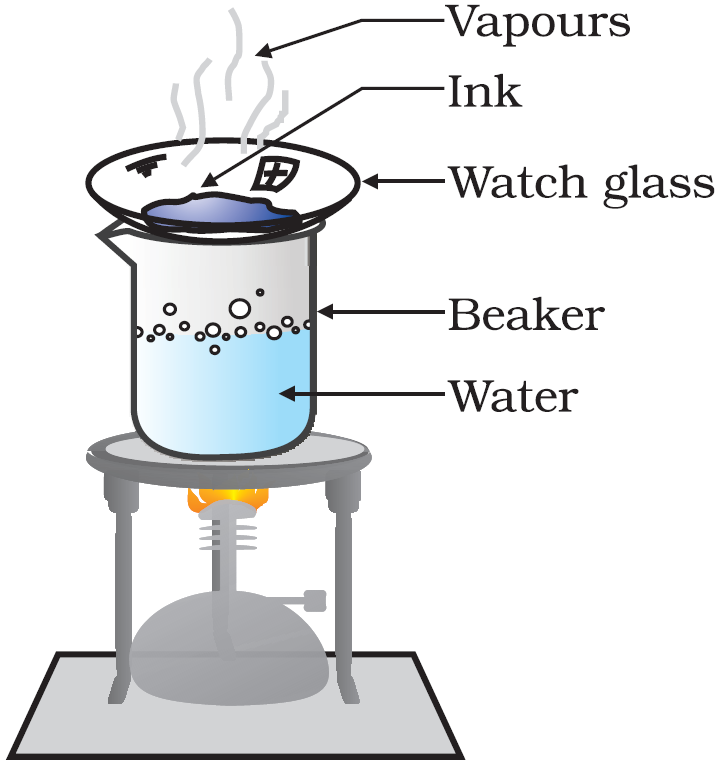
Describe the process to show that the dye used in blue/black ink is a mixture of two or more components with diagram.
Answer
Aim: Prove that Ink is a mixture of a dye in water

Apparatus required: Beaker, Watch glass, Bunsen burner, water and few drops of ink, tripod stand.

Procedure:

  • Fill half of the beaker with water
  • Place a watch glass on the mouth of beaker.
  • Put a few drops of ink on the watch glass.
  • Now, let start heating the beaker.
Observation:

We find the water evaporates and ink is left in watch glass.

Conclusion:

Ink is a mixture of a dye in water. Thus by evaporation method, we can separate the volatile compound from its non volatile compound.


View full question & answer
Question 365 Marks
Describe the method of separating a mixture containing common salt, sand and ammonium chloride.
Answer
The mixture of common salt, sand and ammonium chloride will be heated first. Ammonium chloride sublimes on heating and can be recovered in the form of sublimate by cooling its vapours leaving behind mixture of common salt and sand. Salt is soluble in water whereas sand is insoluble in water. The mixture of sand and salt is dissolved in water, then it is filtered with the help of filter paper. Sand remains as residue on the filter paper while salt solution is obtained as filtrate .The filtrate is then evaporated to get crystals of salt.
View full question & answer
Question 375 Marks
Define the following:
  1. Sol
  2. Aerosol
  3. Emulsion
  4. Foam
Given one example of each.
Answer
  1. Sol: Sol is a colloid in which tiny solid particles are dispersed in a liquid medium.

Examples are ink and soap solution.

  1. Aerosol: Aerosol is a colloid in which a solid or liquid is dispersed in a gas.

Examples are hairspray and fog.

  1. Emulsion: An emulsion is a colloid in which minute droplets of one liquid are dispersed in another liquid which is not miscible with it.

Examples are milk and butter.

  1. Foam: A foam is a colloid in which a gas is dispersed in a liquid medium.

Examples are soap bubbles and shaving cream.

View full question & answer
Question 385 Marks
Classify the following as chemical or physical changes:
  • Cutting of trees.
  • Melting of butter in a pan.
  • Rusting of almirah.
  • Boiling of water to form steam.
  • Passing of electric current, through water and the water breaking down into hydrogen and oxygen gases.
  • Dissolving common salt in water.
  • Making a fruit salad with raw fruits.
  • Burning of paper and wood.
Answer
  • Cutting of trees → Physical change.
  • Melting of butter in a pan → Physical change.
  • Rusting of almirah → Chemical change.
  • Boiling of water to form steam → Physical change.
  • Passing of electric current through water, and water breaking down into hydrogen and oxygen gas → Chemical change.
  • Dissolving common salt in water → Physical change.
  • Making a fruit salad with raw fruits → Physical change.
  • Burning of paper and wood → Chemical change.
View full question & answer
Question 395 Marks
An element is sonorous and highly ductile. Under which category would you classify this element? What other characteristics do you expect the element to possess?
Answer
As the given element is sonorous and highly ductile, therefore, it is categorised as a metal. Some other e pected characteristics of are:
  1. It should possesses metallic lustre and can be polished.
  2. It should be good conductors of heat and electricity.
  3. It should be ductile.
  4. It should be malleable.
  5. It should has high tensile strength.
  6. It should has high densities and melting point/boiling point too.
  7. It should be hard (except sodium and potassium which are soft metals).
  8. It should be solid at room temperature (except mercury, which is liquid at room temperature).
While the characteristics of non-metals are:
  1. Non-metals are neither malleable nor ductile and do not conduct electricity.
  2. Metalloids show some properties of metals and some other properties of non-metals.
View full question & answer
Question 405 Marks
A mixture contains water, kerosene and sand. How will you separate this mixture?
Answer
The mixture of water, kerosene and sand is filtered with the help of filter paper first. Sand remains as residue on the filter paper while mixture of water and kerosene is obtained as filtrate .The mixture of water and kerosene is then put in separating funnel and allowed to stand for some time. The mixture separates into two layers according to the difference in the densities of water and kerosene. Water is heavier than kerosene. So, water forms lower layer while kerosene forms upper layer. On opening the stop clock of separating funnel, the lower layer of water comes out first and collected in beaker leaving behind kerosene in the separating funnel.
View full question & answer
Question 415 Marks
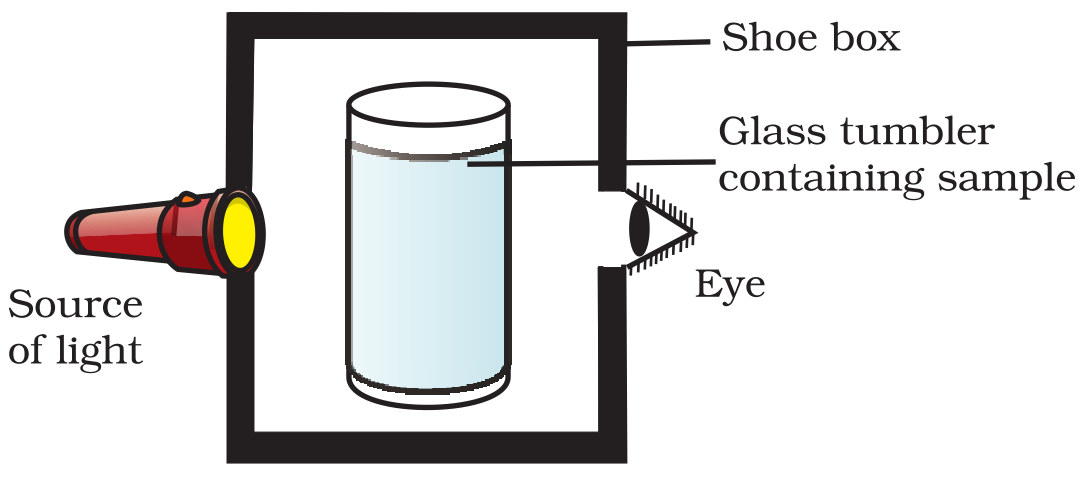
A group of students took an old shoe box and covered it with a black paper from all sides. They fixed a source of light (a torch) at one end of the box by making a hole in it and made another hole on the other side to view the light. They placed a milk sample contained in a beaker/ tumbler in the box as shown in the they were amazed to see that milk taken in the tumbler was illuminated. They tried the same activity by taking a salt solution but found that light simply passed through it?


  1. Explain why the milk sample was illuminated. Name the phenomenon involved.
  2. Same results were not observed with a salt solution. Explain.
  3. Can you suggest two more solutions which would show the same effect as shown by the milk solution?
Answer
  1. The milk sample was illuminated because milk is a colloidal solution and its particles are big enough to scatter the light, hence, they scatter the light passing through it. The phenomenon observed is called “Tyndall effect”.
  2. As salt solution is a true solution i.e., solute particle size is too small to scatter the light, hence, it does not show “Tyndall effect”.
  3. Examples of colloid are gold sol, arsenius sulphide (As2S3) sol., Blood etc.
View full question & answer
Question 425 Marks
A, B and C are all liquids. Liquid A has a comparatively low boiling point. On heating, liquid a vaporizes completely without leaving behind any residue. Liquid A is being used increasingly as a fuel in motor vehicles either alone or by mixing with petrol. Liquid B has a very high boiling point. It also vaporizes completely on heating, without leaving any residue. Liquid B is a conductor of electricity and used in making thermometers. Liquid c has a moderate boiling point. On heating, liquid C vaporises leaving behind a white solid D which is used in cooking vegetables. The condensation of vapours from C give a liquid E which turns anhydrous CuSO4 to blue.
  1. Which liquid could be an element? Name this element.
  2. Which liquid could be a mixture? Name this mixture.
  3. Which liquid could be a compound? Name this compound.
  4. What could the solid D be?
  5. What do you think is liquid E?
Answer
  1. Liquid B has a very high boiling point. It also vaporises on heating. It is a conductor of electricity and is used in making thermometers. So, B could be an element. Further, liquid B is mercury as mercury is a liquid metal, which expands on heating and is used extensively in thermometers.
  2. Liquid C has a moderate boiling point. It could be a mixture. It is a salt solution because when C is heated, it vaporises and leaves behind a white solid (salt), which is used in the process of cooking.
  3. Liquid A is used in motor vehicles as fuel, either alone or after mixing with petrol. It could be a compound because on heating, it does not leave any residue. It is alcohol as alcohol is being used in motor vehicles nowadays.
  4. Solid D is sodium chloride. It is also known as common salt and is added in food.
  5. Liquid E is water as, on heating, liquid C, which is a salt solution, leaves water vapours. On condensing these vapours, we obtain pure water. When water is mixed with anhydrous copper sulphate, we obtain a blue colour solution. This is because of the formation of hydrated copper sulphate solution.

$\text{CuSO}_4+5\text{H}_2\text{O}\xrightarrow{\ \ \ \ \ \ \ \ \ \ \ \ }\text{CuSO}_4\cdot5\text{H}_2\text{O}\\ \ \ \ \ \ \ \ \ \ \ \ \ \ \ \ \ \ \ \ \ \ \ \ \ \ \ \ \ \ \ \ \ \ \ \ \ \ {^\text{hydrated copper sulphate}}$

View full question & answer