Question
How will you separate camphor, common salt and iron nails from their mixture?

Answer

A horse-shoe magnet is moved on the surface of the mixture of camphor, common salt and iron nails. The iron nails are attracted by the magnet, they cling to the poles of the magnet and get separated. This process is repeated a number of times till complete separation of iron nails occur leaving behind mixture of camphor and common salt. Mixture of camphor and common salt is heated. Camphor sublimes on heating leaving behind common salt and can be recovered in the form of sublimate by cooling its vapours.

Need a full question paper?

Generate a complete, print-ready paper with questions like this in minutes — across 16+ boards, with answer keys.
Start Generating Free

Similar questions

If one gram of sulphur contains $x$ atoms, calculate the number of atoms in one gram of oxygen element.
(Atomic masses: $S = 32\ u; O = 16\ u)$
Describe the method of separating a mixture containing common salt, sand and ammonium chloride.
When extremely small particles X derived from the another of a flower were suspended in a liquid Y and observed through a microscope, it was found that the particles X were moving throughout the liquid Y in a very zig zag way. It was also observed that warmer the liquid Y, faster the particles X moved in its surface.
  1. What could particles X be?
  2. What do you think liquid Y is?
  3. What is the zig-zag movement of particles X?
  4. What is causing the zig-zag movement of particles X?
  5. Name the scientist who discovered this phenomenon.
  6. What does this experiment tell us about the nature of liquid Y?
Write the formulae of the following compounds. Also name the elements present in them.
  1. Water.
  2. Ammonia.
  3. Methane.
  4. Sulphur dioxide.
  5. Ethanol.
What do you understand by the terms “balanced forces” and “unbalanced forces”? Explain with examples.
The mass of one molecule of a substance is $4.65 \times 10^{-23} g$. What is its molecular mass? What could this substance be?
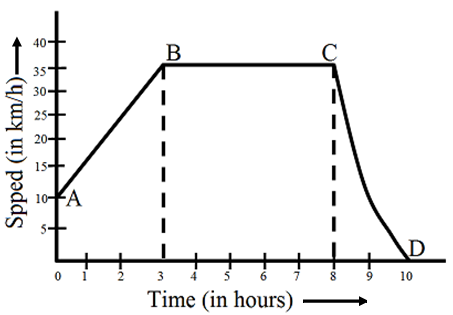
The graph given alongside shows how the speed of a car changes with time:
  1. What is the initial speed of the car?
  2. What is the maximum speed attained by the car?
  3. Which part of the graph shows zero acceleration
  4. Which part of the graph shows varying retardation?
  5. Find the distance travelled in first 8 hours.
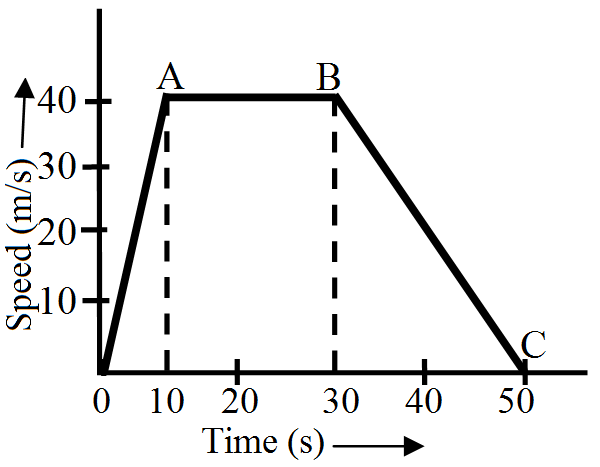
Study the speed-time graph of a car given alongside and answer the following questions:
  1. What type of motion is represented by OA?
  2. What type of motion is represented by AB?
  3. What type of motion is represented by BC?
  4. What is the acceleration of car from O to A?
  5. What is the acceleration of car from A to B?
  6. What is the retardation of car from B to C?
How could you convince a small child that when ou speak, it is not necessary for air to travel from your mouth to the ear of a listener?
A bullet of mass $15\ g$ has a speed of $400\ m/s$. What is its kinetic energy? If the bullet strikes a thick target and is brought to rest in $2\ cm$, calculate the average net force acting on the bullet. What happens to the kinetic energy originally in the bullet?