Question
How would you distinguish between baking powder and washing soda by heating?

Answer

Baking soda is sodium hydrogen carbonate $\left( NaHCO _3\right)$ which forms sodium carbonate $\left( Na _2 CO _3\right)$, water and carbon dioxide gas while heating. $2 NaHCO _3 \rightarrow Na _2 CO _3+ H _2 O + CO _2 \uparrow$
Presence of $CO _2$ can be detected with the help of lime water which turns milky after reacting with carbon dioxide gas
Washing soda is sodium carbonate deca-hydrate $\left( Na _2 CO _3 \cdot 10 H _2 O \right)$ which means there are 10 water molecules present with crystal hence named as water of crystallization
On heating washing soda, it becomes anhydrous and presence of water of crystallization can be detected with the help of anhydrous $CuSO _4$ which shows colour change from white to blue with moisture.
$Na _2 CO _3 \cdot 10 H _2 O \rightarrow Na _2 CO _3+10 H _2 O$

Need a full question paper?

Generate a complete, print-ready paper with questions like this in minutes — across 16+ boards, with answer keys.

Start Generating Free

Similar questions

Give the basic features of the mechanism of inheritance.
A small part of the shoot of a plant is removed with a sharp knife. When the lower end of this small part of the shoot is buried in moist soil, it gradually develops roots and shoots and grows to become a new plant.
  1. What is the name of this method of propagating plants?
  2. What care should be taken while removing a small part of the shoot from the parent plant with a knife?
  3. Name any two plants which provide us with food directly or indirectly and are grown by this method.
  4. Give one advantage of this method of producing new plants.
  5. State whether it is a sexual method of reproduction or an asexual method. Why?
  6. What special name can be given to the genetically identical new plants produced by this technique?
What are the functions of an ecosystem?
The top part A of the flask-shaped reproductive organ X in the flower of a plant secrets a surgery substance into its lower part B which goes towards the bottom part C of the flask-shaped organ. When a tiny grain D coming from the top part E of another reproductive organ Y i the flower falls on part A, it grows a long tube F through the organ X i response to the sugary substance and reaches the bottom part C of flask-shaped organ to carry out fertilisation.
  1. Name parts (i) organ X, and (ii) organ Y, inside the flower?
  2. Name parts (i) A (ii) B, and (iii) C, of flask-shaped organ.
  3. Name (i) grain D, and (ii) part E of organ Y.
  4. Name the tube F.
  5. What is the phenomenon of growing a long tube in response to sugary substance in the process of fertilisation in a flower known as?
A camera fitted with a lens of focal length 50mm is being used to photograph a flower that is 5cm in diameter. The flower is placed 20cm in front of the camera lens.
  1. At what distance from the film should the lens be adjusted to obtain a sharp image of the flower?
  2. What would be the diameter of the image of the flower on the film?
  3. What is the nature of camera lens?
Match the organisms given in column I with the methods of reproduction/propagation given in column II:
 
Column I
 
Column II
(i)
Plasmodium
(a)
Spore formation
(ii)
Spirogyra
(b)
Leaves
(iii)
Jasmin
(c)
Regeneration
(iv)
Apple tree
(d)
Budding
(v)
Bryophyllum
(e)
Binary fission
(vi)
Potatoes
(f)
Layering
(vii)
Rhizopus
(g)
Fragmentation
(viii)
Hydra
(h)
Tubers
(ix)
Planaria
(i)
Cutting
(x)
Leishmania
(j)
Multiple fission
(xi)
Sugar cane
(k)
Grafting
(xii)
Rose
 
 
If the teeth are not cleaned regularly, they become covered with a sticky yellowish layer W of food particles and bacteria. Since layer W covers the teeth, the alkaline liquid X secreted by glands Y inside the mouth cannot reach the teeth surface to neutralise the acid formed by the action of organisms Z on sugary food, and hence tooth decay sets in.
  1. What is W known as?
  2. What is (i) X, and (ii) Y?
  3. What are organisms Z?
  4. State one way of removing layer W from the teeth.
A unicellular animal P having no fixed shape ingests a food particle by forming temporary finger-like projections Q. The food particle is engulfed with a little surrounding water to form a temporary stomach R inside it. The chemicals S from surrounding cytoplasm enter into R and break down food into small and soluble molecules by chemical reactions. The digested food is absorbed directly into cytoplasm by the process T. The undigested food is thrown out of the body by the rupture of a cell organelle U in a process called V.
  1. Name the unicellular animal P.
  2. What are (i) Q, and (ii) R?
  3. Name (i) chemical S, and (ii) process T.
  4. Name (i) organelle U, and (ii) process V.
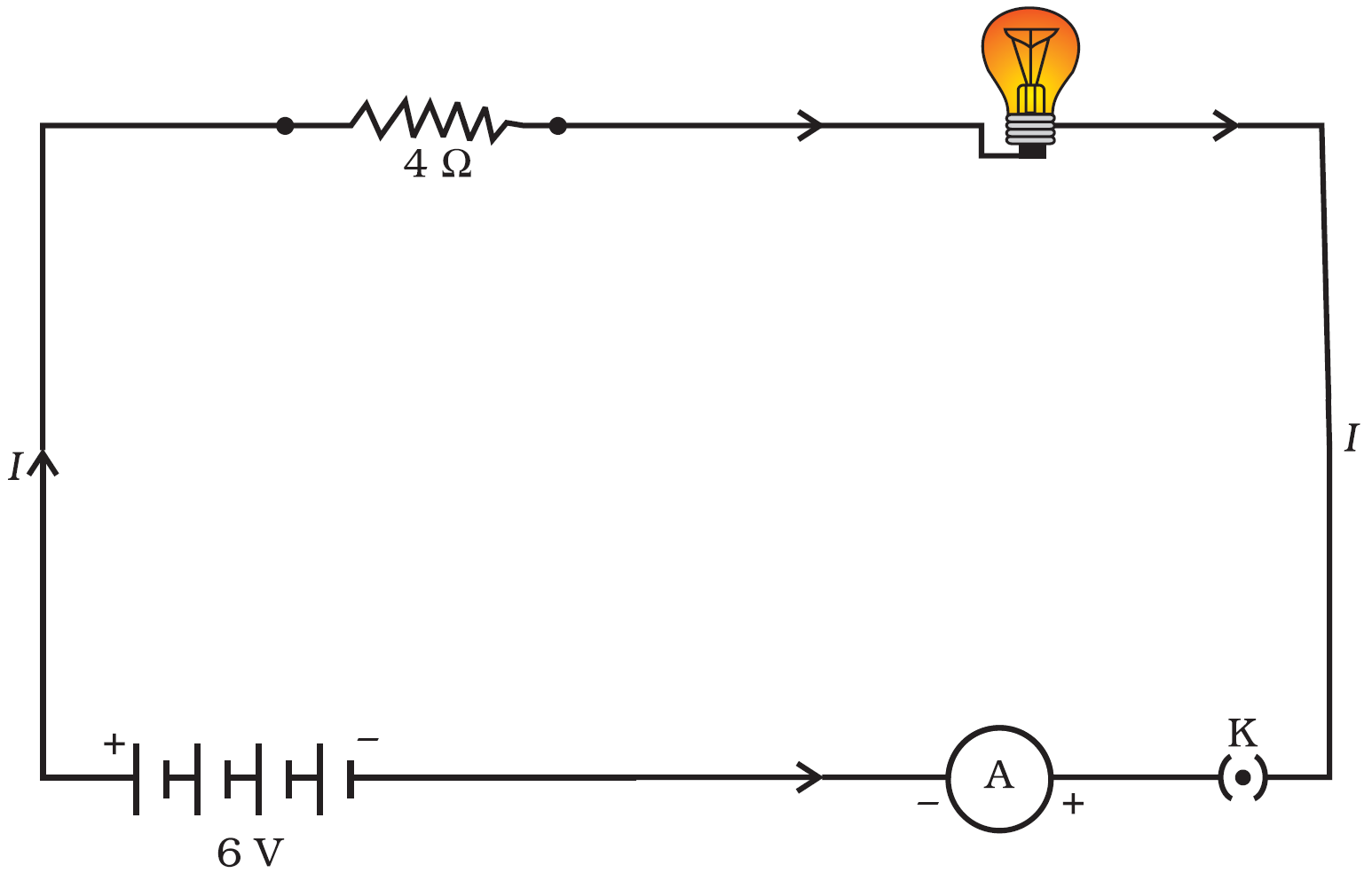
An electric lamp of resistance $20\Omega$ and a conductor of resistance $4\Omega$ are connected to a 6V battery as shown in the circuit. Calculate:
  1. The total resistance of the circuit,
  2. The current through the circuit,
  3. The potential difference across the (i) electric lamp and (ii) conductor, and
  4. Power of the lamp.
A certain form of energy is available due to the difference in the temperature of water at the surface of the ocean and its deeper levels.
  1. Name the form of energy.
  2. Is this energy ultimately derived from the sun or not?
  3. Explain how this form of energy can be converted into electricity.
  4. What is the minimum temperature difference in water at the surface of ocean and its deeper level which is required to operate power plants based on this energy?