Question
How would you react to the statement that the electronegativity of N on Pauling scale is 3.0 in all the nitrogen compounds?

Answer

On Pauling scale, the electronegativity of nitrogen, (3.0) indicates that it is sufficiently electronegative. But it is not correct to say that the electronegativity of nitrogen in all the compounds is 3. It depends upon its state of hybridization in a particular compound, greater the percentage of s-character, more will be the electronegativity of the element. Thus, the electronegativity of nitrogen increases in moving from SP3 hybridized orbital’s to SP hybridized orbital’s i.e., as SP3 < SP3 < SP.

Need a full question paper?

Generate a complete, print-ready paper with questions like this in minutes — across 16+ boards, with answer keys.
Start Generating Free

Similar questions

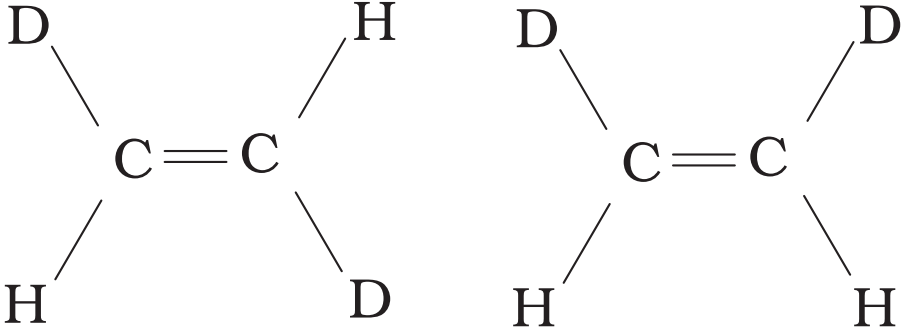
What is the relationship between the members of following pairs of structures? Are they structural or geometrical isomers or resonance contributors?

Balance the following equation,
$
Fe+H_2 O \longrightarrow Fe_3 O_4+H_2
$
Describe what you need to do in the laboratory to test (i) the law of conservation of mass, (ii) the law of definite proportion and (iii) the law of multiple proportions.
Which of the following are isoelectronic species i.e., those having the same number of electrons?
$\text{Na}^+,\text{K}^+,\text{Mg}^{2+},\text{Ca}^{2+},\text{S}^{2-},\text{Ar}.$
How can you predict the following stages of a reaction by comparing the value of Kc and Qc?
  1. Net reaction proceeds in the forward direction.
  2. Net reaction proceeds in the backward direction.
  3. No net reaction occurs.
$\begin{matrix}\text{A }\rightleftharpoons\text{ B }&\text{K}_1=1&\text{B }\rightleftharpoons\text{ C}&\text{K}_2=2\\\text{C }\rightleftharpoons\text{ D}&\text{K}_3=3&\text{D }\rightleftharpoons\text{ E}&\text{K}_4=4\end{matrix}$
What is value of K for $\text{A }\rightleftharpoons\text{ E}?$
Calculate the amount of carbon dioxide that could be produced when
(i) 1 mole of carbon is burnt in air.
(ii) 1 mole of carbon is burnt is 16 g of dioxygen.
(iii) 2 moles of carbon are burnt in 16 g of dioxygen.
Use the following data to calculate $\Delta_\text{lattice}\text{H}^\ominus$ for NaBr

$\Delta_\text{sub}\text{H}^\ominus$ for sodium metal = 108.4kJ mol–1

Ionization enthalpy of sodium = 496kJ mol–1

Electron gain enthalpy of bromine = –325kJ mol–1

Bond dissociation enthalpy of bromine = 192kJ mol–1

$\Delta_\text{f}\text{H}^\ominus$ for NaBr (s) = – 360.1kJ mol–1

  1. Deduce the structures of:
  1. BrF5
  2. PF5 on the basis of VSEPR theory.
  1. Which out of NH3 and NF3 has higher dipole moment and why?
For the reaction,
2Cl(g) → Cl2(g), what are the signs of $\Delta\text{H}$ and $\Delta\text{S}?$