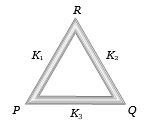
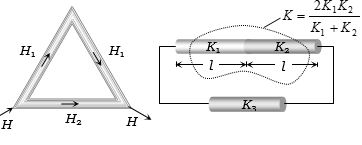
hree rods of same dimensions are arranged as shown in figure they have thermal conductivities ${K_1},{K_2}$ and${K_3}$ The points $P$ and $Q$ are maintained at different temperatures for the heat to flow at the same rate along $PRQ$ and $PQ$ then which of the following option is correct
Medium


Download our appand get started for free
Experience the future of education. Simply download our apps or reach out to us for more information. Let's shape the future of learning together!No signup needed.*
Similar Questions
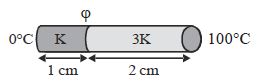
- 1Two bars of thermal conductivities $K$ and $3K$ and lengths $1\,\, cm$ and $2\,\, cm$ respectively have equal cross-sectional area, they are joined lengths wise as shown in the figure. If the temperature at the ends of this composite bar is $0\,^oC$ and $100\,^oC$ respectively (see figure), then the temperature $\varphi $ of the interface is......... $^oC$View Solution
- 2The sun emits a light with maximum wavelength $510\, mm$ while another star $X$ emits a light with maximum wavelength of $350\, nm$. What is the ratio of surface temperature of sun and the star $X$View Solution
- 3A large cylindrical rod of length $L$ is made by joining two identical rods of copper and steel of length $(\frac {L}{2})$ each . The rods are completely insulated from the surroundings. If the free end of copper rod is maintained at $100\,^oC$ and that of steel at $0\,^oC$ then the temperature of junction is........$^oC$ (Thermal conductivity of copper is $9\,times$ that of steel)View Solution
- 4View SolutionInfrared radiation is detected by
- 5Three objects colored black, gray and white can withstand hostile conditions upto $2800\,^oC$. These objects are thrown into a furnace where each of them attains a temperature of $2000\,^oC$. Which object will glow brightest?View Solution
- 6Two identical metal balls at temperature ${200^o}C$and ${400^o}C$ kept in air at ${27^o}C$. The ratio of net heat loss by these bodies isView Solution
- 7View SolutionWhen fluids are heated from the bottom, convection currents are produced because
- 8View SolutionIn Searle's method for finding conductivity of metals, the temperature gradient along the bar
- 9A bowl filled with very hot soup cools from $98^{\circ}\,C$ to $86^{\circ}\,C$ in $2$ minutes when the room temperature is $22^{\circ}\,C$. $..........\,minutes$ long it will take to cool from $75^{\circ}\,C$ to $69^{\circ}\,C$ ?View Solution
- 10View SolutionSnow is more heat insulating than ice, because