MCQ
Human eye:
  • A
    Can detect polarized light
  • Cannot detect polarization of light
  • C
    Can detect only circularly polarized light
  • D
    Can detect only linearly polarized light

Answer

Correct option: B.
Cannot detect polarization of light

Polarization changes when plane of vibration of polarized light changes.
Human eye is insensitive to change in polarization and hence, cannot detect polarization of light.

Need a full question paper?

Generate a complete, print-ready paper with questions like this in minutes — across 16+ boards, with answer keys.
Start Generating Free

Similar questions

A $2\,mW$ laser operates at a wavelength of $500\,nm.$ The number of photons that will be emitted per second is [Given Planck’s constant $h = 6.6 \times 10^{-34}\,Js,$ speed of light $c = 3.0\times 10^8\,m/s$ ]
If the spins of electrons of atoms in a substance are paired, then the substance will have:
At a given instant there are $25\%$ undecayed radioactive nuclei in a same. After $10 \,sec$ the number of undecayed nuclei reduces to $6.25\%$, the mean life of the nuclei is...........$ sec$
An infinite number of charges, each of charge $1 \,\mu C$ are placed on the $x$-axis with co-ordinates $x = 1, 2,4, 8, ....\infty$. If a charge of $1\, C$ is kept at the origin, then what is the net force acting on $1\, C$ charge....$N$
A charge of $10^{-9}C$ is placed on each of the 64 identical drops of radius 2cm. They are then combined to form a bigger drop. Find its potential 
Two mutually perpendicular infinitely long straight conductors carrying uniformly distributed charges of linear densities $\lambda_{1}$ and $\lambda_{2}$ are positioned at a distance $r$ from each other. Force between the conductors depends on $r$ as
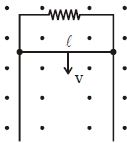
A conductor of length $l$ and mass $m$ can slide along a pair of vertical metal guides connected by a resistance $R,$ as shown in fig. Friction, resistance of conductor and guide rails are negligible. There exist a horizontal uniform magnetic field of strength $B$ normal to the plane of the page and is directed outward. The terminal speed of fall under the unfluence of gravity is, then :-
A beam of parallel rays is brought to a focus by a plano-convex lens. A thin concave lens of the same focal length is joined to the first lens. The effect of this is
What is the space around a current$-$carrying conductor, in which its magnetic effect can be experienced called?
A voltmeter has a resistance of $G\, ohms$ and range $V\, volts$. The value of resistance used in series to convert it into a voltmeter of range $nV$ $volts$ is