d
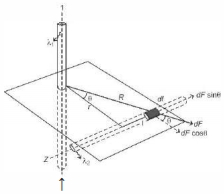
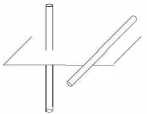
$(d)$ Consider the arrangement given,
Force on a differentiable length element $(d l)$ of conductor 2 due to field of conductor 1 is
$d F=E_{1} d q$
where, $E_{1}=$ ficld of wire 1 at location of $d l$.
'This force can be resolved into components $d F \cos \theta$ and $d F \sin \theta$ net force is sum of all $d F \cos \theta$ components, whereas $\Sigma d F \sin \theta=0$ So, net force on conductor $2$ is
$F=\int d F=\int E_{1} d q$
Here,
$E_{1}=\frac{2 k \lambda_{1}}{R}=2 k \lambda_{1}$
$d q=\lambda_{2} d l$
$\frac{l}{r} =\tan \theta \operatorname{and} \frac{r}{R}=\cos \theta$
$d l =r \sec ^{2} \theta d \theta$
Also, $\theta$ varies from $\frac{-\pi}{2}$ to $\frac{\pi}{2}$ for conductor $2$ .
So, $F=\int \limits_{-\pi / 2}^{\pi / 2} \frac{2 k \lambda_{1}}{r \sec \theta} \cdot \lambda_{2} \cdot r \sec ^{2} \theta d \theta$
$=2 k \lambda_{1} \lambda_{2} \int \limits_{-\pi / 2}^{\pi / 2} \sec \theta d \theta$
As $\int \limits_{-\pi / 2}^{\pi / 2} \sec \theta d \theta=$ a constant
We can say that,
$F_{\text {net }}=C \cdot \lambda_{1} \lambda_{2}$, where $C=$ some constant.
$\therefore F_{\text {net }} \propto r^{0}$