MCQ
Huygens' wave theory is used:
  • A
    To determine the velocity of light.
  • To find the position of the wave front.
  • C
    To determine the wavelength of light.
  • D
    To find the focal length of a lens.

Answer

Correct option: B.
To find the position of the wave front.

Huygen proposed a hypothesis for the geometrical construction of the position of a common wavefront at any instant during the propogation of waves in a medium.

Need a full question paper?

Generate a complete, print-ready paper with questions like this in minutes — across 16+ boards, with answer keys.
Start Generating Free

Similar questions

A single slit of width a is illuminated by violet light of wavelength 400 nm and the width of the diffraction pattern is measured as y. When half of the slit width is covered and illuminated by yellow light of wavelength 600 nm, the width of the diffraction pattern is
Which of the following isotopes is used for treatment of cancer?
A square frame of side I carries a current $i$. The magnetic field at its centre is $B$. The same current is passed through a circular coil having the same perimeter as the square. The field at the centre of the circular coil is $B^{\prime}$. The ratio of $\frac{B}{B^{\prime}}$ is
The curie weiss law is obeyed by iron:
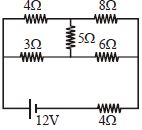
In the given figure the ratio of current in $8\,\Omega $ and $3\,\Omega $  will be
$STATEMENT$ $-1$ If the accelerating potential in an $\mathrm{X}$-ray tube is increased, the wavelengths of the characteristic $\mathrm{X}$-rays do not change. because

$STATEMENT$ $-2$ When an electron beam strikes the target in an $X$-ray tube, part of the kinetic energy is converted into $X$-ray energy.

Two pure inductors each of self inductance L are connected in parallel but are well separated from each other. The total inductance is
An inductor of inductance $L$ and resistor of resistance $R$ are joined in series and connected by a source of frequency $\omega $. Power dissipated in the circuit is
A ray of light falls on the surface of a spherical glass paper weight making an angle α with the normal and is refracted in the medium at an angle β. The angle of deviation of the emergent ray from the direction of the incident ray
The photoelectric effect can be understood on the basis of