MCQ
The photoelectric effect can be understood on the basis of
  • A
    The principle of superposition
  • B
    The electromagnetic theory of light
  • C
    The special theory of relativity
  • Line spectrum of the atom

Answer

Correct option: D.
Line spectrum of the atom
d
(d)Photoelectric effect can be explained on the basis of spectrum of an atom.

Need a full question paper?

Generate a complete, print-ready paper with questions like this in minutes — across 16+ boards, with answer keys.

Start Generating Free

Similar questions

A metal ball of radius $R$ is placed concentrically inside a hollow metal sphere of inner radius $2R $ and outer radius $3R$. The ball is given a charge $+2Q$ and the hollow sphere a total charge $- Q$. The electrostatic potential energy of this system is :
A vibration magnetometer consists of two identical bar magnets placed one over the other such that they are mutually perpendicular and bisect each other. The time period of oscillation in a horizontal magnetic field is $4\, sec$. If one of the magnets is taken away, find the period of oscillation of the other in the same field (in $sec.$) :-
A man is looking at a small object placed at his near point. Without altering the position of his eye or the object, he puts a simple microscope of magnifying power 5X before his eyes. The angular magnification achieved is:
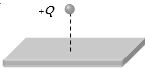
A charge $Q$ is fixed at a distance $d$ in front of an infinite metal plate. The lines of force are represented by
A person uses spectacles of power $+2D.$ He is suffering from
A current of $10\, A$ exists in a wire of crosssectional area of $5\, mm ^{2}$ with a drift velocity of $2 \times 10^{-3}\, ms ^{-1}$. The number of free electrons in each cubic meter of the wire is ..........
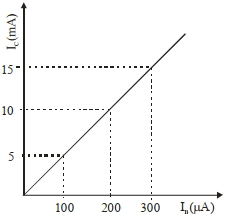
In an experiment of $CE$ configuration of $n-p-n$ transistor, the transfer characteristics are observed as given in figure. If the input resistance is $200 \Omega$ and output resistance is $60 \Omega$ the voltage gain in this experiment will be..........
A plane electromagnetic wave travels in a medium of relative permeability $1.61$ and relative permittivity $6.44$. If magnitude of magnetic intensity is $4.5 \times 10^{-2} \;Am ^{-1}$ at a point, what will be the approximate magnitude of electric field intensity at that point$?$

(Given : permeability of free space $\mu_{0}=4 \pi \times 10^{-7}\;NA ^{-2}$, speed of light in vacuum $c =3 \times 10^{8} \;ms ^{-1}$ )
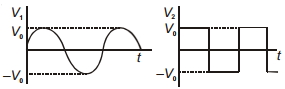
The sinusoidal potential difference $V_1$ shown in figure applied across a resistor $R$ produces heat at a rate $W$. What is the rate of heat dissipation when the square wave potential difference $V_2$ as shown in figure is applied across the resistor?
The light of wavelength $6328 Å $ is incident on a slit of width $0.2 \,mm$ perpendicularly, the angular width of central maxima will be.....$^o$