MCQ
Hydrogen atom does not emit $X-$ rays because
  • Its energy levels are too close to each other
  • B
    Its energy levels are too apart
  • C
    It is too small in size
  • D
    It has a single electron

Answer

Correct option: A.
Its energy levels are too close to each other
a
(a) For hydrogen atom the energy levels in it are very close to each other because of which the transition of electron emits high energy radiations having short wavelengths. Therefore for shortest distance i.e. Lyman series the wavelength obtain in ultra-violet region. since, $\mathrm{X}$ -rays are long radiation photons, hydrogen atom does not emit X-rays.

Need a full question paper?

Generate a complete, print-ready paper with questions like this in minutes — across 16+ boards, with answer keys.
Start Generating Free

Similar questions

Hailstone at $0°C$ falls from a height of $1\, km$ on an insulating surface converting whole of its kinetic energy into heat. What part of it will melt  $(g = 10\,m/{s^2})$
The amplitude and the time period in a $S.H.M.$ is $0.5 \,cm$ and $0.4 \,sec$ respectively. If the initial phase is $\pi /2$ radian, then the equation of $S.H.M.$ will be
If the longest wavelength in the ultraviolet region of hydrogen spectrum is $\lambda_{0}$ then the shortest wavelength in its infrared region is
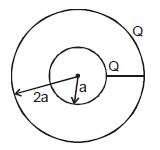
Figure shows a solid metal sphere of radius $‘a’$ surrounded by a concentric thin metal shell of radius $2a$ . Initially both are having charges $Q$ each. When the two are connected by a conducting wire as shown in the figure, then amount of heat produced in this process will be 
When two resistance $R_1$ and $R_2$ connected in series and introduced into the left gap of a meter bridge and a resistance of $10 \Omega$ is introduced into the right gap, a null point is found at $60 cm$ from left side. When $R_1$ and $R_2$ are connected in parallel and introduced into the left gap, a resistance of $3 \Omega$ is introduced into the right-gap to get null point at 40 cm from left end. The product of $R_1 R_2$ is $.............\Omega$
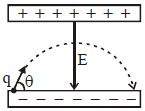
A proton is fired at an initial velocity of $150 \,m/s$ at an angle of $60^o $ above the horizontal into a uniform electric field of $2 \times 10^{-4} \,N/C$ between two charged parallel plates as shown in figure. Then the total time the particle is in motion is :-
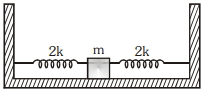
Two identical springs of spring constant $'2k'$ are attached to a block of mass $m$ and to fixed support (see figure). When the mass is displaced from equilibrium position on either side, it executes simple harmonic motion. The time period of oscillations of this sytem is ...... .
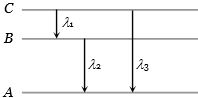
Energy levels $A, B, C$ of a certain atom corresponding to increasing values of energy i.e. ${E_A} < {E_B} < {E_C}$. If ${\lambda _1},\;{\lambda _2},\;{\lambda _3}$ are the wavelengths of radiations corresponding to the transitions $C$ to $B, B$ to $A$ and $C$ to $A$ respectively, which of the following statements is correct
A magnet is parallel to a uniform magnetic field. If it is rotated by $60^o$, the work done is $0.8\, J$. How much work is done in moving it $30^o$ further......$J$
If the length of a clock pendulum increases by $0.2 \%$ due to atmospheric temperature rise, then the loss in time of clock per day is ........... $s$